
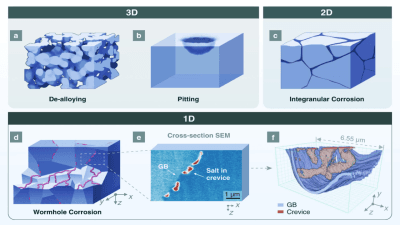
Corrosion is a natural process that occurs when materials are exposed to certain environments, such as moisture, oxygen, and other chemical substances. It can cause significant damage to materials, and identifying new forms of corrosion is important for preventing and mitigating its effects. Recently, scientists have discovered a new form of corrosion known as 1D wormhole corrosion. This article will provide an overview of this discovery and its implications.
What is 1D Wormhole Corrosion?
1D wormhole corrosion is a localized form of penetrating corrosion that occurs in certain materials when exposed to specific environments. It is characterized by a wormhole-like morphology that is highly localized, and it has the ability to serve as a mass-flow pathway. This new form of corrosion was discovered in a nickel-chromium alloy that was exposed to molten fluoride salt.
How is 1D Wormhole Corrosion Different from Other Forms of Corrosion?
1D wormhole corrosion is distinct from other forms of corrosion in several ways. For example, it is highly localized, occurring only in specific areas of the material. It also has a unique 1D morphology that resembles a network of tunnels. Additionally, it serves as a mass-flow pathway, which is not typically seen in other forms of corrosion.
What are the Implications of this Discovery?
The discovery of 1D wormhole corrosion has important implications for the understanding of material degradation mechanisms in molten salt environments. It highlights the importance of identifying and characterizing new forms of corrosion, as they can have significant effects on the performance and reliability of materials in various applications. Additionally, the discovery of this form of corrosion could lead to the development of new strategies for preventing and mitigating its effects.
Last Modified: February 20, 2024