Electronics manufacturing represents a core pillars of the Make in India initiative, driving the transition from a service-led growth model to a high-value industrial powerhouse. Globally, the electronics...
Industrial automation refers to the integration of advanced digital technologies, control systems, and robotic hardware into manufacturing processes to execute operations with minimal human intervention. Under the Make...
The debate between Import Substitution Industrialization (ISI) and Export-Oriented Industrialization (EOI) represents the two primary trade and development paradigms used by developing economies to achieve industrialization. Import Substitution...
Global Value Chains (GVCs) represent the international fragmentation of production, where the different stages of a production process are located across multiple countries. Unlike traditional trade where a...
Industrial competitiveness refers to the capacity of a nation's industrial sector to produce goods and services that meet the test of international markets while simultaneously expanding the real...
Launched in March 2020 as a core pillar of the "Make in India" and "Atmanirbhar Bharat" campaigns, the Production Linked Incentive (PLI) Scheme serves as a performance-based fiscal...
Launched on September 25, 2014, by the Ministry of Commerce and Industry, the "Make in India" initiative is a comprehensive national program designed to transform India into a...
The manufacturing sector serves as a structural pillar of the Indian economy, accounting for approximately 16–17% of India's Gross Domestic Product (GDP). Under the institutional targets of the...
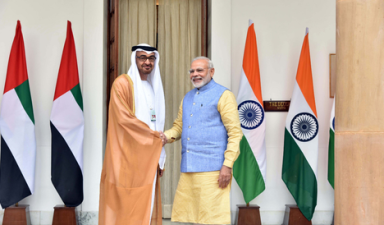
On 15 May 2026, India and the United Arab Emirates finalised seven agreements worth five billion dollars during Prime Minister Narendra Modi’s visit to Abu Dhabi. The visit...
The Himalayan brown bear (Ursus arctos isabellinus) has been recently captured on camera in the Gamgul Siyabehi Wildlife Sanctuary of Himachal Pradesh, marking a vital observation for the...