
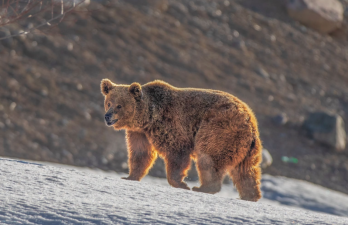
The Himalayan brown bear (Ursus arctos isabellinus) has been recently captured on camera in the Gamgul Siyabehi Wildlife Sanctuary of Himachal Pradesh, marking a vital observation for the conservation of this elusive species. This discovery in the Pir Panjal range provides fresh evidence of the bear’s presence in high-altitude habitats, which are increasingly under pressure from environmental shifts and human encroachment. The state Forest Department, in coordination with the Zoological Survey of India, intends to utilize drone technology to monitor the species, aiming to better understand their behavior and population dynamics within this remote, ecologically sensitive zone.
Species Overview and Characteristics
The Himalayan brown bear is a subspecies of the brown bear and stands as one of the largest mammals in the Himalayan region. It is often referred to as the Himalayan red bear or isabelline bear due to its distinct coat color.
Key Biological Traits
- Physical Appearance: The bears typically exhibit a sandy or reddish-brown coat. They possess a heavy body, a large head, and stocky legs.
- Sexual Dimorphism: Males are significantly larger, ranging from 150 to 230 cm in length, whereas females generally measure between 137 and 183 cm.
- Dietary Habits: They are omnivorous, consuming a diverse diet that includes alpine grasses, roots, berries, fruits, insects, and small mammals like marmots, voles, and pikas. Occasionally, they prey on livestock, which often leads to human-wildlife conflict.
- Life Cycle: These bears go into hibernation during the harsh winter months, typically entering dens in October and emerging around April or May.
Habitat and Distribution
The species is primarily restricted to the subalpine and alpine regions of the Greater and Trans-Himalayan ranges.
Geographical Range
- Global Presence: Their range extends across parts of Pakistan, India, Nepal, the Tibetan Autonomous Region of China, and Kyrgyzstan.
- Indian Distribution: In India, their population is fragmented and spread across the Union Territory of Jammu and Kashmir, Himachal Pradesh, and Uttarakhand.
- Sanctuary Significance: Gamgul Siyabehi Wildlife Sanctuary, where the recent sighting occurred, is located in the Chamba district of Himachal Pradesh. It is a critical high-altitude refuge that also hosts other rare fauna.
Conservation Status and Threats
Despite being a flagship species of the high-altitude ecosystem, the Himalayan brown bear faces severe survival challenges.
Primary Threats
- Habitat Fragmentation: Developmental activities and infrastructure expansion are breaking the connectivity of their natural corridors.
- Human-Wildlife Conflict: Retaliatory killings by livestock herders occur when bears prey on sheep or goats.
- Illegal Trade: Poaching remains a concern due to the demand for their fur, claws, and internal organs in traditional medicine markets.
- Climate Change: The shift in climatic patterns is altering the productivity of alpine meadows, which are primary feeding grounds, forcing bears to move into suboptimal areas.
- Vegetation Loss: The commercial harvesting of the buransh (rhododendron) tree, a vital part of the bear’s habitat, exacerbates the loss of their natural home.
IASPOINT Booster Facts for UPSC
- Legal Status: The Himalayan brown bear is protected under Schedule I of the Indian Wildlife (Protection) Act, 1972, which provides the highest level of legal protection against hunting and trade.
- IUCN Status: While the brown bear species (Ursus arctos) is listed as “Least Concern” by the IUCN, the Himalayan subspecies (Ursus arctos isabellinus) is often considered critically endangered in many of its range states due to its small, isolated populations.
- Gamgul Siyabehi Highlight: This sanctuary is historically significant as one of the few places in Himachal Pradesh where the presence of the Kashmir Stag (Hangul) has been reported.
- Ecological Indicator: The presence of a top carnivore like the Himalayan brown bear serves as an indicator of a healthy ecosystem, suggesting the existence of a robust prey base such as marmots and other mountain ungulates in the sanctuary.
- Scientific Name: Ursus arctos isabellinus.