
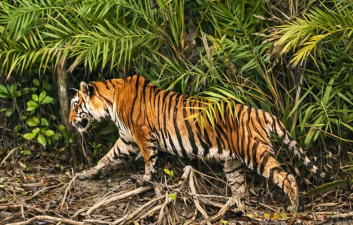
At Sasan Gir in Gujarat, the “Lion” Species Spotlight Event was launched on 14 May 2026. This gathering served as a precursor to the primary International Big Cat Alliance Summit scheduled for 1 and 2 June 2026 in New Delhi, drawing delegates from 95 countries under the central theme “Save Big Cats, Save Humanity, Save Ecosystem.” During the event, the Ministry of Environment, Forest and Climate Change highlighted the successful expansion of the Asiatic lion (Panthera leo persica) population within the Greater Gir Landscape. The discussions emphasized cross-border ecological ties, advanced monitoring technologies, and the expansion of protected satellite habitats to ensure the species survives long term.
Ecological Profile and Population Dynamics
The Asiatic lion is genetically distinct from African lion populations and exhibits specific behavioral and physical characteristics. Its survival depends entirely on the conservation management policies implemented within the Saurashtra peninsula of Gujarat.
Geographical Distribution and Range Expansion
The wild population of the Asiatic lion remains restricted to the state of Gujarat. Over the past 25 years, the spatial distribution of the species grew from three districts to eleven districts within the Saurashtra region. The total tracking territory covered by the cats expanded to approximately 35,000 square kilometers.
Population Demographics (2025 Census)
The 16th Asiatic Lion Population Estimation conducted in May 2025 recorded a total of 891 individuals. This represents a 32.2 percent growth rate compared to the 2020 baseline count of 674 lions.
- Gender Dispersal: The 2025 population metrics documented 196 adult males, 330 adult females, 140 sub-adults, and 225 cubs.
- Habitat Allocation: A total of 384 lions reside inside the demarcated core protected forests and sanctuaries, while 507 lions live in non-forested areas, agricultural lands, and coastal patches outside traditional boundaries. This means roughly 56 percent of the total population functions as a satellite community outside the core zone.
Project Lion and Institutional Infrastructure
Launched in 2020 with a dedicated budgetary allocation of Rs 2,000 crore, Project Lion focuses on landscape-based conservation models, disease management, and standardizing human-wildlife cohabitation rules.
Advanced Surveillance and Tech-Driven Monitoring
The project incorporates multiple digital monitoring applications to minimize poaching and track animal movements in real-time:
- e-gujforest Application: A mobile and desktop software module used by field track workers for direct real-time entry of individual lion sightings, logging accurate GPS coordinates and photographs.
- Automated Sensor Grids: A regional network of infrared heat sensors, motion detectors, and magnetic seismic lines deployed across critical infrastructure passages to prevent vehicle and train accidents.
- Radio-Collar Tracking: High-frequency satellite telemetry collars attached to alpha prides and wandering male coalitions to map natural dispersal patterns and issue early warnings if wildlife enters industrial corridors.
Healthcare and Research Infrastructure
To mitigate single-point failure risks from localized epidemics, like the 2018 Canine Distemper Virus outbreak, the government expanded regional veterinary infrastructure:
- National Wildlife Referral Centre: Based in Junagadh, this center provides specialized diagnostic facilities, handles toxicological analysis, and designs critical immunization programs for wildlife.
- Breeding and Isolation Units: Gene pools and specialized rescue facilities help maintain genetic diversity and offer medical isolation beds for injured or diseased big cats.
Barda Wildlife Sanctuary as an Alternate Habitat
The high density of lions inside the Gir Protected Area prompted the creation of a geographical insurance site to reduce territorial pressure and protect the species from potential catastrophic disease outbreaks.
Historical and Geographical Context
Located roughly 100 kilometers west of the Gir forest near Porbandar, the Barda Wildlife Sanctuary covers 192.31 square kilometers of rugged, semi-arid terrain. Lions had been absent from this landscape since 1879 until a natural male dispersal occurred in 2023. Under Project Lion, it is officially classified as Satellite Population 8.
Habitability Enhancements and Prey Base Relocation
To support the newly translocated prides, which reached 17 lions during the latest census, the forest department carried out extensive habitat restoration:
- The Boma Technique: An African passive herding method utilizing funnel-shaped canvas paths to safely relocate spotted deer (Axis axis) from overpopulated regions of Gir to Barda without causing muscle damage from stress.
- Vegetative Restoration: Clearing invasive weeds and planting local forage shrubs to increase the herbivore carrying capacity of the sanctuary.
International Big Cat Alliance Framework
The International Big Cat Alliance represents India’s primary diplomatic and ecological initiative to institutionalize big cat conservation on a global scale.
Scope and Covered Species
Initially launched in 2023 and transitioning into a treaty-based international organization in 2025, the alliance coordinates financial, scientific, and anti-trafficking strategies across global range countries. The alliance covers seven specific big cat species:
| Species | Scientific Name | Key Global Habitat |
| Tiger | Panthera tigris | Broad Asian forest landscapes |
| Lion | Panthera leo | African savannas and India’s Gir landscape |
| Leopard | Panthera pardus | Distributed across sub-Saharan Africa and Asia |
| Snow Leopard | Panthera uncia | Mountain ranges of Central and South Asia |
| Cheetah | Acinonyx jubatus | African plains and reintroduced pockets in India |
| Jaguar | Panthera onca | Rainforest networks of the Americas |
| Puma | Puma concolor | Mountainous and low forest zones of the Americas |
Financial and Strategic Commitments
The Government of India committed a baseline fund of Rs 150 crore for a five-year period spanning from 2023 to 2028. The alliance facilitates knowledge transfer, assists member nations in formulating national species recovery actions, and promotes community-based eco-tourism models designed after India’s conservation programs.
IASPOINT Booster Facts for UPSC
- Legal Protection Status: The Asiatic lion is placed under Schedule I of the Wildlife Protection Act, 1972, granting it the highest level of legal protection against hunting and commercial trade.
- IUCN Red List Classification: The Asiatic lion is listed as Endangered on the International Union for Conservation of Nature Red List due to its restricted single wild population.
- IUCN Green Status Assessment: Introduced as a new global standard to measure species recovery, the green status places the global lion category under “Largely Depleted,” emphasizing the necessity of expanding independent habitats like Barda.
- CITES Listing: The species is listed under Appendix I of the Convention on International Trade in Endangered Species of Wild Fauna and Flora, which prohibits all international commercial trade in specimens or body derivatives.
- Maldhari Community Coexistence: The Maldharis are local pastoral herdsmen living inside the Gir forest. Their traditional lifestyle and cultural tolerance of apex predators play a critical role in mitigating aggressive human-wildlife conflicts.
- Block Count Method: The census process uses a Direct Beat Verification system rather than unverified track marks. This method requires simultaneous physical observation across predetermined blocks over a three-day period to avoid double counting.