
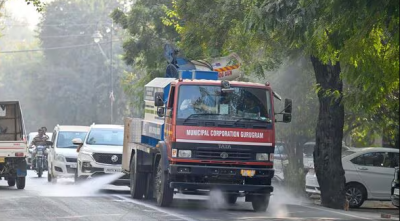
The Commission for Air Quality Management (CAQM) Sub-Committee revoked all Stage-I restrictions under the Graded Response Action Plan (GRAP) in the Delhi National Capital Region (NCR) on 4 May 2026. This decision followed a notable recovery in air quality, with Delhi’s Air Quality Index (AQI) improving from 175 on 3 May to 88 on 4 May, shifting the atmosphere into the ‘satisfactory’ category. Favorable meteorological interventions, including unexpected rainfall and high-velocity winds, assisted this cleanup. While short-term forecasts from the India Meteorological Department (IMD) and the Indian Institute of Tropical Meteorology (IITM) project that the AQI will fluctuate between ‘satisfactory’ and ‘moderate’ levels, the CAQM has directed strict dust mitigation and pollution control protocols across Delhi and surrounding districts in Haryana, Uttar Pradesh, and Rajasthan.
The Graded Response Action Plan Framework
The Graded Response Action Plan (GRAP) is an emergency response architecture designed to implement specific anti-pollution measures sequentially as air quality deteriorates. Originally formulated following Supreme Court directions in the M.C. Mehta vs. Union of India (2016) case, the plan was formally institutionalized to replace ad-hoc administrative reactions with systemic institutional triggers.
Evolution and Implementation Authority
- Historical Framework: GRAP was first notified in 2017 by the Ministry of Environment, Forest and Climate Change (MoEFCC), relying on execution strategies designed by the Central Pollution Control Board (CPCB). Initially, the Environment Pollution (Prevention and Control) Authority (EPCA) oversaw enforcement.
- Modern Governance: Following the dissolution of EPCA, the responsibility of implementing GRAP shifted to the Commission for Air Quality Management (CAQM) in NCR & Adjoining Areas from 2021 onwards.
- Procedural Nature: GRAP operates on an incremental model. When a higher stage is triggered, all restrictions from the preceding stages remain active simultaneously to create a cumulative mitigation framework.
Four Stages of the Graded Response Action Plan
The modern revised GRAP configuration divides emergency actions into four distinct stages tied directly to specific bands of the Air Quality Index (AQI).
| GRAP Stage | Ambient Air Quality Category | Target AQI Range | Key Mandatory Enforcement Measures |
| Stage I | Poor | 201 – 300 | Ban on coal and firewood usage in open eateries; strict regulation of diesel generator sets; mechanical street sweeping; anti-smog gun deployment at construction sites. |
| Stage II | Very Poor | 301 – 400 | Targeted intensive actions at identified pollution hotspots; synchronized water sprinkling on roads; enhanced parking fees to discourage private vehicular usage. |
| Stage III | Severe | 401 – 450 | Imposition of strict bans on non-essential Construction and Demolition (C&D) activities; restrictions on the movement of BS-III petrol and BS-IV diesel light motor vehicles. |
| Stage IV | Severe + | Greater than 450 | Ban on non-essential truck entry into Delhi (excluding EVs, CNG, and BS-VI diesel); potential suspension of physical classes in schools; implementation of odd-even vehicle registration schemes. |
Institutional Setup for Regional Air Governance
Managing the airshed of Delhi-NCR requires cross-border administrative cooperation between neighboring state governments and central scientific bodies.
The Commission for Air Quality Management (CAQM)
The CAQM is a statutory body constituted under the Commission for Air Quality Management in National Capital Region and Adjoining Areas Act, 2021. Led by a chairperson holding the rank of a Secretary to the Government of India or a State Chief Secretary, the commission possesses overriding jurisdiction over Delhi, Haryana, Punjab, Rajasthan, and Uttar Pradesh regarding matters of atmospheric pollution. The body has legal powers to levy environmental compensation fines on stubble burning and order the immediate closure of non-compliant industrial units.
Meteorological Forecasting Partners
The CAQM Sub-Committee relies on active mathematical modelling and weather forecasting systems provided by two primary institutions under the Ministry of Earth Sciences:
- India Meteorological Department (IMD): Provides macro-level meteorological parameters, wind velocity vectors, precipitation tracking, and atmospheric dispersion indices.
- Indian Institute of Tropical Meteorology (IITM): Runs advanced chemical transport models to predict the real-time movement, concentration, and stagnation points of particulate matter across the NCR airshed.
IASPOINT Booster Facts for UPSC
- National Air Quality Index (AQI) Parameters: Launched in September 2014 under the Swachh Bharat Abhiyan, the National AQI simplifies complex air composition data into a single numerical value. It monitors a total of eight core criteria pollutants: Particulate Matter (PM10), Particulate Matter (PM2.5), Nitrogen Dioxide (NO2), Sulfur Dioxide (SO2), Carbon Monoxide (CO), Ozone (O3), Ammonia (NH3), and Lead (Pb).
- AQI Classification Scale: The tracking scale contains six descriptive bands: Good (0–50), Satisfactory (51–100), Moderate (101–200), Poor (201–300), Very Poor (301–400), and Severe (401–500).
- Concept of an Airshed: An airshed refers to a geographical area where local topography and meteorological conditions trap or move pollutants uniformly. It demonstrates that air pollution does not respect political boundaries, requiring Delhi, Punjab, Haryana, and Western Uttar Pradesh to be managed as a single integrated environmental ecosystem.
- National Ambient Air Quality Standards (NAAQS): NAAQS are ambient air quality standards notified by the CPCB under the Air (Prevention and Control of Pollution) Act, 1981. While AQI is a short-term public communication metric, NAAQS outlines the legal limits for 12 pollutants over annual or 24-hour windows.
- Ancillary CAQM Mandates: Beyond GRAP, the CAQM issues binding directions for structural tech updates in the region. These include mandating technology-enabled fuel stations to deny fuel to vehicles lacking valid Pollution Under Control Certificates (PUCC) via Automatic Number Plate Recognition (ANPR) systems, and orchestrating a phased transition toward 100% electric commercial three-wheelers across NCR districts.