
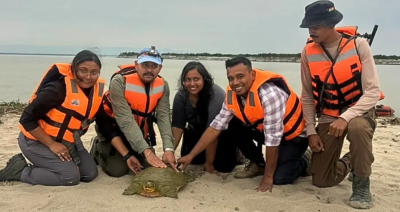
India released its first satellite-tagged Ganges Softshell Turtle into the wild at Kaziranga National Park and Tiger Reserve, Assam, on 15 May 2026. The release was strategically timed to coincide with Endangered Species Day. The satellite tagging initiative operates under the Ministry of Environment, Forest and Climate Change to monitor the seasonal movements, baseline migration corridors, feeding habits, and breeding patterns of the species. This scientific project represents a collaborative effort involving the Wildlife Institute of India, Kaziranga authorities, and the Assam Forest Department, with financial assistance provided by the National Geographic Society.
Biological and Morphological Profile
The Ganges Softshell Turtle, scientifically classified as Nilssonia gangetica, is a large species of freshwater reptile belonging to the family Trionychidae.
Physical Characteristics
- Carapace Structure: Unlike hard-shelled turtles that possess keratinized scutes, this species features a low-humped, round-to-oval, leathery upper shell (carapace). The carapace is olive or dull green with a light yellow border, reaching a maximum recorded length of up to 94 centimeters.
- Head Markings: The head is dark green and displays a distinct pattern of three to five oblique black streaks, alongside a black bar running from the eye to the nape. These arrowhead-shaped markings are prominent in juveniles but fade or break up completely in older adults.
- Respiratory Adaptation: The turtle possesses a long neck and a tube-like snout (proboscis). This physical trait enables the reptile to extend its nose above the water surface to breathe while keeping its body entirely submerged.
- Hydrodynamic Shape: The compressed, flattened nature of its leathery shell reduces water resistance, making the turtle a fast and efficient swimmer.
Ecological and Behavioural Traits
- Diet and Scavenging: The species is an omnivorous freshwater predator and scavenger. It feeds on fish, mollusks, amphibians, birds, reptiles, aquatic vegetation, and carrion. By consuming dead and decaying organic matter, it prevents water contamination in major river basins.
- Habitat Preferences: It inhabits deep, turbid river systems, large canals, lakes, and temporary oxbow wetlands. It shows an affinity for environments with muddy or sandy bottoms where it can bury its body to ambush prey or hide from predators.
- Reproductive Biology: The species reaches sexual maturity between 8 and 9 years of age. The primary breeding season spans from February to April in certain regions, and August to November in others. Females lay multiple clutches annually, with each clutch containing between 8 and 35 eggs deposited in clayey riverbanks and mid-river sand islands.
- Aggressive Behaviour: These turtles exhibit territorial and aggressive traits, particularly during mating seasons. Instances of cannibalism, involving the consumption of eggs and smaller conspecifics, occur under captive conditions.
Geographic Distribution and Regional Diversity
The geographical range of Nilssonia gangetica spans across the northern plains of the Indian subcontinent, encompassing India, Bangladesh, Pakistan, Nepal, and parts of lowland Afghanistan up to an elevation of 1,000 meters above sea level.
Major River Basins
- Indus River Basin
- Ganga-Yamuna River Basin
- Brahmaputra-Meghna River System
- Narmada River Basin
- Mahanadi River Basin
Assam and Kaziranga Distribution
Assam serves as a critical biodiversity hotspot for testudines, hosting 21 out of the 29 freshwater turtle and tortoise species found in India. Kaziranga National Park and Tiger Reserve, which lies along the floodplain of the Brahmaputra River, provides a protected habitat for five of the eight softshell turtle species native to the country.
Conservation Status and Legal Framework
The legal protection and conservation classification of the Ganges Softshell Turtle restrict its capture, trade, and commercial exploitation.
| Regulatory Body / Statute | Conservation Classification / Schedule | Implications |
| IUCN Red List of Threatened Species | Endangered | Reflects severe population decline driven by habitat loss and illegal trade networks. |
| Wildlife (Protection) Act, 1972 (India) | Schedule I (Part II) | Accords the highest level of statutory protection, making hunting or possession a non-bailable offense equivalent to killing a tiger. |
| CITES | Appendix I | Prohibits international commercial trade of the species, its parts, or derivatives. |
Anthropogenic Threats
- Illegal Wildlife Trade: Poachers target the turtle for its meat and calipee (the cartilaginous rim of the shell used in traditional medicines).
- The 20-Claw Myth: Specimen collection is driven by a superstitious belief that individuals possessing exactly 20 claws (five on each webbed limb) bring financial prosperity.
- Habitat Degradation: River pollution, hydrological alterations via dam construction, sand mining on nesting banks, and accidental drowning in commercial fishing nets cause mortality.
IASPOINT Booster Facts for UPSC
- The Family Trionychidae: This family comprises all softshell freshwater turtles worldwide, recognized by the absence of horny scutes and the presence of a fleshy, skin-covered carapace.
- The Kurma Dev Connection: In several regions of India, particularly Odisha and Gujarat, the Ganges Softshell Turtle is conserved within temple ponds due to its cultural status as an incarnation (Avatar) of Lord Vishnu.
- Satellite Telemetry in Herpetology: The 2026 Kaziranga initiative marks the first time satellite telemetry tags have been customized and affixed to the carapace of an Indian softshell turtle to study baseline micro-habitat utilization in a large riverine ecosystem.
- Difference from Hard-shelled Turtles: While hard-shelled species like the Indian Roofed Turtle (Pangshura tecta) rely on rigid bony armor for protection, Nilssonia gangetica utilizes speed, muddy camouflage, and aggressive biting mechanics for defense.