
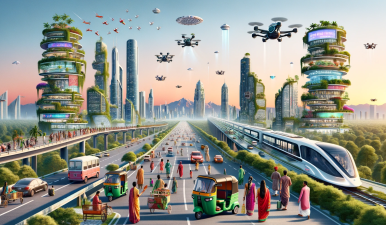
India is one of the world’s oldest civilizations, with a rich cultural heritage and tremendous diversity across its people. As a developing country with the world’s second largest population, India faces various social, economic and environmental challenges. Yet India also holds great promise, given its large, young population and rapid economic growth. By imagining India in 2050, three decades from now, we can envision the possibilities for India to evolve into a prosperous, secure and sustainable society.
In 2050, I envision an India that has effectively addressed issues like poverty, corruption and pollution to become a global leader in technology, education and sustainable development. The India of 2050 will be more urban while also preserving its villages. With economic opportunities reaching small towns and rural areas, the gap between urban and rural India will shrink. India can also build more livable smart cities rooted in community and nature, improving the quality of life across urban spaces.
Body
In 2050, India will have significantly reduced income inequality and poverty through sound policies focused on health, education and empowering women. Even its poorest communities will have the resources they need to thrive. Rural India will exemplify Mahatma Gandhi’s vision of local self-reliance and sustainability. Gandhi stated that “The future depends on what we do in the present.” India’s current investments in human development will shape future prosperity. For instance, Amartya Sen’s capabilities theory will inform policies to uplift human freedom and potential. Sen notes that “India has a long history of skepticism about maxims of prosperity without freedom.” Development policies will enable more equitable opportunity.
India will transform into a knowledge economy built on technology, medicine and creative arts. IT exports now account for billions in revenue. Building on successes in information technology, India can also lead in biotech, renewable energy, sustainable agriculture, and decentralised governance innovations. Indian research institutions will pioneer advances in science and technology to address society’s grand challenges, as envisioned by former president A.P.J. Abdul Kalam: “A land of enlightened people, economically prosperous, socially just and politically democratic.”
Urbanization will increase in sustainable ways, with over half India’s population in cities integrated with nature. Architect Balkrishna Doshi, awarded India’s first Pritzker Prize in 2018, has demonstrated how urban built environments can harmonize contemporary and traditional designs through open, human-centric spaces. Such principles will guide urban planning, along with green technologies like AI and nanotech. Philosopher Jiddu Krishnamurti noted that “It is no measure of health to be well adjusted to a profoundly sick society.” India’s future cities will retain connections to culture, nature and spirituality by design.
Rural India will share in economic advancement through networks of villages with thriving, self-sufficient local economies. Social entrepreneur Dr. Bindeshwar Pathak’s work has demonstrated how village cooperatives and local support can eradicate persistent problems like manual scavenging. Such inclusive business models will be widely replicated. Entrepreneurs will also prosper by leveraging renewable energy tech and selling products online. E.F. Schumacher’s “Buddhist economics” concept of ethical, cooperative business will influence economic patterns.
India’s diverse religious and ethnic communities will make progress toward harmony, despite occasional tensions. While Hindu nationalism has stirred recent controversy, India’s founding vision of secularism, pluralism and equality remains strong. Kerala’s history demonstrates peaceful coexistence between Hindus, Christians and Muslims. The Hindu majority will collaborate with Muslim, Sikh, Christian and other minority groups to nurture interfaith dialogue and cultivate a more tolerant society. Dalit advocacy against caste discrimination will also have achieved greater social equality. As Rabindranath Tagore expressed about Indian nationalism, “The idea of India is against the intense consciousness of separateness.” The India of 2050 will reflect that universalism.
India will balance rapid growth with environmental protection. It will meet climate targets through renewable energy and reforestation. Following Wangari Maathai’s principle that “We owe it to ourselves and to the next generation to conserve the environment,” India’s 2050 economy will operate sustainably within planetary boundaries. Inspiring ecological efforts like Rajendra Singh’s water conservation that turned parched rural Rajasthan into lush green will be replicated. India’s environmental stewardship will set an example.
India will invest heavily in education at all levels to build a knowledge-based society. The country’s demographic dividend gives it the world’s largest population under 25. Ensuring quality education and skill training for youth can secure India’s economic future. Primary school enrollment will be near 100 percent with equal access for girls and boys. Industrialist Ratan Tata has funded programs enabling youth in remote areas to connect with educators worldwide. Such initiatives will bridge the rural-urban divide. Massive open online courses will provide free access to higher education and vocational training for millions. Educational advances now will shape India’s future human capital.
Conclusion
India in 2050 can become a prosperous, environmentally sustainable society by leveraging its cultural strengths and human capabilities. Alleviating poverty, empowering women, developing green technologies, expanding access to education and health care, nurturing local businesses, and supporting ethical policies will help India grow in an inclusive manner. India will play a leadership role in global development while drawing lessons from its rich philosophical tradition to evolve a holistic vision of human progress. With mindful long-term policies and collective effort, India can manifest an inspiring vision of just, equitable and sustainable progress.
Last Modified: February 8, 2024