
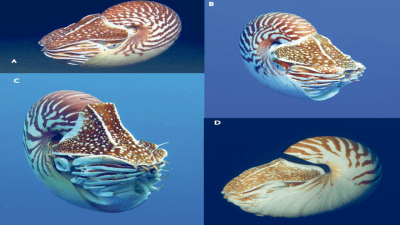
Nautiluses are a group of marine mollusks that belong to the Nautilidae family and are known for their rich fossil records. With a history dating back to 500 million years, these creatures have remained virtually unchanged and are now referred to as living fossils. In this article, we will explore the unique features and habits of nautiluses and delve into the current status of these mysterious creatures.
Discovery of New Species
Marine biologists have recently made an exciting discovery by identifying three new species of nautiluses. These are Nautilus vitiensis, Nautilus samoaensis, and Nautilus vanuatuensis, bringing the total number of known species to a mere few. Nautiluses are confined to the tropical waters of the Indian and Pacific Oceans, close to Australia, Japan, Fiji, and New Caledonia.
The Chambered Nautilus
The chambered nautilus, also known as the pearly nautilus, is a type of mollusk and a distant cousin to squids, octopi, and cuttlefish. The unique feature of this creature is its hard external shell that houses its soft body. The shell has multiple closed interior chambers that function as ballast tanks, allowing the nautilus to swim. The animal resides in the largest chamber, while the tissue in a canal called the siphuncle connects all the chambers, enabling the nautilus to adjust its buoyancy.
Swimming and Buoyancy
The nautilus swims by expelling water through the siphuncle and pulling its body into the chamber, creating jet propulsion. This motion allows it to move backwards and make turns. To swim up or down the water column, the nautilus uses its siphuncle to suck fluid into or out of the smaller sealed chambers, adjusting its overall buoyancy.
In Decline
Unfortunately, the six living species of chambered nautilus appear to be in decline due to over-exploitation for their attractive shells and for the shell’s inner layer, nacre, which is used as a pearl substitute in jewelry and trinkets. However, there are no regulations in place to protect these creatures.
Population Studies
In an effort to better understand the status of nautiluses, NOAA Fisheries funded a University of Washington researcher to conduct population studies in Fiji and American Samoa. The results of this research should provide a clearer picture of nautilus abundance in these areas.
Conclusion
The ancient Greeks saw the chambered nautilus shell as a symbol of perfection, and indeed, these creatures are a unique and fascinating part of the natural world. Despite their decline, the discovery of new species and ongoing population studies give hope for the future of these mysterious living fossils.
Last Modified: February 20, 2024