
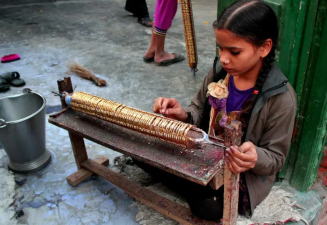
For decades, the name Firozabad has been synonymous with kaanch churiyan — colourful glass bangles that travel from small furnaces in Uttar Pradesh to markets across India and abroad. Now, the ‘Glass City of India’ is attempting a shift in how it presents itself to the world. A high-tech Glass Museum, billed as India’s first of its kind, is set to reframe Firozabad not merely as a manufacturing hub, but as a living archive of craft, technology and cultural history.
What the Glass Museum is about
The upcoming museum is being developed on over 25,700 square metres of land and is envisioned as a comprehensive narrative of glass — from ancient civilisations to Firozabad’s contemporary industry. With nearly 70% of construction complete, the three-storey structure, built at an estimated cost of ₹47 crore, stands out for its all-glass façade, symbolically reflecting the city’s core craft.
Unlike conventional craft museums, the focus is not restricted to bangles alone. The galleries will also feature glassware, decorative pieces, architectural glass and craft exports, placing Firozabad within a wider global history of glass production and trade.
Inside the galleries: from artefacts to immersion
The museum is designed around immersive storytelling rather than static displays. Dedicated galleries will trace the history of glass, its material science, evolving uses and design innovations. Early artefacts such as beads, ornaments and attar bottles will be displayed alongside contemporary products like designer bangles, chandeliers and modern glass installations.
Digital timelines, audio-visual narratives and participatory exhibits will explain how techniques, markets and social functions of glass have changed over centuries. Interactive galleries using light, colour and transparency are planned to help visitors understand the science and aesthetics behind the material.
Live craft, AR-VR and experiential learning
A key attraction will be live glass-blowing demonstrations, allowing visitors to watch artisans at work — an experience common in European craft towns but rare in India. These demonstrations aim to foreground the human skill behind the industry, not just the finished product.
For students and younger visitors, AR-VR learning zones will simulate the entire glass-making process, from melting and moulding to shaping and finishing. The museum is being aligned with curriculum-linked, experiential learning models, making it relevant for education as well as tourism.
Why the museum matters to Firozabad’s economy
Glass is not a marginal activity in Firozabad. An estimated 5–6 lakh people in and around the city depend directly or indirectly on glass-related work, with nearly 50,000 families engaged in bangle manufacturing and decoration alone. The museum is intended to document this evolving industrial ecosystem — how skills were transmitted, how technologies adapted, and how global demand reshaped local production.
By formally recording this transition, the museum seeks to become a reference point for students, designers and policymakers studying craft-based urban economies.
Linking craft with regional tourism
The project is also part of a broader tourism strategy of the Uttar Pradesh government to decentralise tourism beyond established centres like Ayodhya and Varanasi. References to the will be incorporated into the museum galleries, introducing visitors to nearby cultural and religious destinations and embedding Firozabad within a larger tourism geography.
An integrated cultural campus
The Glass Museum is being developed as part of a larger cultural campus. Plans include a tourist information centre, an auditorium, workshop spaces, recreational areas, a watch tower, a library and a souvenir zone featuring locally made glass products. A glass bridge is proposed to connect the tourist centre to the museum, reinforcing the visual identity of glass throughout the campus.
Why this reinvention matters
The museum reflects an attempt to redefine Firozabad’s urban identity — from a low-visibility manufacturing town to a destination that connects heritage, skill and contemporary storytelling. It also offers a model for how craft-based towns can document their own histories in ways that are modern, engaging and economically relevant.
What to note for Prelims?
- Firozabad is known as the ‘Glass City of India’.
- India’s first proposed high-tech Glass Museum is coming up in Firozabad.
- Project cost: around ₹47 crore; three-storey structure with glass façade.
- Focus on immersive learning, AR-VR and live craft demonstrations.
What to note for Mains?
- Role of museums in urban regeneration and cultural economy.
- Preserving intangible heritage through modern institutional frameworks.
- Link between craft clusters, tourism decentralisation and local livelihoods.
- Using experiential learning to bridge heritage and education.
Firozabad’s Glass Museum is not just about displaying objects; it is about narrating a city’s relationship with material, labour and change. If executed well, it could offer a template for reimagining India’s craft towns as centres of cultural knowledge, not just sites of production.
Last Modified: January 26, 2026