
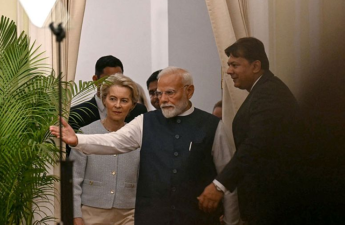
The arrival of the European Union’s top leadership in Delhi over the Republic Day weekend marked more than a ceremonial milestone. It signalled a decisive consolidation of India–Europe relations, translating two decades of intermittent dialogue into a coherent strategic partnership anchored in trade liberalisation, defence cooperation, and geopolitical diversification. For New Delhi, binding itself economically and strategically to Europe — now comparable in size to China’s economy and second only to the US — represents the most consequential external economic alignment it has attempted.
A partnership shaped by choice, not compulsion
The visit by Prime Minister Narendra Modi, European Commission President Ursula von der Leyen, and European Council President António Costa was not merely reactive diplomacy triggered by turbulence in ties with Washington. Both India and Europe remain deeply invested in their economic and security relationships with the United States.
Instead, the current momentum reflects a deliberate strategy of diversification — de-risking against an assertive China and an increasingly unpredictable America, while preserving core partnerships. The India–EU Free Trade Agreement and the broader strategic agenda are thus acts of strategic agency, not geopolitical hedging born of panic.
Why Europe mattered less — and why that changed
For much of the post-Independence period, Europe occupied a marginal place in India’s geopolitical thinking. Delhi viewed the continent largely through the Cold War lens of Russia–West rivalry, while Europe saw Asia primarily as a story of Chinese manufacturing dynamism contrasted with Indian protectionism.
By 2014, the relationship had hit a nadir. The strategic partnership announced in 2004 had stalled. FTA negotiations were suspended in 2013. Annual summits were frozen. Bilateral ties with several European capitals were strained. Europe had become, in Indian strategic parlance, a “flyover continent” en route to Washington.
The diplomatic repair job after 2014
The first phase of the Modi government’s Europe policy was repair. Political irritants were addressed, communication channels reopened, and trust slowly rebuilt. The revival of annual India–EU summits in 2016 proved pivotal. Around the same time, Europe initiated its own strategic reassessment of India in 2018, recognising New Delhi’s growing economic and geopolitical weight.
This reboot paved the way for the resumption of FTA negotiations in 2022, nearly a decade after they were abandoned. Importantly, the engagement widened beyond Brussels. India reinvigorated ties with Paris, Berlin, London, Rome, Madrid, and Warsaw, while also engaging Europe’s sub-regions — the Nordics, Baltics, Central Europe, and the Mediterranean.
From rhetoric to results: what changed structurally
The agreements unveiled this week reflect the cumulative impact of that sustained engagement. Trade talks that once seemed politically impossible were unlocked by a shift in India’s own economic thinking. Defence cooperation expanded from dialogue to industrial collaboration. Connectivity projects like the India–Middle East–Europe Economic Corridor (IMEC) broadened the strategic canvas.
Advanced technologies — semiconductors, green hydrogen, digital infrastructure — moved to the centre of bilateral priorities. Even on traditionally contentious issues such as climate change, human rights, and Russia’s war in Ukraine, India and Europe found pragmatic ways to manage differences without derailing cooperation.
Trade liberalisation as national strategy
Perhaps the most striking transformation lies in India’s approach to trade. The BJP-led government began its tenure sceptical of free trade, a stance reinforced by India’s withdrawal from the Regional Comprehensive Economic Partnership (RCEP) in 2019. That decision cemented India’s reputation as a reluctant liberaliser.
What followed was a strategic recalibration. New Delhi concluded that India gains more by negotiating with complementary Western economies than by competing head-on with East Asian manufacturing hubs. Since exiting RCEP, India has signed FTAs with Australia, the UAE, the European Free Trade Association, the UK, Oman, and New Zealand. The agreement with Europe is the capstone of this new trade doctrine.
Why implementation now matters more than headlines
The challenge ahead is execution. Trade liberalisation demands intense bureaucratic coordination to move from negotiated text to enforceable rules. Defence cooperation, inherently slow, requires sustained political oversight to translate intent into capability.
India’s current moment with Europe echoes the optimism of 2005, when Delhi and Washington redefined their relationship. In retrospect, debates persist on whether India fully leveraged that opening. With Europe, the cost of underperformance would be even higher, given the scale and diversity of the partnership.
Europe as a force multiplier for India’s rise
India and Europe converge on several priorities: internal economic reform, defence modernisation, technological upgrading, and diversification of strategic ties. Europe offers India not just market access but regulatory influence, technological depth, and institutional stability.
Success with Europe should now catalyse further steps — upgrading existing FTAs, reviving talks with Canada, nudging the US toward a steadier trade compact, and exploring engagement with the CPTPP, which notably excludes both China and an increasingly erratic United States.
What to note for Prelims?
- India–EU strategic partnership was first announced in 2004.
- FTA talks were suspended in 2013 and resumed in 2022.
- Annual India–EU summits were revived in 2016.
- The EU economy is comparable in size to China’s.
What to note for Mains?
- The India–EU partnership reflects strategic diversification, not alignment against the US.
- India’s trade policy has shifted from protectionism to selective liberalisation.
- Europe offers India regulatory, technological, and institutional advantages.
- The key challenge lies in implementation and sustained political momentum.