
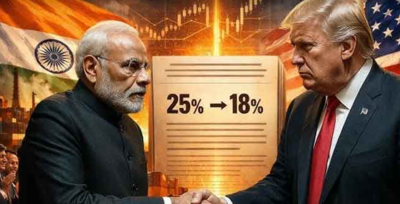
News of a breakthrough on the India–United States trade front has delivered immediate relief to several Indian industries battered by steep U.S. tariffs. Yet, beyond the market optimism and headline numbers, the announcement leaves behind a trail of unanswered questions — on timelines, scope, strategic commitments, and geopolitical consequences — that demand far greater clarity from the government.
What has been announced, and why it matters
The most significant takeaway from the announcement is the reported reduction in U.S. tariffs on Indian imports from 50% to 18%. For labour-intensive sectors such as textiles, apparel, footwear, leather and engineering goods, this is a substantial reprieve that directly improves price competitiveness in the U.S. market.
However, the manner of the announcement itself is unusual. The initial disclosure came via social media by U.S. President Donald Trump, a style consistent with his past practice but a departure for India. Previous trade agreements involving India have typically been communicated through formal joint statements or official channels, often involving the Prime Minister’s Office or the Commerce Ministry. This informality has added to the uncertainty surrounding the deal.
Timing and scope: deal or declaration?
One of the central ambiguities concerns implementation. While President Trump stated that tariff cuts would apply “immediately”, India’s Commerce Minister has said details would be shared “soon”. As of now, there is no notified date, legal instrument, or customs notification confirming the revised tariff rates.
Equally unclear is the nature of the agreement itself. It remains uncertain whether:
- This is a first tranche or “mini-deal” within a broader Bilateral Trade Agreement.
- It is a narrowly defined tariff adjustment with limited sectoral coverage.
- Or an interim arrangement pending a comprehensive trade pact.
This distinction matters because the obligations, durability, and dispute-resolution mechanisms vary significantly across these formats.
The Russia oil question and strategic implications
Perhaps the most sensitive assertion came from President Trump’s claim that Prime Minister had agreed to stop purchasing Russian oil. This statement was not addressed in the Commerce Minister’s press briefing, leaving a major strategic question unanswered.
Russia currently accounts for roughly a third of India’s crude oil imports. A complete halt would require rapid diversification to alternative suppliers, potentially at higher cost and logistical complexity. More importantly, it would signal a sharp geopolitical realignment affecting India’s long-standing ties with Russia, a critical defence supplier and strategic partner.
Such a shift, if contemplated, carries implications far beyond trade and energy policy. It would merit parliamentary debate rather than remaining an unclarified claim made by a foreign leader.
Alternative suppliers and refining constraints
Suggestions that India could substitute Russian crude with supplies from countries like raise additional concerns. Venezuelan crude is heavy and sulphur-rich, posing technical challenges for many Indian refineries. Switching sources is not simply a commercial decision but involves refinery compatibility, long-term contracts, and shipping constraints.
What has India conceded?
Another major gap in information relates to India’s commitments. Trade deals are reciprocal by nature, yet the government has offered limited clarity on:
- Tariff concessions extended to U.S. exports.
- Possible investment commitments or purchase guarantees.
- Market access in sensitive sectors.
Apart from assurances that agriculture and dairy remain protected, official silence persists despite repeated assertions from U.S. negotiators. Transparency on this front is essential for informed public and parliamentary scrutiny.
Market response and sectoral gains
Despite these uncertainties, the announcement has already had visible economic effects. Equity markets responded positively, the rupee strengthened, and export-oriented sectors saw renewed optimism after months of strain under punitive tariffs.
These gains are reinforced by the anticipated India–European Union trade agreement, which Mr. Goyal has indicated could come into force this year. Although Indian exporters may still face marginally higher U.S. tariffs than South-East Asian competitors benefiting from Most-Favoured Nation status, the gap has narrowed significantly.
Policy support and the road ahead
Targeted measures announced in the Union Budget 2026 are expected to further support export sectors in adapting to the new trade environment. Yet, optimism should not substitute for clarity. Markets may celebrate early signals, but durable benefits depend on legally sound agreements, clear timelines, and transparent commitments.
What to note for Prelims?
- Reported reduction of U.S. tariffs on Indian imports from 50% to 18%.
- Role of labour-intensive sectors in India’s export strategy.
- Concept of Most-Favoured Nation status in trade.
What to note for Mains?
- Trade-offs between economic gains and strategic autonomy.
- Energy security implications of changes in crude oil sourcing.
- Need for transparency and parliamentary oversight in major trade decisions.