
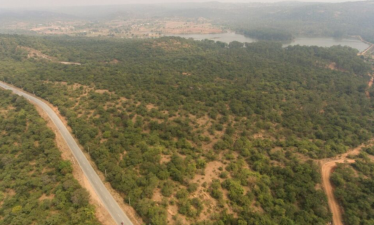
Karnataka prides itself on hosting India’s largest elephant population, yet it also records among the highest human fatalities from elephant encounters. This contradiction is starkly visible around the Bannerghatta National Park (BNP), where successive reductions of the Eco-Sensitive Zone (ESZ) have triggered legal scrutiny, farmer protests, and renewed debate on how development choices are reshaping wildlife conservation and human safety.
Why Bannerghatta’s ESZ matters
BNP lies at the ecological edge of Bengaluru and is far more than a city-adjacent green patch. It hosts over 150 resident elephants and forms part of three crucial elephant corridors — Karadikal–Mahadeshwara, Thally–Bilikal, and Bilikal–Jawalagiri. These corridors connect the park to the larger Mysore Elephant Reserve landscape, enabling seasonal migration and genetic exchange.
In a State that reported 20 human deaths due to elephant attacks in 2025–26 alone, ESZs around such protected areas are meant to act as buffers — moderating land-use change, limiting high-impact activities, and reducing human–wildlife conflict.
What are Eco-Sensitive Zones?
According to the , ESZs are areas with significant ecological, wildlife, and landscape value that require special protection. Defined under the National Environment Policy (2006), their objectives are threefold:
- To prevent environmental degradation from unregulated human activity
- To serve as a shock absorber around protected areas
- To function as a transition zone between high-protection forests and human-dominated landscapes
Under government guidelines, ESZs can extend up to 10 km from a protected area boundary, based on site-specific ecological assessments.
How and why BNP’s ESZ was reduced
In June 2016, a draft notification proposed an ESZ of 268.96 sq. km around BNP, ranging from 100 metres to 4.5 km from the park boundary. This extent was based on ecological studies, including assessments by the , which identified the need for a wider buffer to protect wildlife movement and habitats.
However, the proposed ESZ was progressively reduced:
- From 268.96 sq. km (2016 draft)
- To 181.57 sq. km
- Finally to 168.84 sq. km in the March 2020 notification
The revised notification also compressed the ESZ width to just 100 metres–1 km in many places.
The housing project at the centre of the dispute
Environmental groups argue that the ESZ reduction was driven largely by the Karnataka government’s large housing project — Surya Nagar Layout (KHB Surya City) — developed by the Karnataka Housing Board. Parts of the project area overlapped with villages that lay within the ESZ as per the 2016 draft.
Once ESZ restrictions became an obstacle to housing development, the boundary itself was altered. The Central Empowered Committee (CEC) later noted that land excluded from the ESZ witnessed extensive levelling, destruction of natural topography, and irreversible landscape modification — all without a comprehensive cumulative environmental impact assessment.
Supreme Court intervention and the CEC findings
In May 2025, a petition challenging the ESZ reduction was filed before the . The court constituted a Central Empowered Committee to examine the issue.
After site visits and consultations with farmers and petitioners, the CEC recommended:
- Restoring the 2016 draft ESZ notification
- Cancelling the 2020 ESZ notification
- Completing the re-notification process within six months
Crucially, the committee held that the ESZ reduction violated the 2011 MoEFCC guidelines, which require a multi-disciplinary committee — including the Chief Wildlife Warden and an ecologist — to scientifically assess ESZ boundaries. Such a process was bypassed when the reduction was approved by a Cabinet sub-committee.
Elephant corridors and ecological risks
Ecological studies underline that BNP is not an isolated forest but the northern terminal of the Mysore Elephant Reserve. It supports dry deciduous and scrub forests, riverine valleys, and acts as a watershed feeding tributaries of the Cauvery.
The CEC noted that large-scale construction near the Karadikal–Mahadeshwara corridor is likely to intensify human–wildlife conflict. With elephants, leopards, bears, and even tigers increasingly using these landscapes, fragmentation heightens the risk of frequent and violent encounters.
Farmers’ opposition and land-use conflict
Local farmers from villages such as Kadajakkanahalli and Indlawadi have opposed both land acquisition and ESZ dilution. They argue that fertile agricultural land — once part of the “Ragi Bowl of Karnataka” — is being converted into urban real estate without regard for livelihoods or ecology.
Plans to build large infrastructure, including a proposed 80,000-seat cricket stadium within Surya City, have deepened resentment. For residents, the project represents exclusion rather than development, with environmental costs borne locally and benefits accruing elsewhere.
Beyond elephants: a governance question
The Bannerghatta case exposes a deeper governance dilemma. ESZs are meant to reconcile conservation with development through scientific planning and public consultation. Their dilution to accommodate short-term urban expansion undermines both ecological security and human safety.
At a time when Karnataka faces rising human–wildlife conflict, weakening buffers around protected areas risks making encounters inevitable rather than accidental.
What to note for Prelims?
- Eco-Sensitive Zones are notified under MoEFCC guidelines, not the Wildlife Protection Act.
- ESZs can extend up to 10 km from protected area boundaries.
- Bannerghatta National Park is part of the Mysore Elephant Reserve landscape.
- The Central Empowered Committee advises the Supreme Court on forest and wildlife matters.
What to note for Mains?
- Discuss the role of ESZs in reducing human–wildlife conflict.
- Analyse the tension between urban development and conservation using the Bannerghatta case.
- Examine the importance of scientific assessment and due process in environmental governance.
- Evaluate how ESZ dilution can undermine long-term ecological and social outcomes.