
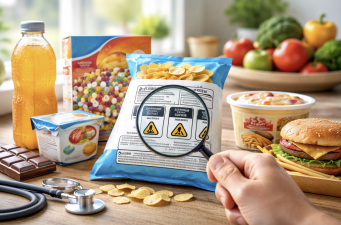
The Supreme Court’s recent observations urging the introduction of mandatory front-of-package warning labels (FOPL) on packaged foods high in sugar, salt, and saturated fats have brought India’s food regulation framework under renewed scrutiny. Framing the issue as one linked to citizens’ right to health, the Court has asked the Food Safety and Standards Authority of India (FSSAI) to place on record its response within four weeks. The development marks a critical moment in India’s public health governance, especially amid rising lifestyle diseases.
What the Supreme Court Has Directed
A Bench comprising Justices J.B. Pardiwala and R. Mahadevan, while hearing a Public Interest Litigation (PIL), noted that regulatory intervention through mandatory warning labels may be necessary to protect public health.
The case concerns the role of the Food Safety and Standards Authority of India (FSSAI), the statutory body responsible for regulating food safety under the Food Safety and Standards Act, 2006.
The Court observed that:
- Front-of-package labelling is internationally prevalent.
- Consumers must be enabled to make informed choices.
- The issue directly implicates the constitutional right to health under Article 21.
Earlier directions had required an expert committee under FSSAI to recommend amendments to the Food Safety and Standards (Labelling and Display) Regulations, 2020. However, the Court has now expressed dissatisfaction with the pace and outcome of the consultative process.
Why Front-of-Package Warning Labels Matter
Front-of-package warning labels (FOPL) are simplified, prominent disclosures placed on food packaging to alert consumers if products contain excessive amounts of “critical nutrients” such as:
- Added sugars
- Sodium (salt)
- Saturated fats
Such nutrients are strongly associated with non-communicable diseases (NCDs), including:
- Diabetes
- Cardiovascular disorders
- Hypertension
- Obesity
India is witnessing a rapid rise in lifestyle-related diseases. Public health experts argue that clearer labelling can act as a behavioural nudge, enabling consumers to avoid unhealthy products and encouraging manufacturers to reformulate foods.
The Debate: Indian Nutritional Rating vs Warning Labels
In 2022, FSSAI proposed the Indian Nutritional Rating (INR) system, a star-based rating (0.5 to 5 stars), with higher stars indicating healthier products.
The Centre has defended the INR model on the grounds that:
- It uses a composite scoring framework.
- It considers both “negative” nutrients (sugar, sodium, saturated fats) and “positive” components (fibre, protein, nuts, legumes).
- It offers a balanced overall health score.
However, petitioners have contended that:
- Star ratings may dilute the seriousness of high sugar or salt content.
- Consumers may not clearly understand composite scoring methods.
- Internationally, warning labels (black stop signs or bold caution marks) are more effective in reducing unhealthy consumption.
The Supreme Court’s remarks indicate a preference for clearer, more direct warning-based disclosure rather than interpretive scoring alone.
Public Health, Regulation, and Industry Concerns
FSSAI has argued that extensive stakeholder consultations are required, including:
- Large food industry associations.
- Micro, small and medium enterprises (MSMEs).
- Consumer groups.
- Global regulatory benchmarking.
The regulator has also proposed mapping packaged food samples and conducting consumer behaviour surveys before finalising norms.
Industry stakeholders often raise concerns about:
- Compliance costs for MSMEs.
- Impact on sales of processed and ultra-processed foods.
- Risk of oversimplification in warning systems.
Yet, from a constitutional lens, the Court appears to prioritise public health over commercial considerations.
Right to Health and Judicial Activism
Although the Constitution does not explicitly list the “right to health” as a fundamental right, the Supreme Court has consistently interpreted it as part of Article 21 (Right to Life).
In recent years, the judiciary has expanded health-related jurisprudence to include:
- Access to clean air and water.
- Regulation of tobacco products.
- Control of misleading advertisements.
The current proceedings reflect judicial willingness to intervene where regulatory inertia affects public welfare. However, this also raises broader debates on separation of powers and the limits of judicial direction in policy matters.
Global Context and Ultra-Processed Foods
Globally, countries such as Chile, Mexico, and Israel have adopted prominent warning-label systems to curb unhealthy consumption. The World Health Organization has also recommended stronger front-of-pack labelling norms to combat rising NCD burdens.
India’s rapid urbanisation, growing processed food market, and demographic transition make it particularly vulnerable to diet-related illnesses. Ultra-processed foods, characterised by high sugar, salt, and fat content, are increasingly under scrutiny.
What to Note for Prelims?
- FSSAI — statutory food regulator under Food Safety and Standards Act, 2006.
- Food Safety and Standards (Labelling and Display) Regulations, 2020.
- Indian Nutritional Rating (INR) — proposed star-based front-of-pack system.
- Front-of-package warning labels (FOPL) — global regulatory tool for unhealthy foods.
- Article 21 — judicially expanded to include right to health.
What to Note for Mains?
- Role of judicial intervention in public health policy.
- Balancing industry interests with constitutional right to health.
- Effectiveness of behavioural nudges in regulatory governance.
- Rise of non-communicable diseases in India and preventive strategies.
- Comparative analysis of global front-of-pack labelling models.