
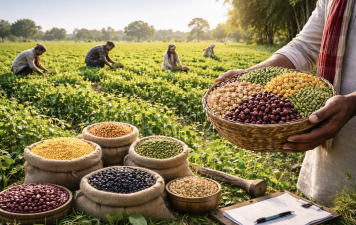
In a comprehensive review of procurement operations, Union Agriculture Minister Shivraj Singh Chouhan assessed the functioning of National Agricultural Cooperative Marketing Federation of India Ltd (NAFED), focusing on pulses and oilseeds procurement under the Minimum Support Price (MSP) framework. The deliberations signal renewed policy emphasis on strengthening assured procurement, stabilising markets, and advancing India’s goal of self-reliance in pulses production.
Why Pulses Procurement Is in Focus
India remains one of the largest producers and consumers of pulses, yet continues to rely on imports to bridge supply gaps. Crops such as tur (arhar), urad, and masoor are central to nutritional security, given their protein content and role in Indian diets.
The government’s concern stems from:
- Volatility in domestic pulses prices
- Fluctuations in production due to monsoon variability
- Dependence on imports during supply shortfalls
- Ensuring remunerative returns to farmers
Strengthening MSP-backed procurement is seen as critical to stabilising both farm incomes and consumer prices.
Review of PSS and PSF Operations
The meeting examined procurement under two key mechanisms:
- Price Support Scheme (PSS): Ensures procurement of pulses and oilseeds at MSP when market prices fall below the declared support price.
- Price Stabilisation Fund (PSF): Maintains buffer stocks to moderate price volatility in essential commodities.
The Minister directed officials to make procurement more transparent, time-bound, and farmer-centric. Emphasis was placed on timely payments, better infrastructure at procurement centres, and clear communication of schedules.
Proposed Six-Year ‘Self-Reliance in Pulses Mission’
A key policy proposal discussed was a six-year mission aimed at achieving Atmanirbhar (self-reliant) status in pulses production.
Core elements under consideration include:
- Improved agronomic practices
- Supply of high-quality seeds
- Enhanced extension and technical support
- Strengthened marketing and procurement linkages
- Alignment of procurement planning with production estimates
The mission seeks to reduce import dependence, stabilise domestic prices, and raise farmers’ income sustainably.
NAFED’s Role in Market Stabilisation
NAFED plays a pivotal role in MSP-based procurement and buffer stock management. Its operations directly influence:
- Farmer realisation of MSP benefits
- Market price stability during surplus years
- Supply management during lean production cycles
The Minister stressed the need for enhanced efficiency, accountability, and continuous monitoring in large-scale procurement operations. Improving storage infrastructure was also highlighted to prevent post-procurement losses.
Reducing Middlemen Dependence
A recurring theme was direct linkage between farmers and government procurement agencies. By streamlining procurement centres and strengthening coordination with state governments, the Centre aims to minimise intermediary exploitation.
Effective procurement systems contribute to:
- Assured income security for farmers
- Reduced price volatility for consumers
- Greater trust in public market intervention
Broader Policy Context
The renewed focus on pulses aligns with multiple national objectives:
- Doubling farmers’ income
- Nutritional security through protein-rich crops
- Reducing trade deficits in agricultural commodities
- Strengthening cooperative marketing institutions
Given climate risks and production variability, a proactive procurement strategy is considered essential for long-term agricultural resilience.
What to Note for Prelims?
- NAFED is a key agency for MSP-based procurement of pulses and oilseeds.
- Price Support Scheme (PSS) operates when market prices fall below MSP.
- Price Stabilisation Fund (PSF) is used to manage buffer stocks and price volatility.
- Proposed six-year Self-Reliance in Pulses Mission aims at Atmanirbhar pulses production.
- Major pulses discussed: tur (arhar), urad, masoor.
What to Note for Mains?
- Discuss the role of MSP in ensuring farmer income security.
- Examine the challenges in achieving self-reliance in pulses production.
- Analyse the effectiveness of buffer stock mechanisms in stabilising agricultural markets.
- Evaluate reforms needed in procurement and storage infrastructure.