
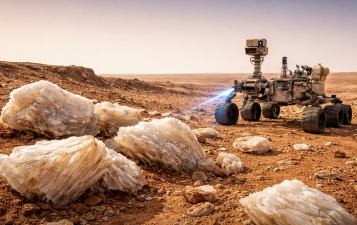
Recent studies in the Atacama Desert of Chile have brought into light the potential of gypsum rocks to harbour and preserve life under extreme conditions. The Salar de Pajonales, a high-altitude salt flat, offers an environment similar to Mars. Scientists have discovered living microbes and ancient fossils within gypsum stromatolites, suggesting that Mars’ gypsum deposits may also conceal signs of past or present life.
Atacama Desert as a Mars Analogue
The Atacama Desert is one of the driest places on Earth. Salar de Pajonales lies 3.5 km above sea level and experiences freezing temperatures. It is exposed to intense ultraviolet radiation. These factors make it a near-perfect analogue for Martian conditions. Studying life here helps understand how organisms might survive on Mars.
Gypsum’s Role in Protecting Life
Gypsum is a mineral composed of calcium sulphate dihydrate (CaSO4·2H2O). It is translucent and allows sunlight to penetrate. This property enables photosynthetic microbes to get energy while being shielded from harmful ultraviolet rays. Gypsum also traps moisture, creating a microhabitat suitable for microbial survival just beneath the rock surface.
Stromatolites and Fossil Preservation
Stromatolites are layered rock structures formed by microbial communities over long periods. Inside gypsum stromatolites, scientists found living microbes millimetres below the surface. Deeper layers contained fossils and chemical traces of ancient life. Gypsum sealed these remains, preserving them against harsh environmental factors. This preservation is crucial for detecting ancient life signatures.
Implications for Mars Exploration
Mars has extensive gypsum deposits detected by orbiters and rovers. Since gypsum can protect and preserve life on Earth’s harshest deserts, similar deposits on Mars are prime targets to search for life signs. Future missions may focus on these areas to detect microbial life or fossil records, advancing the search for extraterrestrial life.
Topics for Prelims:
Gypsum Mineral
- Chemical formula – CaSO4·2H2O
- Translucent and moisture-retaining properties
- Found on Earth and Mars
- Forms protective microhabitats for microbes
- Preserves fossils and chemical life signatures
Stromatolites
- Layered rock structures built by microbes
- Evidence of early life on Earth
- Can contain living microbes near surface
- Fossils preserved in mineral layers
- Important for studying ancient ecosystems
Atacama Desert
- One of the driest deserts globally
- Contains salt flats like Salar de Pajonales
- High altitude (3.5 km above sea level)
- Exposed to intense ultraviolet radiation
- Serves as Mars environmental analogue
Questions for UPSC:
- Discuss the significance of terrestrial analogues like the Atacama Desert in astrobiology and planetary exploration.
- Critically examine the role of mineralogy in the preservation and detection of ancient life forms on Earth and Mars.
- Explain the challenges of detecting microbial life in extreme environments and how these inform Mars mission designs.
- With suitable examples, discuss how geological formations contribute to our understanding of early life and its preservation.
Answer Hints:
1. Discuss the significance of terrestrial analogues like the Atacama Desert in astrobiology and planetary exploration.
- Atacama Desert is one of the driest and most UV-exposed places on Earth, similar to Martian surface conditions.
- Its high altitude and extreme cold mimic Mars’ environment, aiding realistic study of life survival strategies.
- Studying microbial life in Atacama helps identify biosignatures and survival mechanisms relevant to Mars.
- Terrestrial analogues guide instrument development and mission planning for detecting life on Mars.
- They provide natural laboratories to test hypotheses on life’s limits and preservation under harsh conditions.
- Analogues like Atacama reduce uncertainties in astrobiology by offering accessible, Earth-based models.
2. Critically examine the role of mineralogy in the preservation and detection of ancient life forms on Earth and Mars.
- Minerals like gypsum can shield microbes from UV radiation while allowing light for photosynthesis.
- Gypsum traps moisture, creating microhabitats essential for microbial survival in arid environments.
- Minerals preserve fossils and chemical biosignatures by sealing remains against degradation.
- On Mars, gypsum deposits detected by orbiters are prime targets for searching preserved ancient life.
- About mineralogical properties helps refine detection techniques for biosignatures on Mars missions.
- Mineralogy bridges biology and geology, crucial for interpreting ancient life evidence in extreme settings.
3. Explain the challenges of detecting microbial life in extreme environments and how these inform Mars mission designs.
- Microbial life is often hidden millimetres below rock surfaces, requiring sensitive subsurface sampling methods.
- Extreme dryness, radiation, and temperature fluctuations limit microbial abundance and biosignature preservation.
- Contamination risk and false positives complicate life detection in harsh environments.
- Instruments must detect subtle chemical, morphological, and isotopic biosignatures at micro scales.
- Lessons from Earth analogues inform rover payloads, drilling depth, and sample analysis protocols on Mars.
- Adaptation to low biomass and complex preservation states is critical for mission success.
4. With suitable examples, discuss how geological formations contribute to our understanding of early life and its preservation.
- Stromatolites are layered microbial structures providing direct fossil evidence of early life on Earth.
- Gypsum stromatolites in Atacama show living microbes and preserved ancient fossils, illustrating life preservation mechanisms.
- Geological formations trap and protect biological material from environmental degradation over millions of years.
- Examples like banded iron formations and silica sinters also reveal ancient microbial activity.
- Studying these formations helps reconstruct ancient ecosystems and evolutionary history.
- Similar formations on Mars could hold clues to past life, guiding exploration targets and methods.