
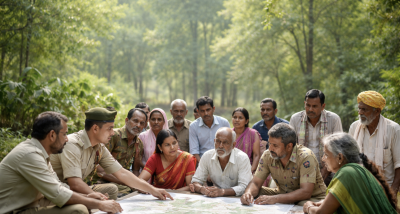
The Government of India has revamped its approach to implementing the Forest Rights Act (FRA), 2006. A year after launching district-level Forest Rights Act Cells (FRA cells) to aid claim processing and record digitisation, the Ministry of Tribal Affairs is expanding their mandate. The new structure will replace separate FRA cells with integrated Project Monitoring Units (PMUs) at State and Union Territory levels. This change aims to streamline policy coordination and improve efficiency in managing forest rights and related livelihood issues.
Background and Recent Developments
The Ministry initially sanctioned 324 district-level FRA cells across 18 States and Union Territories. These cells helped process forest rights claims and digitise records. However, multiple specialised cells created coordination difficulties and increased costs. In February 2026, the Ministry proposed replacing these with PMUs to cover FRA support, livelihood assistance, IT, and management information systems (MIS). Each State or UT will have a PMU with four officials and district-level experts for FRA and MIS coordination.
State-Level Responses and Challenges
Several States, including Odisha and Chhattisgarh, have shown mixed reactions. Odisha ordered closure of FRA cells in 50 sub-divisions, aligning with the new PMU model. Chhattisgarh is assessing whether existing FRA personnel can adapt to broader functions. Some States expressed concerns about losing specialised FRA staff and the temporary nature of current cells. The Ministry has assured time for States to reassign or release personnel as needed.
Objectives and Expected Benefits
The unified PMU system seeks to reduce administrative overlap and improve communication between the Centre and States. Combining FRA support with livelihood and IT expertise under one umbrella is expected to accelerate claim processing and policy implementation. By integrating data management and monitoring, the government aims to strengthen forest governance and protect tribal rights more effectively.
Policy Implications and Future Outlook
This policy shift reflects a broader trend towards integrated governance in tribal affairs and forest management. It also responds to challenges like missing forest rights titles and delays in claim settlements. However, the success of PMUs depends on clear guidelines, adequate training of personnel, and cooperation from States. The Ministry’s move signals an effort to balance efficiency with the sensitive nature of forest rights and tribal livelihoods.
Topics for Prelims:
Forest Rights Act (FRA), 2006
- Recognises rights of forest-dwelling tribal communities and other traditional forest dwellers.
- Allows claimants to receive legal titles to forest land occupied before 2005.
- Focuses on individual and community rights over forest resources.
- Requires Gram Sabhas to verify claims.
- Aims to correct historical injustice against forest-dependent communities.
Project Monitoring Units (PMUs)
- New integrated units replacing separate policy cells at State and UT levels.
- Comprise officials specialising in FRA, livelihood, IT, and MIS.
- Coordinate implementation of multiple forest and tribal policies.
- Include district-level experts for local coordination.
- Designed to improve efficiency and reduce administrative costs.
Ministry of Tribal Affairs
- Government body responsible for tribal welfare and forest rights implementation.
- Launched DAJGUA programme funding FRA cells.
- Facilitates coordination between Central and State governments.
- Monitors policy progress and capacity building for tribal governance.
- Promotes digitisation and transparency in forest rights records.
Questions for UPSC:
- Point out the significance of the Forest Rights Act, 2006 in protecting tribal rights and critically analyse the challenges in its implementation.
- Underline the role of integrated governance models like Project Monitoring Units in improving policy coordination and administration in tribal affairs.
- Estimate the impact of digitisation and data management on forest governance and tribal livelihoods with suitable examples.
- What are the institutional challenges faced by the Ministry of Tribal Affairs in balancing forest conservation and tribal rights? How can these be addressed?
Answer Hints:
1. Point out the significance of the Forest Rights Act, 2006 in protecting tribal rights and critically analyse the challenges in its implementation.
- FRA recognises individual and community forest rights of tribal and traditional forest dwellers, correcting historical injustices.
- It grants legal titles to forest land occupied before 2005, empowering forest-dependent communities.
- Gram Sabhas are empowered to verify and decide on claims, promoting local self-governance.
- Challenges include delays in claim processing, inadequate awareness among tribes, and bureaucratic hurdles.
- Conflicts arise between forest conservation policies and tribal land rights, leading to implementation resistance.
- Missing or inaccurate records and lack of coordination among agencies hinder effective enforcement.
2. Underline the role of integrated governance models like Project Monitoring Units in improving policy coordination and administration in tribal affairs.
- PMUs consolidate multiple policy cells (FRA support, livelihood, IT, MIS) for streamlined coordination.
- They reduce administrative overlap and cut costs by replacing separate specialised cells.
- Enable faster decision-making and claim processing through unified teams at State and district levels.
- Facilitate better communication between Centre and States, improving policy implementation consistency.
- Support integration of livelihood and forest rights efforts, addressing tribal welfare holistically.
- Challenges include adapting existing specialised staff and ensuring clear operational guidelines.
3. Estimate the impact of digitisation and data management on forest governance and tribal livelihoods with suitable examples.
- Digitisation improves transparency and accountability in forest rights claim processing.
- Enables easier record-keeping, reducing loss or misplacement of forest rights titles (e.g., Chhattisgarh case).
- Facilitates quicker verification and monitoring by Gram Sabhas and authorities.
- Supports data-driven policy decisions and targeted interventions for tribal welfare.
- Enhances coordination between multiple agencies through shared digital platforms.
- Challenges include digital literacy gaps and infrastructure limitations in remote tribal areas.
4. What are the institutional challenges faced by the Ministry of Tribal Affairs in balancing forest conservation and tribal rights? How can these be addressed?
- Conflicting mandates – protecting forests vs. recognising tribal land rights create policy tensions.
- Coordination gaps between Central, State, and local bodies lead to implementation delays.
- Limited human resources and specialised staff dedicated to FRA implementation.
- Resistance from forest departments and some States to fully empower tribal claims.
- Address by integrated governance models (PMUs), capacity building, and clear guidelines.
- Enhance participatory decision-making involving Gram Sabhas and tribal communities.