
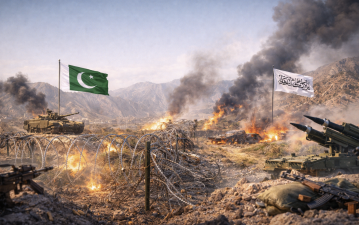
Recent military clashes between Pakistan and Afghanistan have escalated sharply in 2026. Pakistan launched air and missile strikes deep inside Afghanistan, including Kabul and Kandahar. The Taliban retaliated by attacking multiple Pakistani military posts along the Durand Line. These conflicts followed a ceasefire mediated by Turkiye and Qatar after clashes in late 2025. Pakistan’s Defence Minister declared an open war on Afghanistan, signalling a serious breakdown in relations.
Political and Military Rupture
The conflict marks a threefold rupture. Politically, Islamabad and Kabul’s relationship has worsened despite the Taliban takeover in 2021. The Taliban failed to control the Tehrik-e-Taliban Pakistan (TTP), increasing militant attacks in Pakistan’s tribal areas. Militarily, Pakistan’s Deep State, which once supported the Taliban, now opposes it under new leadership. The open war declaration reflects Rawalpindi’s approval. Societally, tensions have risen over Afghan refugees in Pakistan, with government efforts to deport them facing Afghan resistance. This societal divide threatens long-standing ties.
Origins of the Divide
Pakistan helped create and nurture the Taliban in the 1990s. After the US withdrawal in 2021, Pakistan expected the Taliban to rein in the TTP. Instead, militancy surged. The Taliban’s refusal to act against TTP stems from historical refuge ties and tribal loyalties. The Islamic State Khorasan (IS-K) presence complicates matters, as the Taliban sees IS-K as a greater threat and tolerates TTP. Accusations fly both ways – Kabul blames Pakistan for exporting militancy, while Pakistan blames Afghanistan and India for internal problems.
Asymmetry and Strategic Implications
Pakistan holds military, economic, and political advantages over Afghanistan. Its air force and missile capabilities allow strikes deep inside Afghan territory. Afghanistan lacks an air force and navy and depends heavily on Pakistan for trade access through Karachi port. Pakistan can restrict Afghan trade by closing border passes. Pakistan’s regional influence, including ties with the US, is stronger. The Taliban’s limited military capacity restricts its response to Pakistan’s aggression. The conflict threatens long-term regional stability.
Future Prospects and Regional Impact
The Af-Pak relationship is now conflict-prone and fragile. Pakistan views Afghanistan as a strategic trap to avoid. The Taliban’s limited military power and economic dependence on Pakistan limit its options. The societal divide over refugees may fuel future tensions. Regional players like Turkiye and Qatar have tried mediating but peace remains elusive. The conflict’s impact extends beyond the two countries, affecting South and Central Asian security dynamics.
Topics for Prelims:
Durand Line
- Border between Pakistan and Afghanistan established in 1893.
- Disputed by Afghanistan; source of frequent conflicts.
- Divides Pashtun tribal areas across both countries.
- Key in geopolitical and security issues in the region.
- Often a flashpoint for cross-border militancy and military actions.
Tehrik-e-Taliban Pakistan (TTP)
- Militant group operating mostly in Pakistan’s tribal areas.
- Opposes Pakistani state; linked to Taliban factions.
- Uses Afghanistan as a refuge and operational base.
- Responsible for numerous attacks in Pakistan.
- Source of major security challenge for Islamabad.
Islamic State Khorasan (IS-K)
- ISIS affiliate active in Afghanistan and Pakistan.
- Competes with Taliban for influence and recruits.
- Seen as a greater threat by Taliban than TTP.
- Targets civilians and security forces in the region.
- Complicates regional militancy and counter-terrorism efforts.
Questions for Mains:
- Critically discuss the impact of the Durand Line dispute on Pakistan-Afghanistan relations and regional security. [GS-II-International Relations]
- Analyse the role of non-state militant actors like Tehrik-e-Taliban Pakistan in shaping South Asian security dynamics and counter-terrorism policies. [GS-III-Internal & External Security]
- Examine the geopolitical implications of Pakistan’s strategic depth policy in Afghanistan and its evolution post-2021 US withdrawal. How does this affect India-Pakistan relations? [GS-II-International Relations]
- Estimate the socio-economic consequences of Afghan refugee deportations on Pakistan’s society and bilateral ties with Afghanistan. Discuss potential policy approaches. [GS-I-Indian Society]
Answer Hints:
1. Critically discuss the impact of the Durand Line dispute on Pakistan-Afghanistan relations and regional security. [GS-II-International Relations]
- Durand Line (established 1893) is disputed by Afghanistan, dividing Pashtun tribes and causing cross-border tensions.
- Frequent military clashes and militant cross-border attacks have worsened bilateral relations, especially post-2021 Taliban takeover.
- Pakistan’s air and missile strikes deep inside Afghanistan signify escalation and political rupture.
- Societal divide due to refugee issues exacerbates mistrust and long-term animosity between peoples.
- Durand Line dispute fuels militancy, complicates counter-terrorism, and destabilizes regional security in South and Central Asia.
- External mediation attempts (Turkiye, Qatar) have failed to bring lasting peace, denoting fragility of the border issue.
2. Analyse the role of non-state militant actors like Tehrik-e-Taliban Pakistan in shaping South Asian security dynamics and counter-terrorism policies. [GS-III-Internal & External Security]
- TTP operates from Pakistan’s tribal areas, opposes Pakistani state, and uses Afghan territory as safe haven.
- Its attacks have intensified militancy within Pakistan, challenging internal security and governance.
- Taliban’s refusal or inability to control TTP post-2021 strains Pakistan-Afghanistan relations.
- Presence of IS-Khorasan adds complexity, with competing militant groups impacting regional stability.
- Counter-terrorism policies have shifted from carrot-and-stick (under Imran Khan) to military crackdowns (current leadership).
- Cross-border militant dynamics complicate bilateral cooperation and necessitate multi-layered security responses.
3. Examine the geopolitical implications of Pakistan’s strategic depth policy in Afghanistan and its evolution post-2021 US withdrawal. How does this affect India-Pakistan relations? [GS-II-International Relations]
- Pakistan’s strategic depth policy aimed to cultivate a friendly Afghan regime (Taliban) for regional influence and security buffer.
- Post-2021 US exit, Pakistan expected Taliban to control TTP and stabilize Afghanistan under its influence.
- Failure of Taliban to rein in TTP and ensuing military clashes mark rupture in Pakistan-Taliban ties and strategic depth narrative.
- Pakistan’s deteriorating Afghan relations weaken its regional leverage and complicate its India policy.
- India views Pakistan’s instability and militant proxies as security threats; tensions likely to rise amid Af-Pak conflict.
- Pakistan’s strained Afghan policy may push it to adopt more aggressive postures vis-à-vis India, escalating regional rivalry.
4. Estimate the socio-economic consequences of Afghan refugee deportations on Pakistan’s society and bilateral ties with Afghanistan. Discuss potential policy approaches. [GS-I-Indian Society]
- Afghan refugees have lived in Pakistan for decades, contributing to local economies but also creating social tensions.
- Government’s push for deportations fuels hostility, disrupts communities, and strains Pakistan-Afghanistan societal links.
- Refugee deportations risk humanitarian crises, increase cross-border resentment, and destabilize border regions.
- Economic impact includes labor shortages in some sectors and loss of remittances or trade linkages.
- Policy approaches – balanced refugee management, integration programs, humanitarian protections, and bilateral dialogue.
- Engagement with international agencies and regional cooperation essential to address refugee challenges sustainably.