
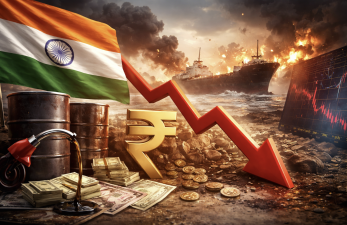
India faces growing macroeconomic stress due to rising geopolitical instability in West Asia as of early 2026. The rupee has depreciated to ₹95 per US dollar, while crude oil prices surged to $156.29 per barrel. The Reserve Bank of India has used large foreign exchange reserves to stabilise the currency. Despite strong GDP growth projections and increased public capital expenditure, external vulnerabilities such as falling forex reserves and rising foreign portfolio outflows have intensified economic pressures. This situation marks contradictions in India’s fiscal and economic structure.
Shift in India’s Revenue Structure
India’s revenue growth increasingly depends on transaction-linked taxes like GST rather than direct income taxes. Transaction-based revenues rose from 8.5% of GDP in FY16–20 to about 9.1% in recent years. This makes fiscal health sensitive to consumption and trade disruptions. Energy price shocks reduce household spending and trade volumes, weakening tax collections. Past shocks, like the pandemic, showed revenue shortfalls forcing government borrowing to compensate states.
Impact of Oil Price Volatility
India imports about 85–87% of its crude oil, exposing it to global price swings. A $10 rise in oil price can increase inflation by 0.2%, widen the current account deficit by 9-10 billion, and reduce GDP growth by 0.5%. Higher oil prices raise subsidy burdens on fertilisers and LPG and increase transport costs. Recent conflicts pushed oil prices above150, forcing the government to cut excise duties and increase subsidies, compressing fiscal space.
Household and Consumption Vulnerabilities
Household liabilities rose from 36–37% of GDP in 2022 to over 41% in 2025, indicating higher debt dependence. Consumption, which forms 61.4% of GDP, is increasingly credit-driven amid weak income growth. Energy inflation and LPG shortages have increased household costs. Meanwhile, welfare spending has declined due to prioritising capital expenditure. This combination strains real incomes and heightens vulnerability to inflationary shocks.
Industrial Sector and Investment Trends
Industrial growth is concentrated in capital-intensive sectors supported by public investment. Manufacturing expanded 8.1% year-on-year, with high-technology industries making up 46% of value added. However, labour-intensive industries remain weak. Private investment is cautious; only 9% of new projects completed in 2022–23. Energy supply disruptions have hurt informal sectors like restaurants and gig workers, showing uneven economic resilience amid external shocks.
Topics for Prelims:
India’s Fiscal and Revenue Structure
- Revenue receipts rose from 8.5% to 9.1% of GDP recently.
- Growth driven by GST and transaction-linked taxes.
- Direct tax buoyancy linked to formal employment.
- Transaction-based taxes sensitive to consumption shocks.
- Past pandemic showed revenue shortfalls and increased borrowing.
Oil Price Impact on Indian Economy
- India imports 85–87% of crude oil.
- $10 oil price rise increases inflation by 0.2%.
- Current account deficit widens by 9-10 billion.</li> <li>Higher subsidies on fertilisers and LPG during price spikes.</li> <li>Excise duty cuts reduce government revenue during shocks.</li> </ol> <h5>Household and Industrial Sector Dynamics</h5> <ol> <li>Household liabilities rose to over 41% of GDP.</li> <li>Private consumption forms 61.4% of GDP.</li> <li>Capital-intensive industries dominate industrial growth.</li> <li>Labour-intensive sectors remain weak and vulnerable.</li> <li>Energy supply issues affect informal businesses and gig economy.</li> </ol> <h4>Questions for Mains:</h4> <blockquote> <ol> <li>Discuss in the light of India’s fiscal architecture how transaction-linked taxation affects economic resilience during global commodity shocks. [GS-III-Economic Development]</li> <li>Analyse the impact of oil price volatility on India’s current account deficit and inflation with suitable examples. [GS-III-World & Physical Geography]</li> <li>Critically discuss the challenges faced by labour-intensive industries in India amid rising capital expenditure and global economic uncertainties. [GS-III-Economic Development]</li> <li>With examples from recent global crises, examine the role of foreign exchange reserves in managing currency volatility and external shocks. [GS-II-Constitution of India & Polity]</li> </ol> </blockquote> <h4>Answer Hints:</h4> <h5>1. Discuss in the light of India’s fiscal architecture how transaction-linked taxation affects economic resilience during global commodity shocks. [GS-III-Economic Development]</h5> <ol> <li>India’s revenue growth increasingly depends on transaction-linked taxes like GST rather than direct income taxes.</li> <li>Transaction-based taxes rise with consumption and trade volumes, making revenues sensitive to economic activity fluctuations.</li> <li>Global commodity shocks, especially energy price spikes, reduce household spending and trade, weakening transaction tax collections.</li> <li>During shocks, fiscal revenues fall while subsidy and welfare expenditures rise, compressing fiscal space.</li> <li>Past examples – pandemic-induced GST shortfalls forced government borrowing to compensate states.</li> <li>Fiscal model’s durability depends on ability to withstand external shocks without revenue collapse or excessive borrowing.</li> </ol> <h5>2. Analyse the impact of oil price volatility on India’s current account deficit and inflation with suitable examples. [GS-III-World & Physical Geography]</h5> <ol> <li>India imports about 85-87% of crude oil, making it vulnerable to global price swings.</li> <li>A %%MONEYBLOCK4%% increase in oil prices raises CPI inflation by ~0.2 percentage points.</li> <li>Oil price spikes widen current account deficit by9–10 billion (~0.4% of GDP) due to higher import bills.
- Example – Post-Ukraine conflict, oil basket price surged to $120+, leading to excise duty cuts and higher subsidies.
- Higher energy costs increase transport, fertiliser, and LPG subsidies, raising fiscal expenditure and inflation.
- Oil shocks compress fiscal space and can slow GDP growth by ~0.5 percentage points under partial pass-through.
3. Critically discuss the challenges faced by labour-intensive industries in India amid rising capital expenditure and global economic uncertainties. [GS-III-Economic Development]
- Industrial growth is concentrated in capital-intensive, high-tech sectors aligned with public investment.
- Labour-intensive industries remain weak, with limited recovery and low private investment completion rates (~9%).
- Energy supply disruptions (e.g., LPG shortages) have forced closures in informal sectors like restaurants and gig economy.
- Labour-intensive sectors are more vulnerable due to daily demand dependence and lack of institutional protections.
- Rising capital expenditure prioritizes infrastructure over direct income or employment support, limiting welfare stabilizers.
- Global uncertainties and energy inflation compress real incomes, worsening conditions for labour-intensive industries.
4. With examples from recent global crises, examine the role of foreign exchange reserves in managing currency volatility and external shocks. [GS-II-Constitution of India & Polity]
- India’s forex reserves (~$709.76 billion) have been used to stabilize the rupee amid geopolitical shocks.
- During West Asia crisis, RBI deployed billions of dollars to contain rupee depreciation (₹95/USD record low).
- Forex reserves provide buffer against capital outflows and currency volatility, supporting external stability.
- Example – During pandemic and Ukraine conflict, reserves helped manage sudden outflows and import payment pressures.
- However, prolonged shocks deplete reserves, reducing room for intervention and increasing vulnerability.
- Maintaining adequate reserves is crucial for monetary policy autonomy and cushioning external shocks in an open economy.