
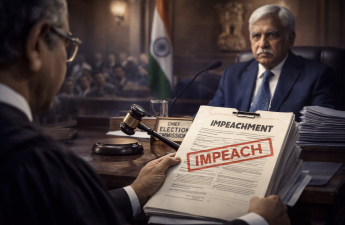
The Opposition parties have recently moved an impeachment motion against the Chief Election Commissioner (CEC) of India. This unprecedented action stems from allegations of partisan conduct, obstruction of investigations into electoral fraud, and disenfranchisement through the Special Intensive Revision (SIR) of electoral rolls. Despite the motion’s slim chances of success, it marks deep political tensions surrounding the Election Commission of India (ECI).
Background of the Impeachment Motion
The motion is the first of its kind targeting the CEC, an institution long respected for upholding Indian democracy. Opposition MPs accuse the CEC of bias favouring the ruling party and mishandling the revision of electoral rolls. The SIR process, aimed at cleaning the voter lists, faced protests and legal challenges, especially from opposition parties. The motion reflects a growing distrust between political parties and the election authority.
Special Intensive Revision of Electoral Rolls
The SIR was launched to remove duplicate and fake voters using new technology and micro-observers. It led to millions of deletions and unresolved cases, particularly in West Bengal. The ECI’s insistence on continuing the revision despite protests and deaths among officials caused widespread controversy. The Supreme Court intervened by appointing judicial officers to resolve pending cases rapidly, an unusual step for a constitutional body.
Political and Institutional Implications
The impeachment move reveals a political strategy where parties fight not to win but to challenge authority. The Opposition’s aggressive stance contrasts with the CEC’s firm adherence to the SIR despite criticism. This has strained communication and eroded trust. The situation questions the impartiality of the ECI and its ability to maintain public confidence during elections.
Impact on Indian Democracy
The controversy affects millions of voters, some of whom risk disenfranchisement. While the ECI claims the process protects electoral integrity, critics argue it undermines voting rights. The impeachment motion, even if unsuccessful, signals a crisis in electoral governance. It marks the delicate balance between ensuring free and fair elections and maintaining institutional credibility.
Topics for Prelims:
Chief Election Commissioner of India
- Head of the Election Commission of India.
- Ensures free and fair elections in India.
- Appointed by the President of India.
- Holds office for six years or till age 65.
- Has constitutional protection to ensure independence.
Special Intensive Revision (SIR) of Electoral Rolls
- Process to update and clean voter lists.
- Uses technology to detect duplicate and fake voters.
- Involves deletion and adjudication of electors.
- Has faced political opposition and legal challenges.
- Implemented before major state elections.
Election Commission of India (ECI)
- Constitutional body overseeing elections in India.
- Established in 1950 under Article 324 of the Constitution.
- Ensures conduct of elections to Parliament and state legislatures.
- Known for its autonomy and integrity.
- Has power to supervise electoral roll revisions and poll conduct.
Questions for Mains:
- Critically analyse the role of the Election Commission of India in maintaining democratic integrity and the challenges it faces in contemporary politics. [GS-II-Constitution of India & Polity]
- Point out the significance of electoral roll revisions in Indian elections and estimate their impact on voter disenfranchisement. [GS-II-Governance]
- With suitable examples, underline the implications of political conflicts on independent constitutional institutions in India and how they affect democratic governance. [GS-II-Constitution of India & Polity]
- Critically analyse the balance between electoral reforms and protection of voters’ rights in India, and how this balance shapes electoral democracy. [GS-I-Indian Society]
Answer Hints:
1. Critically analyse the role of the Election Commission of India in maintaining democratic integrity and the challenges it faces in contemporary politics. [GS-II-Constitution of India & Polity]
- ECI is a constitutional body established under Article 324 to ensure free, fair, and impartial elections in India.
- Known for its autonomy, integrity, and institutional credibility since independence.
- Challenges include political pressure, accusations of bias, and strained relations with opposition parties.
- Recent controversies like impeachment motion against CEC show erosion of trust and politicization of the institution.
- ECI’s firm implementation of electoral roll revisions (SIR) despite protests shows commitment but also rigidity.
- Maintaining democratic integrity requires balancing independence with transparency and dialogue with stakeholders.
2. Point out the significance of electoral roll revisions in Indian elections and estimate their impact on voter disenfranchisement. [GS-II-Governance]
- Electoral roll revisions ensure accuracy by removing duplicate, fake, and ineligible voters, thereby protecting electoral integrity.
- Special Intensive Revision (SIR) used technology and micro-observers for rigorous cleansing before major elections.
- Millions of deletions and unresolved cases, especially in states like West Bengal, raised concerns of disenfranchisement.
- Judicial intervention to adjudicate pending cases puts stress on the complexity and sensitivity of the process.
- Improper or aggressive revision risks excluding legitimate voters, undermining democratic participation.
- Balancing thoroughness with voter rights protection remains a governance challenge in electoral management.
3. With suitable examples, underline the implications of political conflicts on independent constitutional institutions in India and how they affect democratic governance. [GS-II-Constitution of India & Polity]
- Political conflicts can undermine the perceived impartiality and functioning of constitutional bodies like the ECI.
- Example – Opposition’s impeachment motion against CEC alleging bias and obstruction reflects deep political distrust.
- Such conflicts strain communication channels, erode institutional credibility, and polarize public opinion.
- Intervention of judiciary (Supreme Court appointing judicial officers) shows institutional interplay under stress.
- Political parties treating constitutional bodies as opponents weakens democratic checks and balances.
- Overall, politicization hampers smooth governance and public confidence in democratic institutions.
4. Critically analyse the balance between electoral reforms and protection of voters’ rights in India, and how this balance shapes electoral democracy. [GS-I-Indian Society]
- Electoral reforms like SIR aim to enhance election credibility by cleaning electoral rolls and preventing fraud.
- However, aggressive reforms risk disenfranchising genuine voters, violating their fundamental right to vote.
- ECI’s use of technology and micro-observers reflects modernisation but also raises concerns about transparency.
- Protests, deaths of officials, and legal challenges show social and political resistance to reforms.
- Judicial oversight attempts to safeguard voter rights but may slow down reform processes.
- Effective electoral democracy depends on achieving a fair balance where reforms do not compromise inclusivity and rights.