
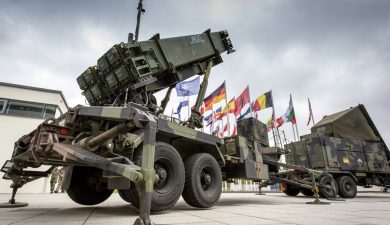
Recent hostilities in 2026 between the U.S.-led coalition, including Israel and the UAE, and Iran have seen the deployment of an advanced regional integrated air and missile defence network. This conflict follows a major 12-day war in 2025 where missile defence systems were tested intensely. The current war involves new technologies and strategies, especially in the Persian Gulf, with the UAE using South Korean and U.S. missile defence systems.
Missile Defence Systems – Function and Importance
Missile defence systems detect and destroy incoming missiles before impact. They use satellites, radar, and command centres to track threats. Interceptors are launched to destroy missiles mid-air. These systems save lives, protect property, and deter missile attacks by reducing their effectiveness. They also give military leaders time to respond.
How Interceptors Work
Using the U.S. Patriot system as an example – radar scans the sky with radio beams. When a missile is detected, the radar locks onto it for continuous tracking. A command centre calculates the missile’s path and fires an interceptor. The interceptor is guided to collide with the target, either exploding nearby or hitting it directly to destroy it.
Advancements and Challenges in Missile Defence
The UAE’s Cheongung II missile system uses 360° radar and hit-to-kill technology. It counters low-flying cruise missiles and tactical missiles quickly reaching the Gulf. The U.S. uses systems like THAAD and Patriot but must ration expensive interceptors due to Iran’s saturation attack strategy. Israel uses laser defence against drone swarms to save costly missiles. Production of interceptors lags behind combat needs, causing shortages.
Iran’s Defence Systems and Limitations
Iran uses advanced systems like Bavar-373 and Sayyad missiles with long-range capabilities. It also deploys mobile systems like Sevom-e-Khordad to protect key sites. Despite these, Iran’s defences are strained by high volumes of attacks. Reload times and limited interceptor stocks leave gaps. Iran’s ability to detect stealth aircraft remains uncertain as coalition strikes continue.
Topics for Prelims:
Missile Defence Systems
- Missile defence detects and destroys incoming missiles before impact.
- Key components include radar, satellites, command centres, and interceptors.
- Interceptors use proximity fuses or hit-to-kill technology.
- Systems include U.S. Patriot, THAAD, Israeli Iron Dome, and South Korean Cheongung II.
- Missile defence deters attacks and provides strategic response time.
Key Defence Technologies
- Cheongung II offers 360° radar and vertical launch capability.
- Patriot system tracks and intercepts high-speed ballistic missiles.
- Iron Beam laser counters drone swarms cost-effectively.
- Iran’s Bavar-373 targets long-range threats with Sayyad missiles.
- Mobile systems like Sevom-e-Khordad enhance survivability of missile defences.
Questions for Mains:
- Discuss in the light of recent Middle East conflicts how integrated missile defence systems impact regional security dynamics. [GS-II-International Relations]
- Critically examine the challenges of missile defence production and deployment in prolonged conflicts with reference to the 2025-26 Gulf war. [GS-III-Economic Development]
- Explain the technological advancements in missile defence systems and their strategic importance, with suitable examples from the U.S., Israel, and South Korea. [GS-III-Science & Technology]
- With suitable examples, discuss how saturation attacks influence missile defence strategies and the implications for modern warfare. Comment on the role of cost in shaping defence procurement decisions. [GS-III-Internal & External Security]
Keywords for Prelims:
Patriot Missile System
- Developed by the United States for missile defence.
- Uses radar to detect and track incoming missiles.
- Employs hit-to-kill interceptors or proximity fuses.
- Effective against ballistic and cruise missiles.
- Costly, with interceptors around $4 million each.
Cheongung II Missile System
- South Korean missile defence system used by UAE.
- Features 360° rotating radar and vertical launch.
- Designed for low-flying cruise and tactical ballistic missiles.
- Uses hit-to-kill technology with onboard radar seeker.
- Optimised for rapid interception in the Persian Gulf region.
Bavar-373 Missile Defence System
- Iranian long-range missile defence system.
- Uses Sayyad-4B missiles with range over 300 km.
- Designed to intercept ballistic missiles and stealth aircraft.
- Includes 360° radar coverage for all-round defence.
- Deployment challenged by high-volume attacks and reload times.
Answer Hints:
1. Discuss in the light of recent Middle East conflicts how integrated missile defence systems impact regional security dynamics. [GS-II-International Relations]
- Integrated missile defence systems enhance collective security by linking capabilities of allied nations (U.S., Israel, UAE, South Korea).
- They deter missile attacks by reducing enemy missile effectiveness and increasing retaliation costs.
- Systems like Patriot, THAAD, Iron Dome, and Cheongung II create layered defence, complicating adversary attack planning.
- Integration encourages strategic partnerships and interoperability among coalition forces in the region.
- However, missile defence also escalates arms race dynamics, prompting adversaries like Iran to develop saturation and decoy tactics.
- Overall, these systems stabilize conflict thresholds but also intensify regional military competition and dependency on allied technology.
2. Critically examine the challenges of missile defence production and deployment in prolonged conflicts with reference to the 2025-26 Gulf war. [GS-III-Economic Development]
- High cost of interceptors (e.g., $4 million per Patriot PAC-3 MSE shot) limits sustained use and forces rationing.
- Production capacity is insufficient to meet high-tempo combat demands; replenishment can take 1.5+ years.
- Saturation attacks by adversaries rapidly deplete interceptor stockpiles, exposing defence gaps during reload times.
- Technological complexity and reliance on multiple integrated systems complicate logistics and maintenance.
- Budget constraints and prioritization affect ability to scale production and deploy advanced systems widely.
- Directed-energy weapons and cheaper alternatives (e.g., Iron Beam laser) are being introduced to ease pressure on interceptor stocks.
3. Explain the technological advancements in missile defence systems and their strategic importance, with suitable examples from the U.S., Israel, and South Korea. [GS-III-Science & Technology]
- 360° rotating multi-function radars (e.g., Cheongung II) enable all-around tracking without repositioning launchers, enhancing reaction speed.
- Hit-to-kill interceptors (Patriot, Cheongung II) improve precision by direct collision, reducing collateral damage and increasing kill probability.
- Vertical launch systems (Cheongung II) allow rapid firing in any direction, critical for low-flying cruise missile threats.
- Directed-energy weapons like Israel’s Iron Beam provide cost-effective defence against drone swarms, conserving interceptor missiles.
- Integration of space-based sensors and networked command centres (U.S. systems) enables early detection and layered defence against ballistic missiles.
- These technologies increase strategic deterrence, protect critical infrastructure, and enhance allied interoperability in conflict zones.
4. With suitable examples, discuss how saturation attacks influence missile defence strategies and the implications for modern warfare. Comment on the role of cost in shaping defence procurement decisions. [GS-III-Internal & External Security]
- Saturation attacks overwhelm missile defence by firing large numbers of cheap missiles/drones simultaneously, depleting interceptors (Iran’s strategy against coalition).
- Defence strategies now emphasize rationing expensive interceptors (e.g., Patriot PAC-3 MSE) and employing layered systems including cheaper/alternative defences (Iron Beam laser, AIM-9X Sidewinder).
- Cost considerations drive procurement towards balanced portfolios combining costly high-end interceptors with affordable directed-energy and kinetic systems.
- Missile defence systems must be adaptable and scalable to counter evolving saturation tactics and decoys (e.g., Russia’s Iskander modifications).
- Modern warfare increasingly relies on integrated multi-domain defence, incorporating cyber, electronic warfare, and missile defences to reduce saturation impact.
- Budget constraints and cost-effectiveness shape production priorities, accelerating development of cheaper, reusable, or multi-role defence technologies.