
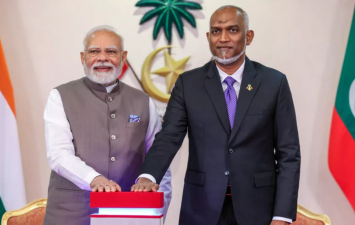
India today stands among the world’s largest economies, with a GDP touching $4 trillion and global political visibility at an all-time high. Yet, paradoxically, its immediate neighbourhood remains uneasy, transactional, and at times openly resistant. Beyond official rhetoric, it is difficult to argue that New Delhi enjoys genuinely warm relations with most of its neighbours, barring Bhutan. This gap between economic weight and regional influence raises a fundamental question: has India confused size and visibility with real power?
Adversaries are clear, but neighbours are uneasy
India’s strategic challenges with Pakistan and China are well understood. Despite public diplomacy and optics—such as Prime Minister Narendra Modi’s interactions with President Xi Jinping at the Shanghai Cooperation Organisation—the ground reality remains tense. Pakistan continues to rely on asymmetric tools, while China presents a far more complex challenge, combining economic interdependence with constant military pressure along the northern borders and expanding naval ambitions in the Indian Ocean.
Why India’s economic and cultural pull has not translated into influence
Given India’s economic growth, military capability, and civilisational depth, one would expect a stronger gravitational pull on neighbouring countries. Yet the “osmotic effect” of Indian power is limited. Strategist George Friedman describes power as an intangible quality—the ability to shape outcomes without resorting to force. By this measure, India’s challenge is not absence of influence, but the premature expectation of deference that usually accompanies mature power.
Weight, influence, and the missing leverage
This distinction was articulated as early as 2011 by India’s former National Security Adviser Shiv Shankar Menon, who cautioned against mistaking influence for power. India, he argued, would remain a major power with many poor citizens for a long time, and its primary task was domestic transformation. That unfinished transformation limits New Delhi’s ability to offer economic leverage comparable to China’s, especially in the form of large-scale, unconditional capital.
China’s expanding footprint in South Asia
The consequences of this gap are visible across the neighbourhood. Bangladesh’s political recalibration, Nepal’s deepening infrastructure and digital ties with China, and Beijing’s growing presence in Myanmar all point to a steady erosion of India’s strategic comfort zone. In Nepal, Chinese investments in railways, roads, energy, and tourism have altered perceptions, while Indian media’s intrusive coverage has sometimes aggravated local sensitivities.
Island neighbours and fragile goodwill
Similar patterns have emerged in Maldives and Sri Lanka, where political transitions often trigger recalibration away from India before relations stabilise again. These swings underline a deeper fragility: goodwill that is not anchored in sustained economic and institutional interdependence is easily reversed.
Limits of hard power and economic depth
On the hard power front, India’s defence exports are rising, but the country remains the world’s second-largest arms importer. This undercuts claims of strategic autonomy. Economically, headline GDP figures obscure a harsher truth: India’s per capita income still ranks around 143 globally. With millions requiring state support, New Delhi lacks the surplus capital that allows Beijing to shape regional policies through generous financing.
What real power looks like in today’s world
Recent global events reinforce an old lesson. From US economic coercion under Donald Trump to China’s use of rare earth dominance, real power lies in economic depth and control over critical resources. As Thucydides observed centuries ago, the strong act on their will while the weak bear the consequences—a principle still visible in modern geopolitics.
Why neighbourhood stability is vital for Viksit Bharat
India’s long-term vision of becoming a developed nation by 2047 cannot coexist with persistent friction in its immediate periphery. Developmental assistance to neighbours reflects civilisational responsibility, but assistance alone cannot substitute for credibility, restraint, and patience. Power must be demonstrated quietly, not asserted loudly.
What to note for Prelims?
- India’s neighbourhood policy and key neighbouring countries.
- Difference between power, influence, and economic weight.
- Role of China in South Asia through infrastructure diplomacy.
- Concept of per capita GDP versus aggregate GDP.
What to note for Mains?
- Critically examine why India’s economic rise has not translated into neighbourhood influence.
- Discuss the relevance of economic depth in sustaining regional power.
- Analyse China’s strategy in India’s neighbourhood and India’s response.
- Suggest ways India can build long-term, trust-based relations with its neighbours.