
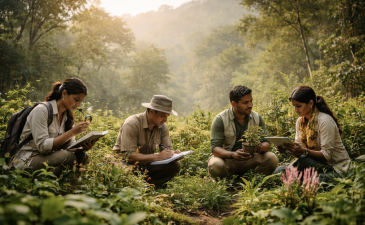
World Wildlife Day 2026 focused on Medicinal and Aromatic Plants – Conserving Health, Heritage and Livelihoods. This theme marks the critical role of these plants in healthcare, culture, and income generation. Around 70–95% of people in developing countries rely on traditional medicine, mostly plant-based. India, rich in biodiversity, plays a key role in conserving these plants for sustainable development and climate resilience.
India’s Medicinal Plant Diversity
India is one of 17 mega biodiversity countries. It hosts 45,000 plant species, including 15,000 medicinal plants. About 8,000 species support traditional and folk medicine. Most medicinal plants grow in the Western and Eastern Ghats, Himalayas, and Aravalli ranges. The Botanical Survey of India has documented over 5,250 species with 9,567 folk medicinal uses. This vast heritage is vital for health and livelihoods.
Conservation Strategies
India uses in situ and ex situ conservation methods. In situ protects plants in natural habitats through national parks and Medicinal Plants Conservation Areas (MPCAs). India has 115 MPCAs preserving indigenous health traditions. Ex situ conservation stores plant genetic material outside natural habitats, like at the National Seed Gene Bank. These methods secure plant diversity for future use and reintroduction.
Government Schemes and Initiatives
The National Medicinal Plants Board (NMPB) leads conservation efforts. The Central Sector Scheme (2021-26) with ₹322.41 crores funds plantations, research, and marketing. The National Ayush Mission promotes cultivation integrated with farming. The e-CHARAK platform facilitates trade and market information for farmers. Programs like Aushadhi Vanaspati Mitra reward contributions to conservation. Livelihood support aids local communities through infrastructure and marketing help.
Geographical Indications and Global Cooperation
India protects medicinal plants through Geographical Indications (GI) tags. Notable examples include Navara Rice (Kerala), Green Cardamom (Kerala and Karnataka), Ganjam Kewda Flower (Odisha), Saffron (Jammu and Kashmir), and Nagauri Ashwagandha. International collaboration enhances protection of traditional knowledge and promotes fair benefit-sharing. India’s integrated approach balances conservation, culture, and economic growth.
Topics for Prelims:
Medicinal and Aromatic Plants (MAPs)
- India has 15,000 medicinal plant species.
- 70% of MAPs grow in Western/Eastern Ghats, Himalayas, Aravalli.
- Medicinal plants support traditional and modern medicine.
- MPCA sites protect MAPs in natural habitats.
- Ex situ conservation stores genetic material outside habitats.
Key Government Schemes
- National Medicinal Plants Board (NMPB) leads conservation.
- Central Sector Scheme funds plantations and marketing.
- National Ayush Mission promotes MAP cultivation.
- e-CHARAK app supports MAP trade and market info.
- Aushadhi Vanaspati Mitra recognises conservation efforts.
Geographical Indications (GI) Tags
- Navara Rice (Kerala) used in Ayurveda treatments.
- Green Cardamom (Kerala, Karnataka) treats asthma and cough.
- Ganjam Kewda Flower (Odisha) aids eye and respiratory health.
- Saffron (Jammu & Kashmir) cures migraine and skin issues.
- Nagauri Ashwagandha GI registered in 2025.
Questions for Mains:
- Discuss the role of medicinal and aromatic plants in India’s traditional healthcare systems and their relevance to modern medicine. [GS-I-Indian Culture]
- Critically examine the conservation strategies of medicinal plants in India and their impact on biodiversity and rural livelihoods. [GS-III-Environment & DM]
- Explain the significance of Geographical Indications (GI) tags in protecting India’s medicinal plant heritage and promoting sustainable development. [GS-II-Constitution of India & Polity]
- With suitable examples, discuss the challenges and opportunities in integrating traditional knowledge with modern digital platforms for medicinal plant trade and conservation. [GS-III-Economic Development]
Answer Hints:
1. Discuss the role of medicinal and aromatic plants in India’s traditional healthcare systems and their relevance to modern medicine. [GS-I-Indian Culture]
- Medicinal plants form the foundation of Ayurveda, Siddha, Unani, and folk medicine systems in India.
- About 70-95% of people in developing countries rely on plant-based traditional medicine for primary healthcare.
- Many modern pharmaceuticals are derived from compounds originally found in medicinal plants.
- Medicinal plants support healthcare accessibility, affordability, and cultural heritage preservation.
- They contribute to holistic health approaches, including preventive and curative therapies.
- Integration of traditional knowledge aids drug discovery, biodiversity conservation, and sustainable livelihoods.
2. Critically examine the conservation strategies of medicinal plants in India and their impact on biodiversity and rural livelihoods. [GS-III-Environment & DM]
- In situ conservation via Medicinal Plants Conservation Areas (MPCA), national parks, and biosphere reserves protects plants in natural habitats.
- Ex situ conservation stores genetic material in seed banks and botanical gardens for future restoration.
- Government schemes like National Medicinal Plants Board (NMPB) and Central Sector Scheme promote cultivation, research, and sustainable harvesting.
- Livelihood support to local communities through Joint Forest Management, SHGs, and marketing infrastructure enhances rural incomes.
- Challenges include habitat loss, overexploitation, climate change, and inadequate awareness among stakeholders.
- Overall, conservation efforts help maintain biodiversity, traditional knowledge, and socio-economic development in rural areas.
3. Explain the significance of Geographical Indications (GI) tags in protecting India’s medicinal plant heritage and promoting sustainable development. [GS-II-Constitution of India & Polity]
- GI tags legally recognize the unique origin and quality of medicinal plants linked to specific regions.
- Examples include Navara Rice (Kerala), Green Cardamom (Kerala/Karnataka), Ganjam Kewda Flower (Odisha), Saffron (J&K), and Nagauri Ashwagandha.
- GI protection prevents unauthorized use and biopiracy, safeguarding traditional knowledge and local biodiversity.
- Promotes rural economy by enhancing market value, branding, and export potential of GI-tagged products.
- Encourages sustainable harvesting and cultivation practices aligned with local ecosystems.
- Supports equitable benefit-sharing and community empowerment under global intellectual property frameworks.
4. With suitable examples, discuss the challenges and opportunities in integrating traditional knowledge with modern digital platforms for medicinal plant trade and conservation. [GS-III-Economic Development]
- Digital platforms like e-CHARAK facilitate market access, price transparency, and stakeholder networking for medicinal plant farmers.
- Integration helps preserve and disseminate traditional knowledge while promoting sustainable trade practices.
- Challenges include digital divide, data privacy, intellectual property rights, and ensuring authenticity of information.
- Opportunities exist for value addition, quality certification, and linking farmers to global markets.
- Examples – e-CHARAK app updates market prices, supports multiple languages, and connects producers with buyers.
- Effective integration can boost livelihoods, conservation awareness, and innovation in medicinal plant sectors.