
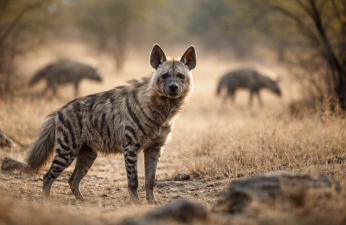
The 15th Meeting of the Conference of the Parties to the Convention on Migratory Species (CMS COP15) held in Campo Grande, Brazil, saw Tajikistan and Uzbekistan propose the inclusion of the striped hyena in both Appendix I and II of CMS. This move aims to enhance international protection and promote coordinated conservation efforts across the species’ range.
Current Status and Population Challenges
The striped hyena (Hyaena hyaena) is listed as Near Threatened globally by the IUCN and Vulnerable in the Mediterranean. Its global population is estimated between 5,000 and 9,999 mature individuals. Population data is limited and outdated, complicating conservation planning. The species is believed to be declining and may soon meet criteria for Vulnerable status. Its elusive and nocturnal nature makes accurate counts difficult. Low population densities increase vulnerability to local extinction.
Habitat and Range
Striped hyenas inhabit diverse environments including savannas, grasslands, semi-deserts, open woodlands, and mountains. Their range covers North and Sub-Saharan Africa, the Middle East, and Central and South Asia. They exhibit varied movement patterns such as long-distance dispersal and seasonal migration. In arid zones, they cross international borders seeking food and water. Their movements often align with migrations of prey species, underscoring the need for transboundary conservation.
Threats to Survival
Major threats include habitat loss from agriculture, urbanisation, and infrastructure growth. Declining prey and changes in livestock practices reduce food availability. Illegal hunting and trade add pressure. Human-wildlife conflict, driven by negative perceptions, leads to persecution. These factors collectively endanger striped hyena populations and complicate conservation efforts.
Importance of CMS Listing
Inclusion in CMS Appendices I and II would provide the highest level of protection. It would require member states to implement safeguarding measures and strengthen local conservation policies. This listing would facilitate international cooperation and coordinated actions across borders. It could overcome bureaucratic hurdles and enhance legal frameworks for the species’ survival. Ultimately, it aims to stabilise and increase striped hyena populations.
Topics for Prelims:
Striped Hyena
- Scientific name – Hyaena hyaena.
- One of four species in the Hyaenidae family.
- Found across Africa, Middle East, Central and South Asia.
- Near Threatened globally; Vulnerable in Mediterranean region.
- Population estimated between 5,000 and 9,999 mature individuals.
Convention on Migratory Species (CMS)
- International treaty for conservation of migratory animals.
- Appendix I lists endangered migratory species needing strict protection.
- Appendix II includes species needing cooperation across countries.
- CMS COP meetings decide on species listings and conservation actions.
- Promotes transboundary collaboration among member states.
Threats to Wildlife Conservation
- Habitat loss due to agriculture and urbanisation.
- Decline in prey species affects predator survival.
- Illegal hunting and wildlife trade.
- Human-wildlife conflict from crop damage and livestock loss.
- Environmental changes forcing species migration and dispersal.
Questions for Mains:
- Critically analyse the role of international treaties like the Convention on Migratory Species in conserving transboundary wildlife species with examples.
- Comment on the challenges faced in estimating populations of elusive and nocturnal species and suggest modern techniques to overcome them. [GS-III-Science & Technology]
- Explain the impact of habitat fragmentation on large carnivores and discuss policy measures to mitigate these effects in the context of human-wildlife conflict. [GS-III-Environment & DM]
- What are the ecological and socio-economic implications of listing species under international conservation agreements and how does this influence national wildlife policies? [GS-II-Governance]
Answer Hints:
1. Critically analyse the role of international treaties like the Convention on Migratory Species in conserving transboundary wildlife species with examples.
- CMS facilitates cooperation among countries sharing migratory species, enabling coordinated conservation efforts.
- Listing species in Appendices I and II ensures legal protection and obligates member states to implement safeguarding measures.
- Example – Proposal to list striped hyena to enhance cross-border habitat protection and population stabilization.
- CMS addresses threats that transcend national borders, such as habitat fragmentation and migratory route disruption.
- International treaties help overcome bureaucratic and policy barriers, promoting uniform conservation frameworks.
- Challenges include enforcement disparities and limited data sharing among member states.
2. Comment on the challenges faced in estimating populations of elusive and nocturnal species and suggest modern techniques to overcome them. [GS-III-Science & Technology]
- Elusive behavior and nocturnal activity limit direct observation and traditional survey methods.
- Low population densities increase difficulty in obtaining representative samples.
- Outdated and sparse data hinder accurate population assessments and trend analysis.
- Modern techniques – camera traps, acoustic monitoring, and environmental DNA (eDNA) sampling.
- Use of satellite telemetry and GPS collars to track movement and estimate range.
- Data analytics and AI-based image recognition improve identification and counting accuracy.
3. Explain the impact of habitat fragmentation on large carnivores and discuss policy measures to mitigate these effects in the context of human-wildlife conflict. [GS-III-Environment & DM]
- Habitat fragmentation reduces available territory, isolates populations, and restricts gene flow.
- Fragmentation often leads to increased encounters with humans, escalating conflict and persecution.
- Loss of prey species due to fragmented habitats reduces carnivore survival chances.
- Policy measures – establishing wildlife corridors and protected area networks to maintain connectivity.
- Community engagement and compensation schemes to reduce retaliatory killings.
- Strengthening legal frameworks and promoting coexistence through awareness and livelihood support.
4. What are the ecological and socio-economic implications of listing species under international conservation agreements and how does this influence national wildlife policies? [GS-II-Governance]
- Ecologically, listings enhance protection, promote habitat conservation, and stabilize threatened populations.
- Socio-economically, listings can affect local livelihoods, requiring balance between conservation and human needs.
- International recognition raises funding and technical support for conservation programs.
- Member states must align national laws and policies with treaty obligations, improving governance.
- Listings encourage transboundary cooperation, harmonizing conservation strategies across borders.
- May lead to stricter regulations on hunting, trade, and land use, impacting economic activities.