
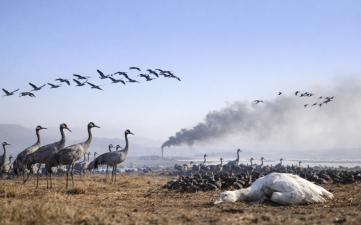
Recent reports reveal a sharp decline in global migratory species. Nearly half of the species protected under the Convention on Migratory Species (CMS) show decreasing populations. Bird flu (HPAI H5N1) has emerged as a severe threat, causing mass deaths among many vulnerable birds and aquatic mammals. These findings will be discussed at the CMS COP15 meeting in Brazil in March 2026.
Global Status of Migratory Species
Almost 49% of CMS-listed species now face population declines, up from 44% two years ago. Around 24% of these species are threatened with extinction, a 2% increase since 2024. The report re-assessed 386 species; 26 moved to more threatened categories, including many shorebirds. Some species showed improvement, such as the Saiga Antelope and Mediterranean Monk Seal.
Impact of Bird Flu on Wildlife
Bird flu H5N1 has caused mass mortality in critically endangered and vulnerable species like African Penguins, Humboldt Penguins, and Dalmatian Pelicans. The disease affects migratory birds across continents, adding pressure on already stressed populations. Aquatic mammals such as South American Sea Lions and Fur Seals have also suffered deaths.
Threats Beyond Disease
Habitat loss, climate change, and expanding infrastructure like roads and pipelines disrupt migration routes. For example, Mongolian Gazelle mobility has sharply declined due to increased traffic barriers. Land use changes have drastically reduced populations like the Mara-Loita Blue Wildebeest. Raptors face threats from illegal hunting, poisoning, and collisions with energy infrastructure.
Conservation Efforts and Challenges
Some species have shown recovery due to conservation efforts and improved habitats. However, many species remain at risk due to combined threats of disease, habitat fragmentation, and climate change. The CMS COP15 meeting aims to strengthen global actions for migratory species protection and habitat connectivity.
Topics for Prelims:
Convention on Migratory Species (CMS)
- Legally binding UN treaty for migratory wildlife conservation.
- Protects over 1,200 species worldwide.
- CMS COP15 held in Brazil, March 2026.
- Focus on population trends and threats to migratory species.
- Promotes habitat connectivity and international cooperation.
Highly Pathogenic Avian Influenza (HPAI) H5N1
- Deadly bird flu virus affecting wild and domestic birds.
- Causes mass mortality in vulnerable migratory birds.
- Spread across continents including Africa, Asia, Europe, South America.
- Threatens aquatic mammals like sea lions and fur seals.
- Increases mortality in already endangered species.
Migratory Species and Threats
- Nearly half of CMS species show declining populations.
- Main threats – habitat loss, climate change, disease, infrastructure.
- Species affected include shorebirds, penguins, raptors, marine mammals.
- Population declines linked to habitat fragmentation and illegal hunting.
- Conservation status updates show some species improving, others worsening.
Questions for Mains:
- Discuss in the light of recent reports, how disease outbreaks like Highly Pathogenic Avian Influenza (HPAI) impact migratory species and global biodiversity. [GS-III-Environment & DM]
- Critically examine the role of international treaties such as the Convention on Migratory Species in addressing habitat fragmentation and species decline. [GS-II-International Relations]
- Explain the effects of infrastructure development on wildlife migration corridors, and discuss mitigation strategies with suitable examples. [GS-III-Environment & DM]
- With suitable examples, discuss the challenges and successes of species conservation efforts in reversing population declines amidst climate change and human pressures. [GS-III-Economic Development]
Answer Hints:
1. Discuss in the light of recent reports, how disease outbreaks like Highly Pathogenic Avian Influenza (HPAI) impact migratory species and global biodiversity. [GS-III-Environment & DM]
- HPAI H5N1 causes mass mortality in vulnerable migratory birds (e.g., African Penguins, Humboldt Penguins, Dalmatian Pelicans) across continents.
- Disease outbreaks increase mortality rates, especially in long-lived species sensitive to population changes, accelerating decline trends.
- Impacts extend to aquatic mammals like South American Sea Lions and Fur Seals, showing cross-species vulnerability.
- HPAI adds pressure on already threatened species, exacerbating extinction risks and reducing biodiversity resilience.
- Spread of disease linked to migratory routes, complicating international conservation efforts.
- Long-term ecological impacts uncertain but likely to disrupt ecosystem functions dependent on migratory species.
2. Critically examine the role of international treaties such as the Convention on Migratory Species in addressing habitat fragmentation and species decline. [GS-II-International Relations]
- CMS is a legally binding UN treaty protecting over 1,200 migratory species globally through international cooperation.
- It promotes habitat connectivity and coordinated conservation actions across countries, essential for migratory species survival.
- CMS COP meetings (e.g., COP15 in Brazil) provide platforms to update conservation status and strategize responses to emerging threats.
- Challenges include enforcement gaps, varying national priorities, and addressing complex threats like disease and climate change.
- CMS facilitates data sharing, species reassessment, and prioritization, helping address habitat fragmentation and population declines.
- Success depends on integration with other treaties, funding, and stakeholder engagement at local and global levels.
3. Explain the effects of infrastructure development on wildlife migration corridors, and discuss mitigation strategies with suitable examples. [GS-III-Environment & DM]
- Infrastructure like roads, railways, fences, and pipelines fragment habitats, disrupt migration routes, and reduce species mobility.
- Example – Mongolian Gazelle mobility declined due to increased traffic volume and barriers, affecting survival and reproduction.
- Land use changes caused Mara-Loita Blue Wildebeest population to decline by 75% due to habitat loss and fragmentation.
- Mitigation includes wildlife corridors, overpasses/underpasses, fencing designs allowing safe passage, and strategic land-use planning.
- Community involvement and environmental impact assessments are critical to minimize infrastructure impacts.
- Integrating climate adaptation measures ensures corridors remain functional under changing conditions.
4. With suitable examples, discuss the challenges and successes of species conservation efforts in reversing population declines amidst climate change and human pressures. [GS-III-Economic Development]
- Challenges – habitat loss, climate change, illegal hunting, disease outbreaks (e.g., bird flu), and infrastructure development continue to threaten species.
- Success stories include Saiga Antelope’s rebound in Kazakhstan (Endangered to Near Threatened) due to disease management and habitat protection.
- Mediterranean Monk Seal improved from Endangered to Vulnerable owing to population growth under 1,000 individuals.
- Scimitar-horned Oryx re-classified from Extinct in the Wild to Endangered due to reintroduction efforts in Chad.
- Conservation requires integrated approaches – habitat restoration, legal protection, community engagement, and international cooperation.
- Climate change complicates conservation by altering habitats and species behavior, requiring adaptive management strategies.