
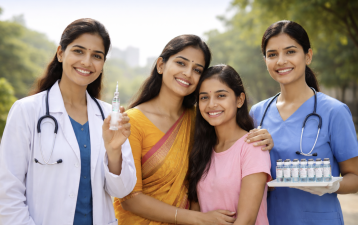
India began a nationwide rollout of the human papillomavirus (HPV) vaccine in 2026. The campaign started in Ajmer on February 28 and will run for three months. It targets voluntary vaccination of 14-year-old girls. After this, the vaccine will be available free at all government centres. Cervical cancer is the second most common cancer among Indian women and the fourth globally. Every seven minutes, a woman dies from cervical cancer in India.
HPV and Cervical Cancer
HPV causes nearly 70% of cervical cancer cases. Over 80% of sexually active people get HPV at some point. Most infections clear naturally without harm. HPV has more than 100 strains; 14 are linked to cancer. The vaccine Gardasil 4 covers types 16 and 18, which cause most cancers, and types 6 and 11, causing genital warts. Other vaccines include Cervarix, Cervavac, and Gardasil-9, which covers more strains.
Vaccine Benefits and Challenges
Experts debate the vaccine’s impact. Some say cervical cancer rates are already falling. Others argue for better sanitation and health infrastructure. Concerns exist about the one-dose regimen India adopted. Protection may need boosters since cancer risk peaks decades later. Vaccine-induced strain replacement is a debated risk but seems unlikely. Past vaccine projects faced setbacks due to safety fears and consent issues.
Social Barriers and Awareness
Social myths hinder vaccine acceptance. Many rural and low-income groups lack awareness. Some wrongly believe the vaccine causes sterility or promotes early sexual activity. Confusion with HIV also exists. School health programmes and community education are vital to combat misinformation. Parental education and attitudes strongly influence vaccine uptake. Integrating HPV awareness with adolescent health schemes can improve acceptance.
Screening and Future Directions
Vaccination alone cannot eliminate cervical cancer. Screening methods like Pap smears and VIA remain underused, below 2%. Self-sampling for HPV testing is promising but costly. WHO’s 90-70-90 target for cervical cancer elimination requires vaccination, screening, and treatment. Expanding vaccination to boys and LGBTQ+ groups is important for broader protection. Combined efforts in education, vaccination, and screening are key.
Topics for Prelims:
Human Papillomavirus (HPV)
- HPV has over 100 strains; 14 cause cancer.
- Types 16 and 18 cause 70% of cervical cancers.
- HPV is a common sexually transmitted infection.
- Most HPV infections clear naturally.
- Vaccines prevent high-risk HPV infections.
HPV Vaccines in India
- Gardasil 4 covers HPV types 6, 11, 16, 18.
- Cervarix and Cervavac are other approved vaccines.
- India uses a one-dose vaccination schedule.
- Vaccination started in Ajmer in 2026.
- Vaccines are free at government centres post-campaign.
Cervical Cancer in India
- Second most common cancer among Indian women.
- A death occurs every seven minutes due to cervical cancer.
- Risk factors include early sexual activity and smoking.
- Screening uptake is below 2% in India.
- WHO aims to eliminate cervical cancer by 2030.
Questions for Mains:
- Discuss in the light of India’s HPV vaccine rollout, the role of vaccination and public health education in controlling communicable diseases. [GS-III-Economic Development]
- Critically examine the challenges posed by social myths and misinformation in vaccine acceptance, with examples from HPV and COVID-19 vaccination drives in India. [GS-II-Governance]
- Explain the importance of integrating vaccination, screening, and treatment in the elimination of cervical cancer, and discuss how such integrated approaches can be applied to other non-communicable diseases. [GS-III-Science & Technology]
- With suitable examples, discuss the significance of gender-neutral vaccination policies and inclusion of marginalized communities in public health programmes. Comment on their impact on disease control. [GS-II-International Relations]
Answer Hints:
1. Discuss in the light of India’s HPV vaccine rollout, the role of vaccination and public health education in controlling communicable diseases. [GS-III-Economic Development]
- Vaccination prevents infection by targeting causative agents (e.g., HPV vaccine prevents high-risk HPV strains causing cervical cancer).
- India’s HPV rollout targets adolescent girls, aiming to reduce cervical cancer burden and future healthcare costs.
- Public health education combats myths, improves awareness, and increases vaccine uptake (critical in rural and low-income areas).
- Combining vaccination with education ensures informed consent, reduces hesitancy, and addresses cultural barriers.
- Vaccination campaigns reduce disease incidence, transmission, and long-term economic burden on healthcare systems.
- Example – HPV vaccine rollout complements existing health programmes (RKSK), showing integrated public health strategy effectiveness.
2. Critically examine the challenges posed by social myths and misinformation in vaccine acceptance, with examples from HPV and COVID-19 vaccination drives in India. [GS-II-Governance]
- Social myths (e.g., vaccine causes sterility, promotes early sexual activity) reduce HPV vaccine acceptance, especially in conservative communities.
- Confusion between HPV vaccine and HIV or fear of side effects (e.g., deaths in 2009 HPV pilot projects) fuel mistrust.
- COVID-19 vaccination faced similar misinformation – fears about safety, conspiracy theories, and vaccine hesitancy.
- Low awareness and poor communication exacerbate misinformation, especially in rural and socio-economically weaker groups.
- Effective governance requires transparent communication, community engagement, and involvement of trusted local leaders.
- Combating misinformation needs integration of education, media campaigns, and addressing cultural sensitivities to improve vaccine uptake.
3. Explain the importance of integrating vaccination, screening, and treatment in the elimination of cervical cancer, and discuss how such integrated approaches can be applied to other non-communicable diseases. [GS-III-Science & Technology]
- Vaccination (HPV vaccine) prevents initial infection, reducing future cancer risk.
- Screening (Pap smear, VIA, HPV self-sampling) detects precancerous changes early for timely intervention.
- Treatment of detected lesions/cancer is essential to reduce mortality and morbidity.
- India’s low screening uptake (<2%) marks need for combined efforts to achieve WHO’s 90-70-90 target.
- Integrated approach ensures comprehensive disease control, addressing prevention, early detection, and management.
- Similar models apply to other NCDs (e.g., diabetes – prevention through lifestyle, screening for early detection, treatment adherence).
4. With suitable examples, discuss the significance of gender-neutral vaccination policies and inclusion of marginalized communities in public health programmes. Comment on their impact on disease control. [GS-II-International Relations]
- Gender-neutral vaccination (including boys and LGBTQ+ groups) broadens herd immunity and reduces HPV transmission.
- Marginalized communities often face higher disease burden and lower access; inclusion ensures equity and wider coverage.
- Example – Expanding HPV vaccination beyond girls helps protect men from HPV-related cancers and interrupts virus circulation.
- Inclusive policies encourage social justice, reduce health disparities, and strengthen public trust in health systems.
- Global health frameworks (e.g., WHO) emphasize equity and inclusivity for effective disease control and elimination.
- Such inclusive approaches improve overall public health outcomes and accelerate progress towards disease elimination goals.