
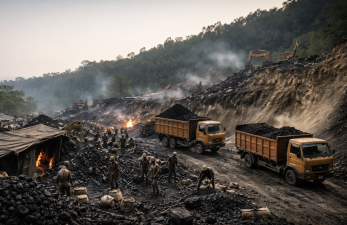
In February 2026, a dynamite explosion in an illegal coal mine in East Jaintia Hills, Meghalaya, killed 34 labourers. This tragic event marks longstanding issues of unregulated coal mining in the region. Although official coal mining began in Meghalaya only in 2025, illegal and primitive ‘rat-hole mining’ has existed for decades. This mining method poses serious risks to people, environment, and local communities.
Background of Coal Mining in Meghalaya
Coal mining in Meghalaya officially started mid-2025 with government permits for two coal blocks. However, ‘rat-hole mining’—a small-scale, manual mining method—has been widespread for years. Land ownership under the Sixth Schedule means land belongs to communities, not the government. Local landowners have conducted mining without scientific methods or environmental clearances. The National Green Tribunal banned rat-hole mining in 2014 due to safety and environmental concerns, but illegal operations continued.
Environmental and Social Impact
Mining beneath natural caves and farmland in East Jaintia Hills has destabilised hills, causing collapses and threatening crops and homes. The region hosts some of South Asia’s longest caves, which are endangered by mining. Mining waste has polluted water sources, forcing residents to buy safe water. Fear and violence surround mining areas, silencing local opposition. Labourers work in unsafe conditions without safety gear or legal protections, suffering exploitation and health hazards.
Regulatory Challenges and Mapping Issues
Despite bans and court orders, illegal mining persists due to weak enforcement and corruption. Police and officials sometimes allow illegal coal transport after bribes. Land mapping in Meghalaya is two-dimensional, ignoring underground mining impacts. The lack of three-dimensional mapping prevents accurate assessment of mining damage and mineral extraction. Recommendations for drone surveys and 3D mapping remain poorly implemented.
Labour and Safety Concerns
Most miners are informal workers paid poorly and exposed to hazardous gases. Accidents and deaths are common, but many avoid medical help fearing arrest. The presence of state machinery in illegal mining creates a perception of informal protection. Mining-related violence and intimidation prevent community resistance. Workers’ rights and safety remain severely neglected.
Topics for Prelims:
Meghalaya Rat-Hole Mining
- Primitive coal mining method using manual labour and small machinery.
- Illegal and banned by National Green Tribunal since 2014.
- Causes environmental damage and hill collapses.
- Threatens natural caves and tribal livelihoods.
- Associated with violence and labour exploitation.
Sixth Schedule and Land Ownership
- Provides autonomy to tribal areas in Northeast India.
- Land owned by communities, not government.
- Limits government control over mining activities.
- Leads to small-scale local mining practices.
- Complicates enforcement of mining laws.
National Green Tribunal Orders on Mining
- Banned rat-hole mining in Meghalaya in 2014.
- Directed stoppage of illegal coal transport without royalty.
- Upheld by Supreme Court in 2018.
- Established monitoring committees for enforcement.
- Implementation remains weak with continued violations.
Questions for Mains:
- Discuss the impact of the Sixth Schedule on natural resource management in tribal areas of Northeast India with examples from Meghalaya. [GS-II-Constitution of India & Polity]
- Critically examine the role of the National Green Tribunal in regulating environmental issues in India, with reference to illegal mining cases. [GS-II-Governance]
- Explain the environmental and social consequences of unscientific mining practices and suggest sustainable alternatives. [GS-III-Environment & DM]
- With suitable examples, discuss the challenges of enforcing labour rights and safety in informal sectors such as illegal mining in India. [GS-I-Indian Society]
Answer Hints:
1. Discuss the impact of the Sixth Schedule on natural resource management in tribal areas of Northeast India with examples from Meghalaya. [GS-II-Constitution of India & Polity]
- The Sixth Schedule grants autonomous councils power over land and resource management in tribal areas, recognizing community ownership.
- In Meghalaya, land is communally owned, limiting state and central government control over mining and resource exploitation.
- This autonomy results in small-scale, locally controlled mining (e.g., rat-hole mining) rather than large corporate or government operations.
- Community ownership complicates enforcement of environmental and mining regulations due to fragmented authority.
- While protecting tribal rights, it creates challenges in balancing development, environment, and safety standards.
- Example – Illegal coal mining continues despite bans, partly due to community land rights and limited external oversight.
2. Critically examine the role of the National Green Tribunal in regulating environmental issues in India, with reference to illegal mining cases. [GS-II-Governance]
- NGT banned rat-hole mining in Meghalaya in 2014 citing environmental degradation and worker safety concerns.
- It directed stoppage of illegal coal transport without royalty payment, aiming to curb unregulated mining.
- The Supreme Court upheld NGT’s orders and constituted monitoring committees (e.g., Justice BP Katakey Committee) for enforcement.
- Despite legal interventions, enforcement remains weak due to corruption, local resistance, and administrative lapses.
- NGT’s role marks judicial activism in environmental governance but also exposes implementation challenges on ground.
- NGT sets precedent for environmental adjudication but requires stronger cooperation with state agencies for effective outcomes.
3. Explain the environmental and social consequences of unscientific mining practices and suggest sustainable alternatives. [GS-III-Environment & DM]
- Unscientific rat-hole mining causes hill collapses, destabilizing land and threatening natural caves and farmlands.
- Mining waste pollutes water sources, turning them acidic and unsafe, forcing residents to buy potable water.
- Local communities face livelihood loss, fear of land collapse, and health hazards due to pollution and unsafe working conditions.
- Labourers work without safety gear, facing exploitation, accidents, and lack of legal protections.
- Sustainable alternatives include scientific underground mining with environmental clearances, 3D mapping, and safety protocols.
- Community involvement, strict enforcement, and promotion of alternative livelihoods can reduce dependence on harmful mining.
4. With suitable examples, discuss the challenges of enforcing labour rights and safety in informal sectors such as illegal mining in India. [GS-I-Indian Society]
- Informal mining workers lack contracts, minimum wages, safety equipment, and social security benefits.
- Fear of arrest and illegal status prevent workers from accessing healthcare or reporting accidents.
- Presence of corrupt officials and informal protection by state machinery perpetuate illegal operations and exploitation.
- Violence and intimidation (e.g., killings in Meghalaya mining areas) suppress worker and community resistance.
- Example – Meghalaya rat-hole miners work in hazardous conditions without safety gear, exposed to toxic gases and accidents.
- Enforcement is hindered by weak regulation, lack of awareness, and socio-political complexities in tribal regions.