
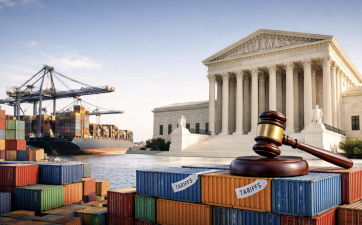
The U.S. Supreme Court recently ruled that the International Emergency Economic Powers Act (IEEPA) does not permit the President to impose tariffs. This decision struck down the tariffs imposed by former President Donald Trump in 2025. The ruling clarifies the constitutional limits on presidential trade authority and emphasises Congress’s role in tariff legislation.
Background of the Tariff Dispute
The IEEPA, enacted in 1977, allows the President to regulate economic activities during a declared national emergency. It originated from the 1917 Trading with the Enemy Act, designed to control trade with hostile nations. Trump used the IEEPA to impose tariffs on imports from Canada, Mexico, China, and other countries, citing national emergencies related to drug trafficking and trade imbalances. These tariffs were unprecedented under IEEPA and sparked legal challenges.
Supreme Court’s Constitutional Reasoning
The Court ruled 6-3 that only Congress has the authority to impose tariffs, as per the U.S. Constitution. Tariffs are a form of taxation and trade regulation, powers explicitly granted to Congress. The Court found no clear congressional authorisation for the President’s unilateral tariff imposition under IEEPA. Chief Justice John Roberts brought into light the broad and indefinite nature of Trump’s tariffs as unconstitutional.
Alternative Legal Routes for Tariffs
Following the ruling, the Trump administration announced new tariffs under different laws. These include – – Section 122 of the Trade Act of 1974, allowing temporary tariffs for balance-of-payments deficits. – Section 301 of the Trade Act of 1974, addressing unfair trade practices. – Section 232 of the Trade Expansion Act of 1962, permitting tariffs for national security reasons. These laws require more specific conditions and often involve Congressional oversight.
Impact on Businesses and Future Trade Policy
The invalidated tariffs collected around $180 billion, affecting many U.S. businesses and consumers. Several companies have filed lawsuits seeking refunds. The ruling sets a precedent limiting executive power in trade policy, reinforcing the need for legislative backing. Future Presidents must work within clearer statutory boundaries when imposing tariffs.
Topics for Prelims:
International Emergency Economic Powers Act (IEEPA)
- Enacted in 1977 to regulate economic activity during national emergencies.
- Originated from the 1917 Trading with the Enemy Act.
- Allows freezing assets and imposing sanctions.
- Did not authorise tariff imposition before 2025.
- Used by Trump to impose tariffs on multiple countries.
U.S. Tariff Laws and Sections
- Section 122 allows tariffs up to 15% for balance-of-payments deficits.
- Section 301 targets unfair trade practices by foreign countries.
- Section 232 permits tariffs on national security grounds.
- All require specific conditions and sometimes Congressional approval.
- Used as alternatives after IEEPA ruling.
U.S. Supreme Court Ruling on Tariffs
- Ruled 6-3 against presidential tariff powers under IEEPA.
- Emphasised Congress’s constitutional authority over tariffs.
- Declared Trump’s tariffs unconstitutional.
- Set precedent limiting executive overreach in trade policy.
- Prompted administration to seek alternative legal routes.
Questions for Mains:
- Critically analyse the constitutional division of trade and tariff powers between the U.S. Congress and the President, with suitable examples. [GS-II-Constitution of India & Polity]
- Comment on the role of emergency powers in economic policy, and discuss their limits in a democratic setup. [GS-II-Governance]
- Explain the impact of unilateral tariff impositions on international trade relations, and assess how multilateral frameworks can address such issues. [GS-II-International Relations]
- What are the implications of judicial review on executive economic decisions, and how does it affect policy continuity and stability? Critically analyse. [GS-II-Constitution of India & Polity]
Answer Hints:
1. Critically analyse the constitutional division of trade and tariff powers between the U.S. Congress and the President, with suitable examples. [GS-II-Constitution of India & Polity]
- The U.S. Constitution vests the power to lay and collect taxes, duties, imposts and excises and regulate foreign trade exclusively with Congress.
- Tariffs are a form of taxation and trade regulation, hence fall under congressional authority.
- The President can act only within powers delegated by Congress through statutes (e.g., Trade Act sections 122, 301, 232).
- Example – Trump’s use of IEEPA (a 1977 statute) to impose tariffs was struck down as unconstitutional for lacking clear congressional authorisation.
- Congress can expand, limit, or require oversight on presidential trade powers, ensuring checks and balances.
- Judicial rulings reinforce the constitutional separation, preventing executive overreach in trade policy.
2. Comment on the role of emergency powers in economic policy, and discuss their limits in a democratic setup. [GS-II-Governance]
- Emergency powers (e.g., IEEPA) allow the executive to act swiftly during unusual and extraordinary threats affecting the economy.
- They enable freezing assets, imposing sanctions, and regulating economic transactions during crises.
- Limits exist to prevent abuse – powers must be clearly authorised by legislation and are subject to judicial review.
- Democratic setups require transparency, accountability, and legislative oversight to safeguard rights and prevent executive overreach.
- Example – Supreme Court struck down tariffs imposed under IEEPA as exceeding intended emergency scope.
- Emergency powers should be temporary, specific, and proportional to the threat to maintain democratic balance.
3. Explain the impact of unilateral tariff impositions on international trade relations, and assess how multilateral frameworks can address such issues. [GS-II-International Relations]
- Unilateral tariffs disrupt global supply chains, increase costs for businesses and consumers, and provoke retaliatory measures.
- They can strain bilateral relations, reduce trust, and escalate trade conflicts or trade wars.
- Example – Trump’s tariffs on China, Canada, Mexico, and others led to diplomatic friction and legal challenges.
- Multilateral frameworks like the WTO promote rules-based trade, dispute resolution, and discourage arbitrary tariffs.
- They encourage negotiation, transparency, and collective enforcement to manage trade disputes peacefully.
- Such frameworks limit unilateral actions by requiring justification and adherence to agreed rules, preserving global trade stability.
4. What are the implications of judicial review on executive economic decisions, and how does it affect policy continuity and stability? Critically analyse. [GS-II-Constitution of India & Polity]
- Judicial review ensures executive actions comply with constitutional and statutory limits, preventing arbitrary or unlawful decisions.
- It acts as a check on executive overreach, reinforcing rule of law and protecting democratic governance.
- Example – Supreme Court invalidated Trump’s tariffs under IEEPA, emphasizing need for clear legislative backing.
- While it promotes legality, judicial intervention can create uncertainty or delays in policy implementation.
- Frequent judicial reversals may affect investor confidence and policy continuity but encourage better legislative clarity.
- Overall, judicial review balances executive agility with constitutional safeguards, encouraging stable and accountable economic governance.