
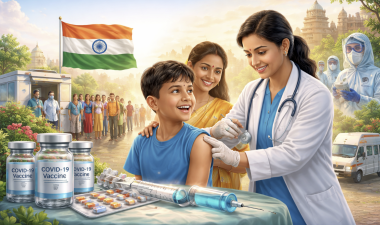
India’s vaccination programme has achieved remarkable success by eradicating deadly diseases and expanding immunisation coverage. On National Vaccination Day, March 16, the nation marks vaccines’ role in saving lives and strengthening healthcare. This success stems from decades of sustained efforts and innovations.
Disease Eradication and Immunisation Milestones
India has eliminated smallpox, polio, and maternal and neonatal tetanus through vaccination. The last polio case was in 2011 under the Pulse Polio Programme started in 1995. Vaccines have also reduced child mortality and controlled diseases like measles, rubella, and tuberculosis. These achievements show vaccines as a key public health tool.
Universal Immunisation Programme and Coverage
Launched in 1985, the Universal Immunisation Programme (UIP) provides free vaccines to nearly 2.9 crore pregnant women and 2.54 crore newborns annually. Immunisation coverage rose from 62% in 2015 to 98.4% in 2026. Zero-dose children decreased , reflecting strong healthcare networks, cold chains, and digital monitoring.
Expanding Vaccine Range and Innovation
India expanded its vaccine basket to include Inactivated Polio Vaccine, Rotavirus, Measles-Rubella, and Pneumococcal vaccines. In 2026, two key initiatives launched – an indigenously developed Tetanus-Diphtheria vaccine and a nationwide Human Papillomavirus (HPV) vaccination campaign for 14-year-old girls to prevent cervical cancer. India produces 60% of the world’s vaccines, showing growing self-reliance.
Last Mile Delivery and Technology Use
Mission Indradhanush, started in 2015, targets unvaccinated children and pregnant women, covering over 5.46 crore children and 1.32 crore women. Vaccines reach people through Primary Health Centres, Community Health Centres, hospitals, and outreach camps with frontline workers like ASHAs and Anganwadi staff. Digital tools like CoWIN, U-WIN, and eVIN ensure efficient tracking and cold-chain management.
Topics for Prelims:
Universal Immunisation Programme (UIP)
- Started in 1985 by Ministry of Health and Family Welfare.
- Provides free vaccines to pregnant women and newborns annually.
- Coverage increased from 62% in 2015 to 98.4% in 2026.
- Supports over 1.3 crore immunisation sessions yearly.
- Uses digital platforms for monitoring and delivery.
Mission Indradhanush
- Launched in 2015 to improve vaccine coverage.
- Targets unvaccinated and partially vaccinated children and pregnant women.
- Covered over 5.46 crore children and 1.32 crore pregnant women.
- Operates in remote and underserved districts.
- Relies on frontline workers like ASHAs and Anganwadi staff.
Vaccine Innovation and Production
- India produces nearly 60% of global vaccines.
- Introduced new vaccines like IPV, Rotavirus, Measles-Rubella, and Pneumococcal.
- Launched indigenous Tetanus-Diphtheria vaccine in 2026.
- Started nationwide HPV vaccination campaign in 2026.
- Supports self-reliance and global vaccine supply.
Questions for Mains:
- Discuss in the light of India’s Universal Immunisation Programme how large-scale vaccination drives contribute to public health and national development. [GS-III-Economic Development]
- Analyse the role of technology platforms like CoWIN and eVIN in improving vaccine delivery and healthcare transparency in India. [GS-III-Science & Technology]
- With suitable examples, examine the challenges and strategies involved in reaching the last mile in India’s immunisation efforts. Critically discuss the role of frontline health workers in this context. [GS-II-Governance]
- Taking example of India’s eradication of polio and smallpox, discuss the importance of sustained vaccination campaigns in controlling communicable diseases globally. How can these lessons be applied to emerging health threats? [GS-I-Modern World History]
Answer Hints:
1. Discuss in the light of India’s Universal Immunisation Programme how large-scale vaccination drives contribute to public health and national development. [GS-III-Economic Development]
- UIP launched in 1985 provides free vaccines to millions annually, improving population immunity.
- Immunisation coverage rose from 62% in 2015 to 98.4% in 2026, reducing disease burden and child mortality.
- Vaccination prevents outbreaks, lowers healthcare costs, and reduces economic losses due to illness.
- Healthy children lead to better educational outcomes and future workforce productivity.
- Large-scale vaccination strengthens healthcare infrastructure and cold-chain logistics.
- Contributes to national development by improving life expectancy and socio-economic stability.
2. Analyse the role of technology platforms like CoWIN and eVIN in improving vaccine delivery and healthcare transparency in India. [GS-III-Science & Technology]
- CoWIN enabled efficient large-scale COVID-19 vaccination with real-time registration and tracking.
- eVIN monitors vaccine stocks and cold chain temperatures, preventing wastage and stockouts.
- U-WIN platform supports routine immunisation tracking and beneficiary management.
- Digital tools improve transparency, data accuracy, and accountability in vaccine delivery.
- Technology facilitates last-mile delivery by identifying gaps and optimizing resource allocation.
- Enhances public trust through accessible information and timely updates.
3. With suitable examples, examine the challenges and strategies involved in reaching the last mile in India’s immunisation efforts. Critically discuss the role of frontline health workers in this context. [GS-II-Governance]
- Challenges include remote locations, vaccine hesitancy, socio-economic barriers, and infrastructure gaps.
- Mission Indradhanush targets unvaccinated/partially vaccinated children and pregnant women in underserved areas.
- Frontline workers like ASHAs and Anganwadi staff play critical roles in awareness, mobilization, and vaccine administration.
- Use of outreach camps and Primary Health Centres ensures accessibility in difficult terrains.
- Cold-chain maintenance and digital tracking (eVIN) support last-mile delivery effectiveness.
- Community engagement and trust-building are essential to overcome resistance and misinformation.
4. Taking example of India’s eradication of polio and smallpox, discuss the importance of sustained vaccination campaigns in controlling communicable diseases globally. How can these lessons be applied to emerging health threats? [GS-I-Modern World History]
- India eradicated polio (last case in 2011) and smallpox through persistent, nationwide vaccination drives.
- Pulse Polio Programme (1995) exemplifies targeted, repeated immunisation campaigns for disease elimination.
- Sustained efforts build herd immunity, interrupt transmission, and prevent resurgence.
- Lessons include importance of political will, community participation, and robust surveillance.
- Application to emerging threats requires rapid vaccine development, mass coverage, and global cooperation.
- Integration of technology and frontline workers ensures timely response and equitable access.