
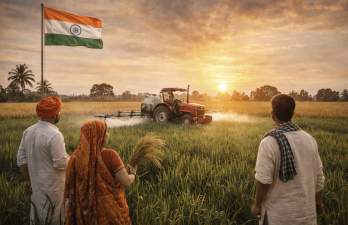
India’s agriculture sector continues to be a backbone of the economy and rural livelihoods. In 2024-25, the country achieved record foodgrain production of 357.73 million metric tonnes. This growth was driven by higher outputs in rice, wheat, maize, and coarse cereals. Horticulture also reached a new high, with 362.08 million tonnes produced, reflecting a shift towards high-value crops.
Production and Crop Leadership
India ranks among the top global producers in several key crops. It is the second-largest producer of rice and wheat, with major production in Uttar Pradesh, Punjab, and West Bengal. India leads the world in pulses and millet production, with Madhya Pradesh and Rajasthan as key states. In horticulture, India is the second-largest producer of fruits and vegetables. It also leads globally in dry onion and coconut production. High-value cash crops such as sugarcane, cotton, tea, spices, and coffee contribute to the economy and exports.
Policy and Support Measures
The government has increased budgetary support for agriculture, with Rs. 1.30 lakh crore allocated in 2026-27. Key missions focus on self-reliance in pulses, edible oils, and food security. Initiatives like the Soil Health Card and Pradhan Mantri Krishi Sinchayee Yojana improve soil quality and irrigation. The Kisan Credit Card scheme and custom hiring centres enhance access to credit and mechanisation. Crop insurance under Pradhan Mantri Fasal Bima Yojana protects farmers from risks.
Market Reforms and Infrastructure
Digital platforms such as e-National Agriculture Market (e-NAM) connect farmers with markets, improving price discovery and transparency. Over 49,000 storage projects and thousands of Farmer Producer Organisations (FPOs) strengthen supply chains. Food processing schemes like PMKSY and PMFME promote value addition and rural employment. Public procurement and the One Nation One Ration Card scheme ensure food security and efficient distribution.
Global Trade and Sustainability
India’s agricultural exports reached USD 51.1 billion in FY25, with processed foods gaining prominence. The sector aligns with Sustainable Development Goals, addressing hunger, climate action, and responsible production. Focus on sustainable farming and technology adoption supports long-term resilience and economic growth.
Topics for Prelims:
India’s Major Crops
- India is the second-largest producer of rice and wheat globally.
- It leads the world in pulses, millets, dry onion, and coconut production.
- Major producing states for rice include Uttar Pradesh and West Bengal.
- Pulses are mainly produced in Madhya Pradesh, Maharashtra, and Rajasthan.
- Horticulture output reached 362.08 million tonnes in 2024-25.
Key Agricultural Schemes
- Pradhan Mantri Fasal Bima Yojana provides crop insurance to millions of farmers.
- Soil Health Card scheme promotes balanced fertiliser use based on soil testing.
- Kisan Credit Card scheme offers timely credit to farmers.
- e-NAM integrates agricultural markets digitally across India.
- PM-KISAN provides direct income support to farmers.
Questions for Mains:
- Discuss in the light of India’s agricultural growth, how technological interventions have enhanced productivity and farmer welfare. [GS-III-Economic Development]
- Analyse the impact of digital market platforms like e-National Agriculture Market (e-NAM) on the agricultural supply chain and price transparency in India. [GS-III-Economic Development]
- Examine the role of government schemes such as Pradhan Mantri Fasal Bima Yojana and Soil Health Card in managing agricultural risks and promoting sustainable farming. [GS-III-Environment & DM]
- With suitable examples, discuss India’s position in global agricultural markets and how diversification of crops contributes to food and nutrition security. [GS-II-International Relations]
Topics for Prelims:
India’s Major Crops
- India is the second-largest global producer of rice and wheat.
- Leads in pulses and millet production worldwide.
- Dry onion production accounts for 25% of global output.
- Major rice-producing states – Uttar Pradesh, Telangana, West Bengal.
- Key pulse producing states – Madhya Pradesh, Maharashtra, Rajasthan.
Key Agricultural Schemes
- Pradhan Mantri Fasal Bima Yojana insures over 4 crore farmers.
- Soil Health Card scheme covers 25 crore soil samples.
- Kisan Credit Card scheme has 7.7 crore operative accounts.
- e-NAM connects 1.8 crore farmers and 4,700 FPOs digitally.
- PM-KISAN disbursed Rs. 4.27 lakh crore in direct farmer support.
Answer Hints:
1. Discuss in the light of India’s agricultural growth, how technological interventions have enhanced productivity and farmer welfare. [GS-III-Economic Development]
- Improved input management – Quality seeds (SMSP scheme producing 1,649.26 lakh quintals), balanced fertiliser use guided by 25.55 crore Soil Health Cards.
- Expansion of irrigation – PMKSY increased gross irrigated area to 55.8%, promoting micro-irrigation (drip, sprinkler) for water-use efficiency.
- Mechanisation access – 27,554 Custom Hiring Centres providing farm machinery to smallholders, enhancing timeliness and reducing labor costs.
- Credit availability – 7.72 crore operative Kisan Credit Card accounts facilitating timely, affordable institutional credit for cultivation and allied activities.
- Livestock technology – Large-scale vaccinations (125 crore FMD) and artificial inseminations (88.32 million) boosting productivity in allied sectors.
- Natural farming & extension – 17,632 clusters covering 6.39 lakh hectares with 15.79 lakh farmers enrolled, promoting sustainable practices.
2. Analyse the impact of digital market platforms like e-National Agriculture Market (e-NAM) on the agricultural supply chain and price transparency in India. [GS-III-Economic Development]
- Market integration – e-NAM connects 1.8 crore farmers, 2.72 lakh traders, and 4,724 FPOs across 1,656 mandis in 23 states and 4 UTs, enabling unified trading.
- Price discovery – Online bidding and AI-based quality assaying improve transparency and competitiveness in price setting.
- Reduction of intermediaries – Direct e-payment to farmers reduces delays and leakages.
- Enhanced market access – Farmers can sell beyond local mandis, expanding demand and reducing regional price disparities.
- Improved supply chain efficiency – Digital platform facilitates quicker transactions and better inventory management.
- Supports farmer collectives – Integration of thousands of FPOs strengthens collective bargaining power and market linkage.
3. Examine the role of government schemes such as Pradhan Mantri Fasal Bima Yojana and Soil Health Card in managing agricultural risks and promoting sustainable farming. [GS-III-Environment & DM]
- PMFBY provides affordable crop insurance covering natural disasters, pests, and diseases, protecting 4.19 crore farmers and 6.2 crore hectares in 2024-25.
- Over Rs. 1.90 lakh crore claims disbursed since 2016-17, expanding risk mitigation and income stability.
- Soil Health Card scheme promotes balanced fertiliser use based on detailed soil nutrient analysis (12 parameters), issued to 25.55 crore landholdings.
- Improves soil fertility, reduces input costs, and prevents overuse of chemical fertilisers, supporting long-term sustainability.
- Both schemes contribute to resilience against climate variability and resource degradation.
- Complementary role – PMFBY manages external risks; Soil Health Cards improve internal resource management.
4. With suitable examples, discuss India’s position in global agricultural markets and how diversification of crops contributes to food and nutrition security. [GS-II-International Relations]
- Global leadership – 2nd largest producer of rice (150.18 MT) and wheat (117.94 MT), leading producer of pulses (25.68 MT), millets (18.59 MT), dry onion (25% global output), coconut, spices, and coffee.
- Export growth – Agricultural exports rose from USD 34.5 billion (FY20) to USD 51.1 billion (FY25), with processed foods increasing share from 14.9% to 20.4%.
- Diversification – Shift towards high-value horticulture (362.08 MT), fruits (114.51 MT), vegetables (219.67 MT), and cash crops like sugarcane, cotton, tea, spices, and coffee enhances nutrition and income.
- Regional strengths – Crop production aligned with agro-climatic zones (e.g., pulses in Madhya Pradesh, millets in Rajasthan, fruits in Andhra Pradesh), supporting sustainable local economies.
- Food and nutrition security – Diversified crop base reduces dependence on staple cereals, improves dietary diversity, and climate resilience.
- Policy support – Targeted promotion of region-specific high-value crops (coconut, sandalwood, cocoa, nuts) to harness agro-climatic advantages and economic returns.