
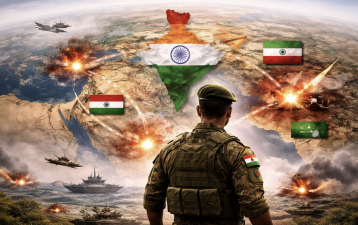
The sinking of the Iranian warship IRIS Dena by the United States in March 2026 has brought the West Asia conflict directly to South Asia’s doorstep. The war that began in late February has disrupted essential supplies such as food, fuel, and fertilisers. It has also threatened the safety of millions of South Asians living and working in West Asia. India, with its diaspora and maritime interests, faces complex diplomatic and security challenges.
Impact on South Asia and Diaspora
Around 25 million South Asians live in West Asia, including 10 million Indians. Others include Pakistanis, Bangladeshis, Nepalis, Sri Lankans, Bhutanese, and Maldivians. Many work as seafarers, especially near the Strait of Hormuz, a strategic chokepoint weaponised by Iran. The conflict has disrupted travel, trade, and remittances, affecting economies and families across the region. Energy shortages have led neighbouring countries to seek fuel from India, increasing pressure on its resources.
India’s Diplomatic Position
India’s initial response to the conflict was cautious and delayed. It took days to express condolences after Iran’s Supreme Leader Ayatollah Ali Khamenei was killed by U.S.-Israel strikes. This contrasted with immediate reactions from Pakistan, Bangladesh, and Sri Lanka, who condemned the attacks. India’s close ties with Israel and recent Prime Minister Narendra Modi’s visit to Israel influenced its stance. However, India now seeks a balanced approach to maintain goodwill with all West Asian nations.
Maritime Security and Regional Cooperation
The sinking of IRIS Dena near Sri Lanka shocked the region. India’s Navy assisted in rescue operations but did not publicly mourn the sailors’ deaths, raising questions. India’s role as a net security provider in the Indian Ocean is challenged by unilateral U.S. actions. Strengthening regional coalitions like the Indian Ocean Rim Association, Colombo Security Conclave, and Information Fusion Centre is vital. Enhanced regional trade, connectivity, and security dialogue are priorities.
Future Diplomatic and Economic Priorities
India will chair the Quad summit in 2026 and the BRICS summit, both crucial for regional stability and economic cooperation. Managing tensions within BRICS, especially involving Iran and the UAE, requires diplomatic finesse. India must restore its traditional balanced policy in West Asia to safeguard its interests and those of its neighbours. The focus will be on stabilising the maritime region and ensuring uninterrupted supply chains.
Topics for Prelims:
West Asia Conflict and South Asia
- War began on 28 February 2026 involving US, Israel, and Iran.
- IRIS Dena, an Iranian warship, sunk by the US near Sri Lanka.
- About 25 million South Asians live/work in West Asia.
- Strait of Hormuz is a key strategic maritime chokepoint.
- Conflict disrupted fuel, food, and trade in South Asia.
India’s Diplomatic and Security Role
- India delayed condolences after Iran’s Supreme Leader’s death.
- PM Modi visited Israel days before conflict escalated.
- India helped rescue Iranian sailors but did not publicly mourn.
- India is part of Quad and chairs BRICS in 2026.
- Strengthening regional coalitions like IORA and Colombo Security Conclave is key.
Questions for Mains:
- Critically discuss India’s balancing act in West Asia amidst rising US-Israel-Iran tensions and its impact on regional diplomacy. [GS-II-International Relations]
- Analyse the strategic importance of the Strait of Hormuz and its implications for Indian maritime security and energy supplies. [GS-III-Internal & External Security]
- Examine the role of regional coalitions such as the Indian Ocean Rim Association and Colombo Security Conclave in maintaining maritime stability in South Asia. How can India leverage these platforms effectively? [GS-II-Governance]
- Estimate the economic and social impact of West Asia conflicts on South Asian diaspora communities and remittance flows, and suggest policy responses for India. [GS-III-Economic Development]
Answer Hints:
1. Critically discuss India’s balancing act in West Asia amidst rising US-Israel-Iran tensions and its impact on regional diplomacy. [GS-II-International Relations]
- India’s initial cautious and delayed response to Iran’s Supreme Leader Khamenei’s killing contrasted with immediate condolences by Pakistan, Bangladesh, Sri Lanka, reflecting diplomatic sensitivity.
- PM Modi’s recent visit to Israel and statement supporting Israel influenced India’s initial tilt towards Israel, complicating India-Iran relations.
- India’s traditional non-aligned, balanced approach in West Asia aimed at maintaining strong ties with all countries, including Iran, Israel, UAE, and Saudi Arabia.
- India’s failure to condemn U.S.-Israel strikes while criticizing Iran’s retaliation created perceptions of imbalance, affecting regional trust.
- India’s role as a regional security provider is challenged by U.S. unilateral actions (e.g., sinking IRIS Dena), necessitating recalibration of policy.
- Balancing act impacts India’s diplomatic capital in South Asia and West Asia, influencing energy security, diaspora safety, and regional cooperation.
2. Analyse the strategic importance of the Strait of Hormuz and its implications for Indian maritime security and energy supplies. [GS-III-Internal & External Security]
- Strait of Hormuz is a vital chokepoint connecting the Persian Gulf to the Arabian Sea, through which ~20% of global oil trade passes.
- India imports portion of its oil and gas from West Asia, making uninterrupted access critical for its energy security.
- Iran’s weaponization of the Strait and regional tensions threaten freedom of navigation and maritime trade routes.
- Presence of Indian merchant seafarers and naval ships near the Strait exposes India to security risks and potential conflict spillovers.
- India’s naval cooperation with Iran (e.g., securing passage of Indian ships) marks strategic interest in maintaining stability in the region.
- Disruption in the Strait could lead to fuel shortages, price volatility, and economic instability in India and South Asia.
3. Examine the role of regional coalitions such as the Indian Ocean Rim Association and Colombo Security Conclave in maintaining maritime stability in South Asia. How can India leverage these platforms effectively? [GS-II-Governance]
- Indian Ocean Rim Association (IORA) promotes regional economic cooperation, maritime security, and sustainable development among Indian Ocean littoral states.
- Colombo Security Conclave is a security grouping of South Asian navies (India, Sri Lanka, Maldives) focusing on maritime security and counterterrorism.
- Information Fusion Centre – Indian Ocean Region (IFC-IOR) enhances maritime domain awareness through intelligence sharing and coordination.
- India can strengthen these platforms by enhancing intelligence sharing, joint exercises, and coordinated responses to threats like piracy and unilateral actions.
- Leveraging these coalitions helps India assert leadership, build trust with neighbours (except Pakistan), and counterbalance external unilateralism (e.g., U.S. actions).
- Promoting regional trade, connectivity, and energy-sharing dialogues within these frameworks can boost economic resilience and security cooperation.
4. Estimate the economic and social impact of West Asia conflicts on South Asian diaspora communities and remittance flows, and suggest policy responses for India. [GS-III-Economic Development]
- About 25 million South Asians live/work in West Asia, with 10 million Indians; conflicts threaten their safety and livelihoods.
- Disruptions in travel, trade, and employment reduce remittance flows, impacting household incomes and national economies in South Asia.
- Energy shortages in neighbouring countries (Bangladesh, Sri Lanka, Maldives, Nepal, Bhutan) increase demand on India’s resources and diplomatic engagement.
- India’s past Vaccine Maitri program shows value of regional cooperation and crisis response; similar all of region approaches needed for conflict fallout.
- Policy responses include evacuation plans, consular support, diversifying energy sources, boosting regional cooperation on supply chains, and economic aid.
- Strengthening regional trade, connectivity, and social safety nets can mitigate long-term socio-economic impacts on diaspora and home countries.