
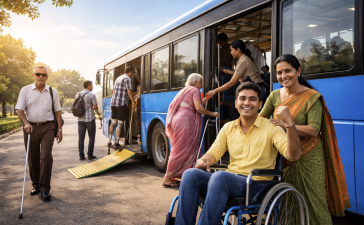
The Andhra Pradesh government launched the Divyang Shakti Scheme in 2026 to provide free bus travel for persons with disabilities. The scheme was inaugurated by Chief Minister N. Chandrababu Naidu in Amaravati. It is part of the Ugadi festival initiatives aiming to enhance mobility and access to public transport for disabled citizens.
Scheme Overview and Objectives
The scheme offers free travel on APSRTC buses to persons with disabilities having over 40% disability. Attendants accompanying disabled persons get a 50% fare concession. It covers 12.76 lakh beneficiaries including attendants. The goal is to increase social inclusion and independence by easing transportation barriers.
Financial and Administrative Support
The Andhra Pradesh government allocates ₹207 crore annually to APSRTC for this scheme. This funding supports operational costs and fare subsidies. APSRTC is responsible for implementing the scheme across the state’s bus network. The initiative reflects government commitment to welfare and accessibility.
Impact on Disabled Persons and Society
The scheme improves access to education, employment, and healthcare for disabled persons. It reduces travel costs and encourages greater participation in social and economic activities. Attendant concessions also support caregivers, easing their financial burden. This encourages a more inclusive society.
Eligibility and Benefits
Eligible persons must have a disability certificate showing more than 40% impairment. Free bus travel applies to all APSRTC routes within Andhra Pradesh. Attendants receive a 50% discount on fares. This policy ensures mobility rights for disabled persons and their helpers.
Topics for Prelims:
Divyang Shakti Scheme
- Launched by Andhra Pradesh government in 2026.
- Free bus travel for persons with disabilities over 40% disability.
- 50% fare concession for attendants.
- Annual budget of ₹207 crore for APSRTC.
- Benefits over 12.76 lakh persons including attendants.
Andhra Pradesh State Road Transport Corporation (APSRTC)
- State-run bus service in Andhra Pradesh.
- Implements Divyang Shakti Scheme.
- Receives government funding for welfare schemes.
- Operates intra-state and some inter-state routes.
- Supports accessibility and public transport initiatives.
Persons with Disabilities (PwD) in India
- Defined by over 40% impairment for scheme eligibility.
- Rights protected under Rights of Persons with Disabilities Act, 2016.
- Require accessible transport for social inclusion.
- Often accompanied by attendants for support.
- Government schemes aim to improve mobility and livelihood.
Questions for Mains:
- Discuss the role of government welfare schemes in enhancing the mobility of persons with disabilities in India. Critically examine their impact on social inclusion. [GS-II-Social Justice]
- Explain the challenges faced by public transport systems in India in providing accessibility to disabled persons. With suitable examples, discuss how these challenges can be overcome. [GS-III-Internal & External Security]
- Comment on the significance of financial allocations like the ₹207 crore funding for APSRTC in implementing social welfare schemes. Discuss the importance of budgetary support in public transport reforms. [GS-III-Economic Development]
- Discuss the Rights of Persons with Disabilities Act, 2016 in the light of recent state initiatives like the Divyang Shakti Scheme. How do such schemes complement legislative measures? [GS-II-Constitution of India & Polity]
Answer Hints:
1. Discuss the role of government welfare schemes in enhancing the mobility of persons with disabilities in India. Critically examine their impact on social inclusion. [GS-II-Social Justice]
- Government schemes like Divyang Shakti provide free or subsidized transport, reducing mobility barriers for PwDs.
- Enhanced mobility facilitates access to education, employment, healthcare, and social activities, promoting independence.
- Such schemes help reduce social stigma by encouraging PwDs’ participation in mainstream society.
- Challenges remain in awareness, implementation, and coverage, limiting full social inclusion impact.
- Complementary initiatives (infrastructure accessibility, awareness campaigns) are needed for holistic inclusion.
- Overall, welfare schemes are crucial but must be integrated with broader policy frameworks for sustained social integration.
2. Explain the challenges faced by public transport systems in India in providing accessibility to disabled persons. With suitable examples, discuss how these challenges can be overcome. [GS-III-Internal & External Security]
- Infrastructure gaps – Lack of ramps, low-floor buses, tactile paths, and audio-visual aids limit accessibility.
- Operational challenges – Inadequate training of staff, irregular services, and poor enforcement of accessibility norms.
- Financial constraints restrict upgrades and adaptations in many state transport systems.
- Example – APSRTC’s Divyang Shakti Scheme addresses financial and service barriers by subsidizing fares.
- Solutions include increased budget allocation, policy enforcement, staff sensitization, and technology adoption.
- Public-private partnerships and community involvement can enhance accessibility and service quality.
3. Comment on the significance of financial allocations like the ₹207 crore funding for APSRTC in implementing social welfare schemes. Discuss the importance of budgetary support in public transport reforms. [GS-III-Economic Development]
- Dedicated funding ensures sustainability and effective implementation of schemes like Divyang Shakti.
- Financial support covers operational costs, fare subsidies, and infrastructure upgrades for accessibility.
- Budgetary allocations enable transport corporations to plan long-term reforms and service expansions.
- Without adequate funding, welfare schemes risk poor reach and quality, limiting benefits to beneficiaries.
- Transparent and accountable fund utilization enhances public trust and scheme efficacy.
- Budgetary support is critical for inclusive economic growth by enabling mobility for marginalized groups.
4. Discuss the Rights of Persons with Disabilities Act, 2016 in the light of recent state initiatives like the Divyang Shakti Scheme. How do such schemes complement legislative measures? [GS-II-Constitution of India & Polity]
- The RPwD Act, 2016 mandates accessibility, non-discrimination, and equal opportunities for PwDs.
- It legally obligates governments to ensure accessible public transport and social welfare measures.
- State schemes like Divyang Shakti operationalize these legal provisions by providing tangible benefits.
- Such schemes demonstrate proactive government commitment beyond statutory requirements.
- They help bridge the gap between legislation and ground-level implementation for PwDs’ rights.
- Combined, the Act and schemes promote empowerment, inclusion, and social justice for disabled persons.