
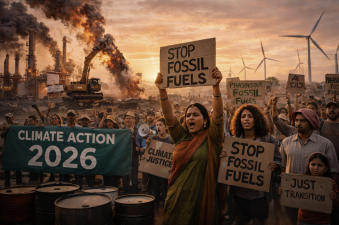
Civil society groups and climate experts from South and Southeast Asia have urged a faster transition away from fossil fuels. This call was made through the Kuala Lumpur Declaration on Climate Justice in March 2026. The declaration was adopted during regional meetings ahead of the 31st UN Climate Change Conference (COP31). It stresses the need for stronger international cooperation and a clear global plan to phase out coal, oil, and gas.
Geopolitical Impact on Energy Transition
Geopolitical conflicts, especially the war in West Asia, have caused fuel price shocks and brought into light global dependency on fossil fuels. Asian countries face risks from supply disruptions and rising costs due to reliance on imported fossil fuels. Despite tensions, experts argue that war can delay but not stop the shift to renewable energy. The crisis should accelerate solar and other renewable energy deployment rather than revert to coal.
Climate Finance and Economic Support
The declaration demands large-scale climate finance from developed countries. Current funding commitments are insufficient for developing nations to make a just energy transition. It calls for 5.1 to6.8 trillion by 2030 and at least 5 trillion annually thereafter. Developed countries must meet existing pledges, including300 billion annually through global climate funds. Alternative funding like taxes on extreme wealth and polluters is also proposed.
Fossil Fuel Treaty and Governance Reforms
A key demand is a Fossil Fuel Treaty to legally manage the global phase-out of coal, oil, and gas. The declaration also calls for reforms in global governance and trade rules. It opposes investor-state dispute settlements that hinder fossil fuel regulation. The transition must be just, focusing on vulnerable groups such as women, youth, Indigenous peoples, and marginalised communities.
Adaptation, Loss and Damage Financing
The declaration marks the need to triple adaptation finance by 2035. It urges new pledges to funds like the Adaptation Fund and Green Climate Fund in 2026. Access to climate finance should be simplified for least-developed countries and small island states. It demands a massive increase in loss and damage funds with rapid-response mechanisms after climate disasters.
Topics for Prelims:
Kuala Lumpur Declaration on Climate Justice
- Issued in March 2026 ahead of COP31.
- Focuses on phasing out fossil fuels globally.
- Calls for international cooperation and clear transition roadmaps.
- Highlights geopolitical risks to fossil fuel dependency.
- Advocates for climate finance and systemic reforms.
Climate Finance and Funding Mechanisms
- Calls for 5.1-6.8 trillion by 2030 for developing countries.
- Existing commitments include 300 billion annually.</li> <li>Proposes alternative taxes on wealth and polluters.</li> <li>Supports grant-based finance over loans.</li> <li>Emphasises adaptation and loss and damage financing.</li> </ol> <h5>Fossil Fuel Treaty and Global Governance</h5> <ol> <li>Legal framework to phase out coal, oil, and gas.</li> <li>Seeks reforms in trade and investment rules.</li> <li>Opposes investor-state dispute settlements blocking climate action.</li> <li>Focuses on social equality in energy transition.</li> <li>Targets vulnerable groups for just transition.</li> </ol> <h4>Questions for Mains:</h4> <blockquote> <ol> <li>Critically discuss the role of geopolitical conflicts in shaping global energy transition policies and their impact on developing economies. [GS-III-Economic Development]</li> <li>Examine the importance of climate finance in facilitating a just energy transition and analyse the challenges in mobilising adequate funds from developed countries. [GS-III-Environment & DM]</li> <li>Estimate the potential impact of a global Fossil Fuel Treaty on international climate governance and discuss the need for reforms in global trade rules to support climate action. [GS-II-International Relations]</li> <li>Point out the social dimensions of climate change adaptation and loss and damage financing, and analyse how these can be addressed to protect vulnerable communities. [GS-II-Social Justice]</li> </ol> </blockquote> <h4>Answer Hints:</h4> <h5>1. Critically discuss the role of geopolitical conflicts in shaping global energy transition policies and their impact on developing economies. [GS-III-Economic Development]</h5> <ol> <li>Geopolitical conflicts (e.g., West Asia war) cause fuel price shocks and supply disruptions, exposing fossil fuel dependency risks.</li> <li>Developing economies reliant on imported fossil fuels face economic strain and energy insecurity during conflicts.</li> <li>Conflicts may delay but cannot stop the global energy transition; they show urgency for renewables deployment.</li> <li>Risk of reverting to coal or fossil fuels during crises versus strategic shift to renewables like solar for energy security.</li> <li>Geopolitical tensions push for stronger international cooperation and clear phase-out roadmaps to reduce vulnerabilities.</li> <li>Energy transition policies must balance short-term crisis management with long-term sustainability and climate goals.</li> </ol> <h5>2. Examine the importance of climate finance in facilitating a just energy transition and analyse the challenges in mobilising adequate funds from developed countries. [GS-III-Environment & DM]</h5> <ol> <li>Climate finance is crucial for developing countries to invest in renewable energy and phase out fossil fuels equitably.</li> <li>Current commitments (~300 billion annually) fall short of estimated needs (5.1-6.8 trillion by 2030, $5 trillion annually thereafter).
- Challenges include lack of political will, accountability, and reluctance to increase grant-based over loan-based funding.
- Mobilising funds requires innovative mechanisms – taxes on extreme wealth, corporate polluters, shipping, and aviation.
- Ensuring simplified access to finance for least-developed countries and small island states is essential.
- Addressing debt crises and economic vulnerabilities in developing countries is critical for effective fund utilisation.
3. Estimate the potential impact of a global Fossil Fuel Treaty on international climate governance and discuss the need for reforms in global trade rules to support climate action. [GS-II-International Relations]
- A Fossil Fuel Treaty would legally mandate the phase-out of coal, oil, and gas, complementing the Paris Agreement.
- It would provide a structured framework to hold countries accountable for fossil fuel production and phase-out timelines.
- Reforms in global trade rules needed to remove investor-state dispute settlement (ISDS) mechanisms that hinder fossil fuel regulation.
- Trade and investment rules must align with climate goals to prevent legal challenges against environmental policies.
- The treaty could promote equity by prioritising vulnerable nations and ensuring just transition principles.
- Strengthened governance would accelerate global cooperation and reduce fossil fuel industry influence on policy-making.
4. Point out the social dimensions of climate change adaptation and loss and damage financing, and analyse how these can be addressed to protect vulnerable communities. [GS-II-Social Justice]
- Climate change disproportionately affects vulnerable groups – women, youth, Indigenous peoples, marginalized communities.
- Adaptation finance must triple by 2035 to build resilience in vulnerable regions and communities.
- Loss and damage funds require massive scale-up with rapid-response mechanisms for climate disasters.
- Simplified access to finance for least-developed countries and small island states is vital for social equity.
- Just transition frameworks must integrate social justice, addressing inequalities and ensuring participation of marginalized groups.
- Inclusive governance and targeted support can reduce climate-induced social and economic vulnerabilities.