
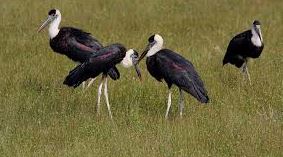
A rare sighting of the woolly-necked stork (Ciconia episcopus) was reported from paddy fields near Vannarapettai village in Thanjavur district, Tamil Nadu. The bird was observed outside its usual migration period by researchers from the Endangered Wildlife and Environmental Trust (EWET) in April 2024. The sighting was confirmed and documented through photographs by EWET founder Sathishkumar Rajendran and coordinator Viswapream CA.
Species Description and Habitat
The woolly-necked stork is a medium-sized wading bird native to India, predominantly found in northern states. It inhabits open grasslands, paddy fields, riverbanks, ponds, and wetlands. Its diet includes fish, frogs, small reptiles, insects, and other aquatic organisms. The species is classified as ‘near threatened’ on the IUCN Red List.
Significance of the Sighting
The presence of the stork in Thanjavur after the migration season is considered rare. The species typically appears in southern India, including Tamil Nadu, only during migration. Researchers suggest the sighting may indicate a range expansion or environmental changes affecting the region’s fauna.
Observation and Documentation
The initial sighting was reported by birdwatcher S Sriram. Subsequent field visits by EWET personnel verified the presence of the bird and resulted in photographic documentation. Researchers noted the species is usually solitary or found in small groups. Nesting involves building nests on tall trees and laying two to four eggs during the breeding season.
Conservation and Monitoring Efforts
Following the sighting, EWET has initiated continuous monitoring to document further occurrences of the woolly-necked stork in Thanjavur and surrounding areas. The effort aims to understand changes in distribution patterns and support conservation measures for this near-threatened species.
What to Study for UPSC Exams?
- Wetland Ecosystems in India
- Bird Migration Patterns
- Threatened Avian Species
- Role of NGOs in Wildlife Conservation
Wetland Ecosystems in India
India hosts diverse wetlands including the Sundarbans, Chilika Lake, and Loktak Lake. Wetlands cover about 4.6% of India’s geographical area. They support over 370 species of birds and act as natural water purifiers and flood buffers. Mangroves and freshwater wetlands are distinct types with unique flora and fauna.
Bird Migration Patterns
Bird migration involves seasonal movement between breeding and wintering grounds. India lies on Central Asian and East Asian-Australasian flyways. Some species travel over 10,000 km, using landmarks like the Himalayas and coastlines for navigation. Migration timing is influenced by climate, food availability, and breeding cycles.
Threatened Avian Species
Threatened birds face risks from habitat loss, hunting, and climate change. India’s critically endangered birds include the Great Indian Bustard and White-bellied Heron. The IUCN Red List categorizes species as vulnerable, endangered, or critically endangered based on population trends and threats.
Role of NGOs in Wildlife Conservation
NGOs conduct research, awareness campaigns, and habitat restoration. They collaborate with governments for policy advocacy and community engagement. Examples include WWF India, BNHS, and Wildlife Trust of India. NGOs often monitor endangered species and promote sustainable livelihoods to reduce human-wildlife conflict.
Last Modified: April 12, 2026