
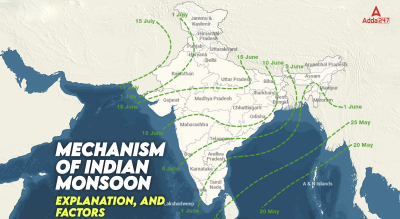
India’s Meteorological Department (IMD) released the 2026 southwest monsoon forecast, predicting normal rainfall with a 96% probability. The forecast estimates monsoon rainfall at 98% of the Long Period Average (LPA) of 88 cm. The monsoon season spans June to September, covering 75% of India’s annual rainfall.
Monsoon Rainfall Distribution
The IMD forecast indicates above-normal rainfall in central India and parts of the northeast. Below-normal rainfall is expected in northwest India and some western regions. The southern peninsula is predicted to receive rainfall near the LPA. Regional variability is expected due to local climatic factors.
Climate Variability Factors
The forecast accounts for the El Niño-Southern Oscillation (ENSO), which is currently in a neutral phase. Sea surface temperatures in the Indian Ocean are warmer than average, potentially influencing monsoon patterns. The Madden-Julian Oscillation (MJO) activity is moderate, affecting monsoon onset and breaks.
Monsoon Onset and Progress
The IMD projects monsoon onset over Kerala by 1 June 2026, with a normal progression northwards. The monsoon withdrawal is expected in early October. The onset is influenced by Arabian Sea conditions and cross-equatorial winds.
Impact on Agriculture and Water Resources
Normal monsoon rainfall supports kharif crop sowing over 120 million hectares. Reservoir storage levels depend on rainfall distribution, affecting irrigation and drinking water supply. Regions forecasted for below-normal rainfall may experience water stress.
What to Study for UPSC Exams?
- El Niño and La Niña Effects
- Indian Ocean Dipole Phenomenon
- Monsoon Mechanisms and Variability
- Water Resource Management in India
El Niño and La Niña Effects
El Niño is characterized by warming of the central and eastern Pacific Ocean, disrupting global weather patterns. La Niña is its cooling counterpart, often causing opposite climate impacts. Both influence Indian monsoon strength, with El Niño typically suppressing rainfall and La Niña enhancing it. These phenomena operate on 2-7 year cycles and affect atmospheric circulation worldwide.
Indian Ocean Dipole Phenomenon
The Indian Ocean Dipole (IOD) is an irregular oscillation of sea surface temperatures between the western and eastern Indian Ocean. Positive IOD phases warm the western Indian Ocean, often boosting Indian monsoon rainfall. Negative phases cool the west, reducing rainfall. IOD events can last 3-6 months and interact with ENSO, influencing regional climate variability.
Monsoon Mechanisms and Variability
Monsoons arise from differential heating between land and ocean, causing seasonal wind reversals. The Indian monsoon depends on factors like the Tibetan Plateau heating, Arabian Sea moisture, and jet stream shifts. Variability is driven by ocean-atmosphere interactions, including ENSO, IOD, and Madden-Julian Oscillation, causing fluctuations in onset, intensity, and spatial distribution.
Water Resource Management in India
India relies on monsoon rains for 70% of its freshwater supply. Water management includes reservoirs, canals, and groundwater extraction. Challenges include uneven rainfall distribution, over-extraction, and pollution. Traditional methods like rainwater harvesting coexist with modern projects like interlinking rivers. Efficient management impacts agriculture, urban supply, and drought mitigation.
Last Modified: April 13, 2026