
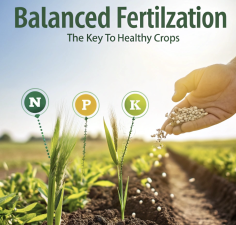
India’s agricultural growth since the Green Revolution has been built on high-yielding varieties, irrigation, and chemical fertilisers. While this raised foodgrain output and strengthened food security, prolonged and imbalanced nutrient use has also caused soil degradation, nutrient mining, and lower crop efficiency. Balanced fertilisation has therefore become central to sustainable agriculture, soil restoration, and long-term productivity.
Why Balanced Fertilisation Matters
Balanced fertilisation means applying essential macro and micronutrients in the right proportion, at the right time, and through the right method. It is based on Justus von Liebig’s Law of the Minimum, which states that crop growth is limited by the scarcest nutrient. Excess use of nitrogen alone, without adequate phosphorus, potassium, sulphur, zinc, and other nutrients, reduces soil fertility and weakens crop performance.
Impact of Imbalanced Fertiliser Use
Imbalanced fertilisation has several adverse effects:
- It depletes secondary and micronutrients from the soil.
- It damages soil structure and organic matter.
- It increases nutrient loss through runoff and leaching.
- It reduces crop quality, yield, and resistance to pests and diseases.
- It also affects livestock, as nutrient-poor crops produce inferior fodder.
Scientific Approaches for Nutrient Management
India has promoted several tools to improve fertiliser efficiency:
- Integrated Nutrient Management (INM): combines chemical fertilisers, compost, manure, and biological inputs.
- Soil Test-Based Recommendations: use soil data to decide crop-wise nutrient doses.
- STCR Approach: links fertiliser use with yield targets.
- DRIS: assesses nutrient balance through plant tissue analysis.
- Site-Specific Nutrient Management: adjusts fertiliser use according to field variability.
Government Measures and Policy Support
The Soil Health Card Scheme, Nutrient-Based Subsidy, neem-coated urea, Paramparagat Krishi Vikas Yojana, PM-PRANAM, nano fertilisers, and fortified fertilisers are key policy instruments supporting balanced nutrient use. These measures aim to reduce overdependence on urea, improve nutrient-use efficiency, and encourage soil-test-based farming. They also support environmental protection by lowering runoff, pollution, and greenhouse gas emissions.
Last Modified: April 27, 2026