
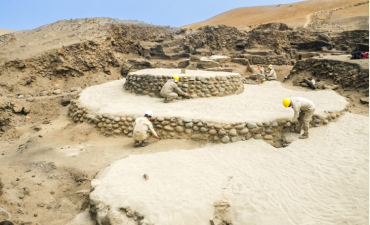
Archaeologists in Peru have identified a structure at Áspero that appears to have been used for observing the sky, adding new evidence on scientific and ritual practices in the Caral Civilisation. The discovery was made at the coastal settlement of Áspero, one of the main centres linked to Caral, a civilisation regarded as among the earliest in the Americas.
About the Site
Áspero is located near the Pacific coast in Supe Puerto and dates to around 3000 to 1800 BC. The settlement covers nearly 19 hectares and contains more than 20 architectural complexes. Its coastal location supported fishing and shellfish collection, while its links with inland areas suggest active exchange networks.
Structure and Excavation Findings
The newly recorded structure is in Sector J1, close to larger pyramidal buildings. It offers clear views of the shoreline and the lower Supe Valley. Excavations show that the structure developed in several phases. In its earliest stage, it appears to have served as a public or ceremonial space. Later, a circular platform of just over three metres was added, with a standing stone at its centre. Such stones, known as huancas, are often associated with ritual use in the Andes. A later modification included a double-stepped platform, a rectangular stone at the centre, and an enclosed area with a hearth.
Possible Astronomical Function
Researchers believe the layout may have helped track the movement of the Sun, Moon and stars. Such observations would have been useful for marking seasonal change. For a coastal community dependent on fishing, this would have helped in planning activities linked to tides, weather and marine resources.
Historical Significance
The structure was later covered and reused for domestic purposes, suggesting its earlier function had ended. The find strengthens the view that Caral communities combined ritual life, social organisation and practical knowledge of the environment. Previous discoveries at Áspero, including elite burials such as the Lady of the Four Tupus, also indicate social hierarchy and complex organisation.
Last Modified: April 25, 2026