
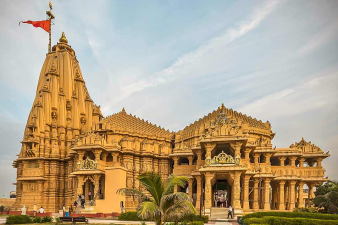
The Somnath Temple in Gujarat celebrated 75 years of its modern post-independence reconstruction and inauguration during the Somnath Amrut Parv from 8 May to 11 May 2026. Situated at Prabhas Patan near Veraval along the Saurashtra coast, the shrine holds historical position as the first among the twelve sacred Aadi Jyotirlingas of Lord Shiva. The year 2026 also marks the millennium of the temple’s first recorded major attack by Mahmud of Ghazni in 1026 CE. The modern structure stands as a monument to national resurgence, initiated after independence by political leaders and consecrated by Dr. Rajendra Prasad, the first President of India, on 11 May 1951.
Historical Chronology and Cycles of Destruction
The site has an ancient legacy detailed in classical Indian literature, followed by multiple phases of destruction and local rebuilding during the medieval and early modern eras.
Ancient Literary References and Traditions
- Vedic and Puranic Texts: References to the Prabhas Teertha and the deity exist in the Rig-Veda, Skanda Purana, Shreemad Bhagavat, and Shiva Purana. The Dwadasha Jyotirlinga Stotram explicitly places Somnath at the beginning of the twelve shrines.
- Association with Moon God: According to textual traditions, the temple was originally built in phases: first using gold by Somraj (the Moon God), then in silver by Ravana, and later in wood by Lord Krishna.
- Dehotsarg Teertha: The geographic precinct includes the Neejdham Prasthan Leela site along the Hiran River, where Lord Krishna completed his earthly journey.
Medieval Transgressions and Dynastic Reconstructions
- The 1026 CE Invasion: Mahmud of Ghazni led the first major recorded raid, looting the temple and destroying the sanctum. The event was documented by contemporary regional chroniclers and the Persian scholar Al-Biruni.
- Solanki Restoration: King Bhima I of the Solanki (Chalukya) dynasty rebuilt the temple using stone shortly after the Ghaznavid withdrawal.
- Subsequent Invasions: The structure faced waves of demolition under the Delhi Sultanate forces in 1297 CE (Alauddin Khalji’s army), in 1394 CE, and a final imperial destruction under Mughal Emperor Aurangzeb in 1706 CE.
- Maratha Revival under Ahilyabai Holkar: During the late 18th century, Maharani Ahilyabai Holkar of Indore built a separate, adjacent temple structure to maintain ritual continuity when the original spot lay in ruins under hostile political conditions.Post-Independence Reconstruction and Governance
The reconstruction of the contemporary temple was a major project of cultural revival led by the newly formed independent Indian state.
Leadership Roles in Institutional Restoration
- Sardar Vallabhbhai Patel: Visited the ruins of Prabhas Patan on 13 November 1947 alongside Mahatma Gandhi’s endorsement and publicly resolved to build a grand temple on the original site.
- K. M. Munshi: Headed the institutional execution of the project and authored the text Somanatha: The Shrine Eternal to record its history.
- Jam Saheb Digvijaysinhji: The ruler of the princely state of Nawanagar served as the first chairman of the reconstruction trust and contributed financial resources to anchor the initial fund.
- Presidential Consecration: The Pran Pratishtha ceremony of the newly completed temple was performed on 11 May 1951 by President Dr. Rajendra Prasad, asserting the civilizational pride of independent India.
Contemporary Trust Administration
The administration of the temple complex is managed by the Shri Somnath Trust. Recent infrastructural developments under the trust include the creation of a dedicated Heritage Corridor, the upgradation of a 3D Laser Light and Sound show, and tourism amenities funded under the central PRASHAD scheme.
Architectural Classification and Structural Geography
The current monument reflects traditional architectural methods native to the western regions of India.
Māru-Gurjara Temple Architecture Style
The modern structure belongs to the broad Nagara school of Northern Indian architecture, specifically executing the Kailas Mahameru Prasad layout variation.
- Core Components: Features a high Shikhara (spire) rising approximately 155 feet, topped with an Amalaka and a Kalasha. It is divided into three distinct halls: the Garbhagriha (sanctum sanctorum), the Sabhamandap (assembly assembly hall), and the Nrityamandap (dance hall). +1
- Artisanal Lineage: Hand-carved by the Sompura Salats, the traditional master stone masons of Gujarat.
Geographic and Maritime Position
- River Confluence: The temple is located at the Triveni Sangam, the physical confluence of three distinct rivers: the Kapila, the Hiran, and the mythical Saraswati, before they empty into the Arabian Sea.
- The Tirth Stambh (Arrow Pillar): A structural pillar erected on the sea-facing retaining wall of the temple axis. It contains an inscription indicating that it stands on an uninterrupted sea route (Abadhit Samudra Marg) straight to the South Pole, meaning no geographic landmass intersects that specific longitude line across approximately 9,936 kilometers.
Comparative Overview of Historical Architecture Phases
| Historical Era / Builder | Core Material | Notable Architectural Status | Primary Historical Context |
|---|---|---|---|
| Traditional Phase (Solanki) | Stone and Timber | Baseline Māru-Gurjara style | Post-Ghaznavid restoration by Bhima I and Kumarapala |
| 18th Century (Ahilyabai Holkar) | Stone | Underground shrine model | Built to protect the Shiva Lingam from recurrent iconoclasm |
| Modern Phase (Post-1947) | Sandstone / Granite | Kailas Mahameru Prasad style | National public subscription project initiated by Union leadership |
IASPOINT Booster Facts for UPSC
- PRASHAD Scheme: The Pilgrimage Rejuvenation and Spiritual Heritage Augmentation Drive is a central sector scheme fully funded by the Ministry of Tourism, focused on integrated infrastructure development at selected pilgrimage destinations like Somnath.
- Al-Biruni: An Iranian scholar who traveled to India in the 11th century alongside Mahmud of Ghazni. He authored Kitab-ul-Hind, a text providing observations on Indian philosophy, sciences, geography, and religious institutions.
- Sompura Salats: An artisan community of Gujarat whose lineage dates back to the architectural manuals of the Shilpa Shastras. They designed the Somnath Temple, the Akshardham structures, and the Ram Mandir in Ayodhya.
- Swachh Iconic Places: Somnath was designated under this initiative by the Ministry of Drinking Water and Sanitation to establish high standards of environmental waste management and civic amenities at heritage spots.
- Somnath Swabhiman Parv: An institutional festival organized by the Ministry of Culture in January 2026 to commemorate 1,000 years of the community’s cultural defense since the historical challenges of 1026 CE.