
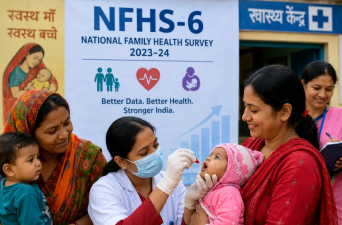
The National Family Health Survey-6 (NFHS-6), conducted during 2023-24 by the Ministry of Health and Family Welfare, highlights substantial advancements in India’s maternal and child health landscape. Over the five years since the previous survey cycle (NFHS-5), the country recorded a sharp rise in institutional deliveries, childhood immunization, and early breastfeeding practices. Concurrently, chronic undernutrition markers like stunting and wasting among children under five years registered a downward trajectory. However, the comprehensive data also highlights structural challenges, including a surge in medicalized birth interventions through caesarean sections and a growing burden of non-communicable lifestyle conditions among adults.
Maternal Health Care and Birth Interventions
The latest survey data reflects expanded penetration of structural maternal healthcare services alongside an escalating trend in surgical deliveries.
Antenatal Care and Supplementation
- Antenatal Care (ANC) Coverage: The percentage of pregnant women who completed at least four recommended ANC visits reached 65.2% nationally, up from 58.5% in NFHS-5.
- Nutritional Supplementation: The consumption of Iron and Folic Acid (IFA) tablets for a minimum duration of 180 days during pregnancy improved to 37.8%, compared to the previous baseline of 26%.
- Institutional Deliveries: Births occurring in medical facilities expanded to 90.6% nationally from 88.6%, driven by targeted state cash incentives and rural health infrastructure deployment.
Escalation in Caesarean Section Rates
Medicalized births through Caesarean sections (C-sections) have risen rapidly, driven primarily by operations inside commercial healthcare settings. The World Health Organization prescribes an ideal C-section rate between 10% and 15% for optimal maternal outcomes.
| Region / State | Overall C-Section Rate (%) | Private Facility C-Section Rate (%) |
| National Average | 24.3% | 49.8% |
| Telangana | 62.1% | 74.5% |
| Andhra Pradesh | 56.4% | 71.2% |
| Kerala | 43.8% | 55.6% |
| Maharashtra | 33.6% | 48.9% |
Child Nutrition and Survival Metrics
Childhood health indicators show a distinct shift, with standard undernutrition metrics easing while initial feeding practices strengthen.
Declining Trends in Malnutrition
The physical indicators of chronic and acute undernutrition among children under the age of five years experienced steady drops.
- Stunting (Low Height-for-Age): Declined to 29.3% from 35.5% in NFHS-5, representing a long-term reduction in chronic nutritional deprivation.
- Severe Wasting (Low Weight-for-Height): Dropped from 7.7% to 5.2%, showing progress in managing acute, life-threatening starvation conditions.
- Underweight (Low Weight-for-Age): Registered a marginal correction, moving from 32.1% down to 31.8%.
Breastfeeding and Infant Feeding Practices
- Exclusive Breastfeeding: The proportion of infants under six months of age who were exclusively breastfed reached 95.6%, up from the prior level of 62.1%.
- Timely Complementary Feeding: The introduction of solid or semi-solid foods alongside breast milk for infants aged 6-9 months improved to 60.1%.
Immunization and Preventive Healthcare Coverage
Universal immunization metrics demonstrated positive growth, with newer vaccine variants registering maximum expansion.
Core Vaccine Universalization
- Full Immunization Cover: The percentage of children aged 12-23 months who received all basic vaccinations reached 82.6%, up from 76.6%.
- Rotavirus Vaccine Uptake: Protection against severe diarrheal disease expanded from 36.4% to 85.4%.
- Measles-Rubella (MR) Coverage: First-dose coverage for the MR vaccine climbed to 91.2%, helping suppress localized childhood outbreaks.
IASPOINT Booster Facts for UPSC
Institutional Structure of NFHS
The International Institute for Population Sciences (IIPS), Mumbai serves as the designated nodal agency responsible for the administrative coordination, technical design, and execution of all NFHS rounds. Funding is primarily provided by the Ministry of Health and Family Welfare, Government of India, with technical assistance from ICF International.
Excluded Territories
Due to prevailing administrative friction and complex security environments on the ground, the fieldwork for NFHS-6 could not be completed in the state of Manipur. Consequently, national aggregates omit data from this region.
Core Demographic Definitons
- Stunting: Reflects chronic undernutrition resulting from long-term nutritional deprivation, frequently linked to poor maternal health, multiple infections, and inappropriate infant feeding.
- Wasting: Reflects acute malnutrition, indicating substantial weight loss usually associated with recent illness or acute food shortage.
- Neonatal Mortality Rate (NMR): The number of infant deaths happening within the first 28 completed days of life per 1,000 live births.
- Infant Mortality Rate (IMR): The number of deaths of children under one year of age per 1,000 live births.
National Healthcare Initiatives Linked to Trends
- Poshan 2.0: An integrated nutrition support programme targeting nutritional content, delivery, outreach, and outcomes across children, adolescent girls, and pregnant women.
- Mission Indradhanush: A targeted health initiative aimed at expanding full immunization coverage to at least 90% of infants, focusing on pockets with low vaccination rates.
- Pradhan Mantri Matru Vandana Yojana (PMMVY): A direct benefit transfer scheme providing cash incentives to pregnant women to fulfill nutritional needs and compensate for wage loss.