
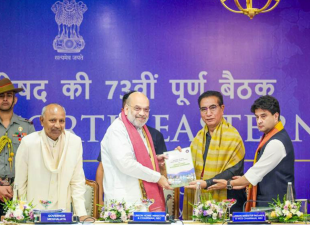
The 73rd Plenary Session of the North Eastern Council (NEC) concluded in Shillong, Meghalaya, under the chairmanship of Union Home Minister Amit Shah. The high-level meeting brought together the Union Minister for Development of North Eastern Region (DoNER), along with the governors and chief ministers of all eight northeastern states. Deliberations centered on the North East Vision Plan 2047, evaluating developmental roadmaps, connectivity projects, and cross-border trade mechanisms. The forum served as a key vehicle to advance cooperative federalism and review execution strategies across critical infrastructure, investment, and security parameters in the region.
Core Institutional Framework of NEC
The North Eastern Council is the statutory advisory body constituted for the economic and social development of the northeastern region.
Legal Genesis and Structure
- Statutory Body: Established under the North Eastern Council Act, 1971, making it a non-constitutional, statutory regional planning body.
- Ex-Officio Leadership: The Union Home Minister acts as the ex-officio Chairman, while the Minister of DoNER serves as the Vice-Chairman.
- Composition: Includes the Governors and Chief Ministers of all eight member states alongside three members nominated by the President of India.
- Territorial Mandate: Covers the eight states of Arunachal Pradesh, Assam, Manipur, Meghalaya, Mizoram, Nagaland, Tripura, and Sikkim. Sikkim was added through an amendment to the NEC Act in 2002.
Primary Functions and Mandate
- Regional Planning: Formulates a unified, coordinated regional plan for member states regarding matters of common interest.
- Inter-State Coordination: Reviews measures taken by member states for maintaining security, public order, and economic stability.
- Dispute Resolution: Minimizes inter-state friction by providing a collaborative platform to discuss boundary, transit, and resource distribution issues.
Key Focus Areas of the 73rd Plenary Session
The session prioritized sector-specific targets designed to transition the region from a zone of historical geopolitical vulnerabilities into an economic powerhouse.
Strategic Vision 2047
- North East Vision Plan 2047: Formulates a long-term roadmap to establish the region as a hub of connectivity, innovation, and sustainable agriculture by India’s centenary year of independence.
- Strategic Execution over Distribution: Directions were issued to shift the role of the NEC from a mere fund-allocating agency to an institute of strategic planning.
Sectoral Task Forces and Self-Reliance
- CM High-Level Task Forces: Evaluated progress reports submitted by chief minister-led committees in critical sectors including sports promotion, handloom, and handicrafts.
- Nutritional Self-Reliance: Formulated precise implementation strategies to achieve self-sufficiency in milk, eggs, fish, and meat production.
- Unified Tourism Market: Reviewed a roadmap presented by the High-Level Task Force on Tourism to promote the entire Northeast as a single, combined tourist destination rather than marketing states in isolation.
Tech and Energy Transition
- Digital Infrastructure Hub: Flagged technical training initialization for regional youth in Artificial Intelligence (AI), Machine Learning, and Blockchain to build an information technology corridor.
- Clean Energy Expansion: Emphasized tapping the unutilized potential of regional solar energy and hydropower, alongside attracting commercial data centers.
Security and Law Enforcement
- Routine Policing Upgrades: Stressed the complete adoption of the Bharatiya Nyaya Sanhita (BNS) parameters with technology-backed criminal justice interventions.
- Forensic Interventions: Mandated increasing conviction rates using modern forensic science tools and online court testimonies.
Cross-Border Trade and Geo-Economic Initiatives
The economic integration of the Northeast remains closely linked with India’s Act East Policy.
Land Ports and Border Logistics
- Sabroom Land Port: Positioned as the key maritime access gateway connecting Tripura with the Chittagong port in Bangladesh, reducing transit times for goods entering the landlocked northeast.
- Ashtalakshmi Darshan Initiative: Designed to boost cross-border experiential tourism circuits connecting neighboring Southeast Asian nations.
- Commercial Agriculture Flaggings: Focused on high-value cash crops by prioritizing dedicated, multi-state commercial roadmaps for Bamboo and Agarwood cultivation.
IASPOINT Booster Facts for UPSC
- Nodal Ministry: The NEC functions directly under the administrative control of the Ministry of Development of North Eastern Region (MDoNER), which was created in 2001 and elevated to a full ministry in 2004.
- Financing Mechanism: NEC projects are funded via the Central Pool of Non-Lapsable Central Pool of Resources (NLCPR), where central ministries must allocate 10% of their gross budgetary support for the northeastern states.
- Zonal Councils vs. NEC: Unlike the five Zonal Councils created under the States Reorganisation Act, 1956 (which are purely advisory bodies under the Ministry of Home Affairs), the NEC was established via a separate Act of Parliament and possesses a distinct regional planning mandate with dedicated budgetary funds.
- The “Ashtalakshmi” Concept: The term signifies the eight states of the Northeast, representing eight forms of wealth or prosperity that these states contribute to the national economy.
- Hill Area Development: The NEC holds a specific mandate to look into ecological conservation and developmental gaps in autonomous hill councils established under the Sixth Schedule of the Indian Constitution.
