
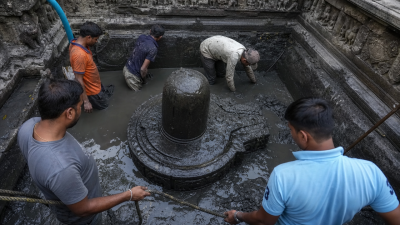
On 2 July 2026 the Archaeological Survey of India discovered a centuries‑old Shivling at the bottom of the 65‑foot‑deep Amrit Kund in the Trimbakeshwar Temple complex, Nashik district, Maharashtra. The find occurred during an ASI conservation and cleaning project.
The Shivling Discovery
- Date & Agency: 2 July 2026; Archaeological Survey of India during conservation of the Amrit Kund.
- Physical context: Shivling recovered from the bottom of a 65‑foot‑deep stepped kund after deliberate draining.
- Age estimate: Assessed at least 240 years old; scientific dating pending.
Trimbakeshwar Temple: Key Facts
- Jyotirlinga status: One of the twelve recognised Jyotirlingas.
- Three‑faced Linga: Unique lingam with three faces representing Brahma, Vishnu and Shiva.
- Location & river link: At the foothills of the Brahmagiri Hills, Western Ghats; revered as the origin of the Godavari (Dakshin Ganga).
- Structure & chronology: Present temple dates to the mid‑18th century, erected by the Peshwa era on an older shrine; features four cardinal gateways.
Simhastha Kumbh Mela Timing
- Festival period: Nashik Simhastha Kumbh Mela: 31 October 2026 to 24 July 2028.
- Flag‑hoisting sites: Trimbakeshwar, Ramkund and Panchavati.
- Amrit Snan dates: 2 August 2027; 31 August 2027; 11–12 September 2027.
Booster Facts
- ASI mandate: ASI conserves centrally protected monuments under the Ancient Monuments and Archaeological Sites and Remains Act, 1958.
- Jyotirlinga concept: Denotes shrines where Shiva is worshipped as a column of light; referenced in Puranic lists.
- Geography: Nashik lies in the Godavari river basin; Kumbh rituals centre on designated riverine ghats.