
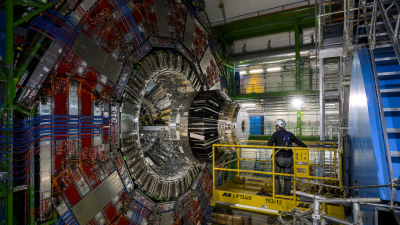
CERN’s Large Hadron Collider entered Long Shutdown 3 on 29 June 2026 for a High‑Luminosity upgrade budgeted at about USD 1.5 billion and intended to raise collision frequency fivefold.
Schedule and Scope
- Restart date: HL‑LHC currently slated to begin operations in June 2030, ≈1 year later than initial plans; LS3 extended by ~4 months.
- Primary cause of delay: Phase II upgrade work on ATLAS and CMS eroded schedule contingency, impacting overall timeline.
Detector Upgrades
- Pileup handling: ATLAS/CMS must cope with 140–200 proton–proton collisions per bunch crossing versus ≈60 in the last run.
- Key systems: New trigger architectures and advanced silicon trackers required; specific schedule shortfalls for ATLAS Inner Tracker and CMS HGCAL/new tracker.
Machine and Civil Works
- Vertical cores: Tendering issues for 28 vertical cores delayed connection of new HL‑LHC technical galleries, reverting to original six‑month excavation plan.
- High‑intensity tests: End‑of‑Run‑3 beam tests probed limits for machine protection and instability thresholds.
Beam & Computing
- Protons per bunch: HL‑LHC aims for 2.3×10^11 protons per bunch versus the original 1.7×10^11, raising instability and protection demands.
- WLCG capacity: Worldwide LHC Computing Grid must expand to more than three times its current capacity (~125,000 running jobs) and adapt to heterogeneous environments.
Costs & Programme Risks
- Estimated cost: HL‑LHC programme assessed at at least 1.2 billion Swiss francs.
- LHCb funding risk: UKRI non‑commitment could force LHCb to cease in 2033, excluding it from HL‑LHC operation and conflicting with the European Strategy roadmap.
IASPOINT Booster Facts
- Integrated luminosity goal: HL‑LHC targets a tenfold increase in integrated luminosity for precision Higgs measurements and extended new‑physics reach.
- Beam energy: LHC accelerates protons to ~6.8 TeV per beam in current operation.