
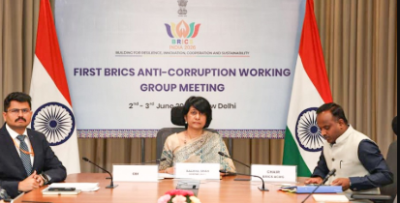
The first BRICS Anti-Corruption Working Group (ACWG) meeting concluded virtually on June 3, 2026, marking a critical step under India’s BRICS Presidency. Led by the Department of Personnel and Training, Ministry of Personnel, Public Grievances and Pensions, the two-day event focused on boosting international cooperation to track cross-border financial crimes. Member nations deliberated on structural reforms to fast-track asset recovery, improve intelligence sharing, and freeze the proceeds of crime. This meeting sets the groundwork for advanced practitioner-level engagements scheduled for August 2026 in Hyderabad, Telangana, where members aim to finalize unified operational protocols.
Core Priorities of the 2026 India Presidency
The working group advanced discussions based on India’s overarching presidency theme: “Building for Resilience, Innovation, Cooperation and Sustainability.” The agenda was divided into two core priority frameworks designed to streamline global anti-corruption efforts.
International Cooperation for Asset Recovery and Cross-Border Corruption
- Fugitive Economic Offenders: Member states analyzed mechanisms to prevent corrupt officials and economic offenders from seeking safe havens in foreign jurisdictions.
- Asset Tracing: The session emphasized real-time tracking of illicit financial flows and removing bureaucratic delays in cross-border wealth recovery.
- Practitioner-Level Engagement: Delegates agreed to establish direct communication lines between investigative agencies, skipping prolonged diplomatic channels for preliminary data exchange.
Enhancing Transparency and Accountability in Governance
- Digital Governance Tools: The group explored using blockchain, data analytics, and automated procurement systems to eliminate human discretion in public delivery.
- Information Exchange Templates: To ensure quick legal assistance, countries discussed standardizing legal requests and templates for financial intelligence sharing.
- Institutional Strength: Discussions focused on building independent anti-corruption institutions capable of auditing complex transnational financial networks.
Key Mechanisms and Parallel Outcomes
The meeting also featured specialized side events to build practical frameworks for law enforcement agencies across the BRICS block.
Focal Points of BRICS Expert on Asset Recovery
Organized on the sidelines of the main working group meeting, this specialized network held its first focal points meeting. The network targets the structural delays that traditionally slow down international asset retrieval.
Structural Reforms Formulated
- Directory of Focal Points: Creation of an updated, verified directory containing direct contact nodes of asset recovery experts across all member countries.
- Standardized Templates: Development of simplified, pre-approved templates for information requests to minimize technical rejections by foreign courts.
- Informal Cooperation Channels: Emphasizing police-to-police and agency-to-agency informal intelligence sharing before filing formal Mutual Legal Assistance Treaties (MLATs).
Institutional Framework for Anti-Corruption in India
India’s participation in the BRICS ACWG is supported by a multi-layered domestic institutional setup that handles domestic corruption and international asset recovery.
| Agency / Law | Role in Anti-Corruption | International Alignment |
| Department of Personnel and Training (DoPT) | Nodal ministry for anti-corruption policy and international desk coordination. | Leads India’s representation at BRICS ACWG and G20 Anti-Corruption tracks. |
| Central Bureau of Investigation (CBI) | Premier investigative agency handling corruption, economic offenses, and conventional crimes. | Acts as the National Central Bureau for Interpol in India. |
| Enforcement Directorate (ED) | Enforcement of economic laws and fighting financial crimes like money laundering. | Nodal agency for implementing the Prevention of Money Laundering Act (PMLA). |
| Fugitive Economic Offenders Act, 2018 | Allows confiscation of properties of economic offenders fleeing Indian jurisdiction. | Formulates the baseline for India’s global push against safe havens. |
IASPOINT Booster Facts for UPSC
- Establishment of ACWG: The BRICS Anti-Corruption Working Group was set up in 2015 following a directive from the BRICS Leaders at the Ufa Summit in Russia.
- Chairmanship Dynamics: The working group is chaired by the nation holding the rotating BRICS Chairmanship for that calendar year. India holds the presidency for 2026.
- UNODC Partnership: The ACWG coordinates its annual work plans closely with the United Nations Office on Drugs and Crime (UNODC) to align with the UN Convention against Corruption (UNCAC).
- BRICS Expansion: Originally consisting of Brazil, Russia, India, China, and South Africa, the group expanded to include Egypt, Ethiopia, Iran, Saudi Arabia, and the United Arab Emirates as full members, with an additional ten partner countries admitted recently.
- Nodal Legal Framework: In India, international asset recovery and extradition requests are routed through the Ministry of Home Affairs (MHA) and the Ministry of External Affairs (MEA) under the Extradition Act of 1962 and the Code of Criminal Procedure (CrPC).
