
Daily Activities

UPSC Prelims Current Affairs

UPSC Mains Current Affairs

Current Affairs

SARTHI for ITI Ecosystem Reform

SARTHI for ITI Ecosystem Reform

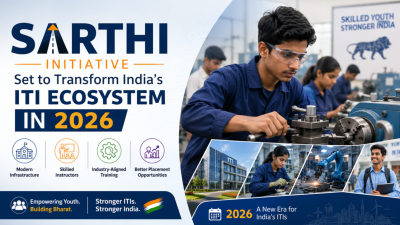
The Ministry of Skill Development and Entrepreneurship (MSDE) will hold the first meeting of SARTHI (Strategic Advisory and Reforms Taskforce for Holistic ITI Transformation) on 12 June 2026 to drive reforms in India’s Industrial Training Institutes (ITIs). SARTHI, an apex advisory body under the Craftsmen Training Scheme (CTS), aims to align vocational training with industry needs through coordinated policy dialogue among government, industry, and other stakeholders. The taskforce will focus on curriculum reforms, assessment improvements, gender inclusion, instructor development, and strengthening governance and industry linkages across 13,888 ITIs nationwide. This initiative seeks to enhance the quality, accessibility, and relevance of vocational education to support India’s evolving workforce requirements.

Institutional Architecture of SARTHI

SARTHI serves as the premier advisory and reform vehicle designed to overhaul the operational dynamics of the Craftsmen Training Scheme (CTS) across India.

Governance and Stakeholder Representation

The taskforce is structured as a multi-stakeholder platform to eliminate the separation between academic vocational training and real-world industrial application. It brings together senior officials from MSDE, the Directorate General of Training (DGT), state skill departments, prominent industry associations (such as FICCI, CII, and ASSOCHAM), and sector skill councils. This diverse composition ensures that policy directives reflect the shifting demands of the domestic and global manufacturing and services sectors.

Operational Scale and Footprint

The reform framework targets the complete network of 13,888 Industrial Training Institutes operating across the country. This network includes both government-run and private institutions, creating a standardized national framework for skill acquisition, testing, and certification.

Strategic Reform Pillars

The advisory body divides its interventions across five core structural areas to modernise the vocational education ecosystem.

Curriculum Alignment and Industry Integration

SARTHI focuses on updating outdated training syllabi to match modern industrial standards. The taskforce integrates courses on Industry 4.0 technologies, including automation, robotics, artificial intelligence, green energy systems, and advanced electric vehicle (EV) maintenance, into the core CTS portfolio. This updates traditional engineering and non-engineering trades into high-demand technical specializations.

Advanced Instructor Development

To resolve gaps in training quality, the taskforce is designing a mandatory re-skilling framework for ITI instructors. This includes regular industrial attachments where trainers spend time in modern manufacturing plants, alongside standardized training through the National Skill Training Institutes (NSTIs) to master advanced pedagogical tools and digital simulation software.

Assessment and Certification Overhaul

The taskforce is restructuring the examination system administered by the National Council for Vocational Education and Training (NCVET). Reforms shift testing away from rote theory toward continuous, practical, and simulation-based competency assessments, making ITI certificates more credible to corporate employers.

Gender Inclusion and Spatial Accessibility

SARTHI implements targeted measures to improve female participation in conventional male-dominated trades. Strategies include establishing safe campus infrastructure, designing flexible learning shifts, and introducing targeted scholarship models to increase female enrollment in technical fields.

Current Structural Vulnerabilities in ITIs

The creation of SARTHI addresses long-standing operational deficiencies that have lowered the employment rates of ITI graduates.

Vulnerability DomainExisting Operational BottleneckSARTHI Policy Directives
Infrastructure QualityOutdated machinery and obsolete workshop tools in rural centers.Upgrading workshops via Public-Private Partnerships (PPP) and Corporate Social Responsibility (CSR) funds.
Apprenticeship LinkagesLow conversion rates from classroom training to formal industry apprenticeships.Dual Training System (DST) models linking ITIs directly with local industrial clusters.
Governance DeficitsFragmented administrative control between central DGT guidelines and state directorates.Standardizing operational procedures through a unified digital governance portal.

IASPOINT Booster Facts for UPSC

  • The Craftsmen Training Scheme (CTS): Introduced in 1950 by the Ministry of Labour and Employment, the CTS is the foundational scheme for vocational training in India, later transferred to the Ministry of Skill Development and Entrepreneurship (MSDE).
  • Nodal Regulatory Authority: The National Council for Vocational Education and Training (NCVET) serves as the apex micro-regulator, standardizing qualifications, recognizing awarding bodies, and regulating assessment agencies across the skilling sector.
  • The Dual System of Training (DST): The DST approach combines theoretical training at an ITI with practical, on-the-job training (OJT) inside a partner industrial enterprise, ensuring students gain immediate operational experience.
  • STRIVE Project Linkage: ITI reforms are supported financially by the Skills Strengthening for Industrial Value Enhancement (STRIVE) project, a World Bank-assisted program aimed at improving the relevance and efficiency of vocational training.
  • National Apprenticeship Promotion Scheme (NAPS): Launched in 2016, NAPS runs parallel to ITI graduation, providing financial incentives to industries to hire ITI pass-outs as formal apprentices by subsidizing a portion of their monthly stipend.
Last Modified: June 12, 2026

Leave a Reply

Your email address will not be published. Required fields are marked *

Archives