
Daily Activities

UPSC Prelims Current Affairs

UPSC Mains Current Affairs

Current Affairs

Indian Navy Explosive Ordnance Disposal

Indian Navy Explosive Ordnance Disposal

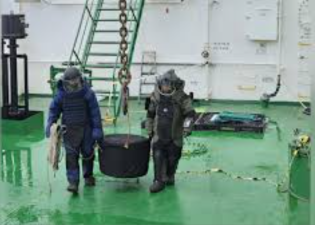
The Indian Navy successfully recovered an unexploded missile warhead from the Marshall Islands-flagged crude oil tanker MT Olympic Life off the coast of Kochi. The tanker reported an explosion and the presence of unexploded ordnance while en route from Fujairah, UAE, to Kochi. A specialist Explosive Ordnance Disposal (EOD) team from the Southern Naval Command safely extracted the warhead after a detailed assessment and phased operation. This operation highlights the Indian Navy’s expertise in handling maritime explosive threats and its commitment to regional maritime safety and security.

Operational Framework of Maritime EOD Operations

Maritime Explosive Ordnance Disposal (EOD) involves highly specialized operations conducted under volatile environmental conditions, requiring strict adherence to naval safety protocols.

Command and Response Structure

The extraction off the Kochi coast was executed by the specialist EOD unit of the Southern Naval Command (SNC), headquartered in Kochi. The SNC serves as the primary training command for the Indian Navy and maintains rapid-response diving and explosive disposal teams to secure the strategic sea lanes of the Arabian Sea.

Tactical Extraction Phases

The recovery of unexploded ordnance (UXO) from a laden crude oil tanker follows a strict, non-negotiable operational sequence to prevent catastrophic secondary explosions:

  • Stabilization and Damage Assessment: The EOD team boards the vessel to assess structural damage, identify the exact design and mechanism of the ordnance, and check for hazardous gas leaks like volatile hydrocarbons.
  • Render Safe Procedures (RSP): Technicians apply specialized physical or chemical interventions to interrupt the weapon’s firing circuit or fusing mechanism, neutralizing the immediate detonation threat.
  • Physical Extraction: The stabilized warhead is carefully removed from the ship’s structure using non-magnetic, non-sparking tools.
  • Controlled Disposal: The UXO is transferred to a secure naval platform, transported to a designated open-sea disposal zone, and destroyed via controlled detonation at a safe depth.

Asymmetric Threats to Indian Ocean Shipping

The deployment of naval EOD units highlights the growing security challenges facing commercial shipping lines across the Western Indian Ocean.

Proliferation of Anti-Ship Weaponry

Commercial vessels face an array of asymmetric threats from state and non-state actors operating near critical maritime choke points like the Bab-el-Mandeb and the Strait of Hormuz. These threats include:

  • Anti-Ship Cruise Missiles (ASCMs): High-speed sea-skimming weapons designed to strike a ship’s hull directly above the waterline.
  • One-Way Attack (OWA) Drones: Loitering munitions that target a vessel’s superstructure, bridges, or upper decks.
  • Waterborne Improvised Explosive Devices (WBIEDs): Remote-controlled, explosive-laden fast boats intended to breach ship hulls.
The Risk to Liquid Bulk Carriers

Crude oil tankers, such as the MT Olympic Life, are exceptionally vulnerable to explosive impacts. Even when a warhead fails to detonate completely, the kinetic impact can rupture cargo tanks, releasing volatile organic compounds (VOCs). A single spark during ordnance extraction could ignite these trapped gases, leading to a massive hull breach, loss of life, and catastrophic environmental oil spills.

India’s Role as a Preferred Security Provider

The Indian Navy’s swift intervention highlights its growing operational role as a net security provider across the wider Indian Ocean Region (IOR).

Operational DimensionNaval Capability DeploymentStrategic Geopolitical Objective
Sea Lanes of Communication (SLOCs)Continuous anti-piracy and maritime security patrols across the Arabian Sea.Ensures the uninterrupted flow of global trade and domestic energy imports.
Information Fusion Centre (IFC-IOR)Real-time tracking of merchant vessel anomalies from Gurugram.Enhances Maritime Domain Awareness (MDA) among partner nations.
Special Forces DeploymentDeployment of MARCOS (Marine Commandos) and EOD teams on frontline warships.Delivers rapid intervention capabilities for boarding, search, and seizure operations.

IASPOINT Booster Facts for UPSC

  • Southern Naval Command Jurisdiction: The Southern Naval Command (SNC) is the youngest of the Indian Navy’s three operational commands, with its geographic area of responsibility stretching across the crucial sea lanes of the Lakshadweep Sea and the South-Western Arabian Sea.
  • The IFC-IOR Framework: Hosted by the Indian Navy at Gurugram, the Information Fusion Centre – Indian Ocean Region (IFC-IOR) coordinates with over 40 partner countries and international maritime agencies to track piracy, smuggling, and weapon proliferation.
  • The Hydrocarbon Safety Hazard: When EOD teams operate on crude carriers, they utilize specialized intrinsic safety equipment, including explosion-proof communication gear and beryllium-copper tools, which prevent mechanical sparks.
  • Operation Sankalp Legacy: Launched initially in 2019 following attacks on tankers in the Gulf of Oman, Operation Sankalp represents the Indian Navy’s sustained deployment of major surface combatants to safeguard Indian-flagged merchant vessels transiting the Persian Gulf and Gulf of Aden.
  • United Nations Convention on the Law of the Sea (UNCLOS) Mandate: The Indian Navy’s interventions to protect foreign-flagged vessels in international waters align with Article 100 of UNCLOS, which obligates all states to cooperate to the fullest possible extent in suppressing piracy and maintaining order on the high seas.
Last Modified: June 12, 2026

Leave a Reply

Your email address will not be published. Required fields are marked *

Archives