
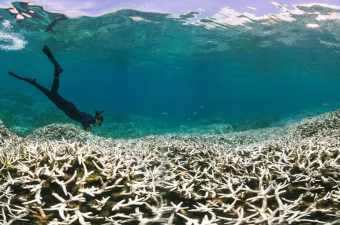
The National Oceanic and Atmospheric Administration (NOAA) and the International Coral Reef Initiative (ICRI) confirmed that the world’s fourth mass coral bleaching event likely concluded by mid-2025. Spanning from early 2023 to mid-2025, this ecological crisis was the fastest, most widespread, and largest on record, impacting all three major coral reef-containing basins across the Pacific, Atlantic, and Indian Oceans. Data from NOAA Coral Reef Watch indicates that mass bleaching impacted 84% of the global reef area across 83 countries and territories. The severe bleaching in Western Australia in early 2025 served as the final marker of this historic global thermal stress wave.
Geographic and Structural Scale of the Fourth Event
The scale of the fourth global event surpassed all previous historical marine heatwave records, necessitating new emergency monitoring frameworks.
Global Ocean Basin Penetration
Thermal stress expanded across both hemispheres, leading to extensive coral bleaching across key marine ecosystems:
- Atlantic Ocean Basin: Severe degradation occurred across Florida, the Caribbean, and the northeastern coastal waters of Brazil.
- Pacific Ocean Basin: Massive thermal stress impacted the Eastern Tropical Pacific, covering the maritime jurisdictions of Mexico, El Salvador, Costa Rica, Panama, and Colombia, alongside Australia’s Great Barrier Reef.
- Indian Ocean Basin: Widespread bleaching affected the Western Indian Ocean, including Kenya, Tanzania, Mauritius, the Seychelles, Mayotte, and western Indonesia.
Revision of the NOAA Alert Framework
The extreme intensity of the marine heatwaves during this event forced NOAA Coral Reef Watch to modify its traditional bleaching alert system. Because the existing maximum threshold, Alert Level 2, could no longer accurately classify the catastrophic heat stress, scientists added three new levels (Alert Levels 3, 4, and 5). Alert Level 5 indicates areas where heat stress is so severe that it causes immediate multi-species coral mortality rather than standard bleaching.
Tipping Point Thresholds and Human Dependency
The publication of the Global Tipping Points Report 2025 confirmed that shallow, warm-water coral reefs have become the first planetary-scale climate system to cross an irreversible ecological threshold.
The Thermal Tipping Point
The Global Tipping Points Report 2025, compiled by 160 scientists across 23 countries, states that warm-water coral reefs have surpassed their thermal tipping point. This threshold is estimated at 1.2°C of warming above pre-industrial levels, with a narrow safety range of 1.0°C to 1.5°C. With current global averages hovering around 1.35°C to 1.4°C, reefs are experiencing repeated, high-frequency disturbances that eliminate the standard 10-to-15-year recovery window required for coral ecosystems to regenerate. Climate projections indicate that even if global warming stabilizes exactly at 1.5°C, there is a 99% probability that extensive coral reef systems will be permanently lost.
Socioeconomic and Ecological Consequences
The collapse of these marine structures triggers cascading socio-ecological impacts:
- Livelihood Threat: Nearly one billion people worldwide depend directly or indirectly on shallow coral reefs for food security, tourism income, and local employment.
- Coastal Vulnerability: Reef structures act as natural wave attenuators, absorbing up to 97% of wave energy. Their loss exposes coastal communities to severe storm surges, typhoons, and erosion.
- Marine Biodiversity Loss: Coral reefs occupy less than 0.1% of the ocean floor but support more than 25% of all marine life, meaning reef collapse threatens extensive fisheries.
Ongoing Risks and Resilience Research
Despite the formal conclusion of the fourth global event, ocean temperatures remain high, and emerging climate anomalies present immediate threats.
Upcoming El Niño Vulnerabilities
NOAA’s four-month predictive modeling indicates that sea surface temperatures remain higher than baselines recorded 25 years ago. The expected emergence of a strong El Niño pattern threatens to return high heat stress to the North Pacific Ocean, including Hawaii, Florida, and the Caribbean. Historically, every major global bleaching event has coincided with strong El Niño phases, with each successive event showing greater intensity.
Science-Based Conservation Interventions
To combat widespread mortality, researchers are focusing on local pockets that resisted bleaching despite high thermal exposure. Active restoration strategies now include:
| Restoration Strategy | Operational Mechanism |
| Cryobanking Assisted Gene Flow | Fertilizing fresh coral eggs with frozen sperm to generate heat-tolerant offspring for reef re-wilding. |
| Deep-Water Nurseries | Relocating critical coral fragments to deeper, cooler marine zones during peak summer heat waves. |
| Resilience-Based Management | Minimizing local stressors like overfishing and agricultural runoff to maximize natural thermal tolerance. |
IASPOINT Booster Facts for UPSC
Chronology of Global Coral Bleaching Events
- First Global Event (1998): Triggered by a strong El Niño, destroying roughly 16% of the world’s coral reefs.
- Second Global Event (2010): Driven by combined multi-basin thermal anomalies.
- Third Global Event (2014–2017): The longest continuous event on record, impacting 68.2% of global reefs and killing nearly 30% of the Great Barrier Reef.
- Fourth Global Event (2023–2025): The largest on record, impacting 84% of global reef areas.
Biological Mechanism of Bleaching
Corals maintain a mutualistic symbiotic relationship with microscopic, photosynthetic algae called zooxanthellae, which reside within the coral polyps. The algae supply up to 90% of the coral’s energy through photosynthetic products and give corals their distinct coloration. When sea surface temperatures rise by as little as 1°C above the seasonal maximum, the coral’s metabolic pathway is disrupted. The zooxanthellae begin producing toxic reactive oxygen species, forcing the host coral polyp to expel the algae. This exposure reveals the white calcium carbonate skeleton beneath. If the thermal stress does not recede within weeks, the coral starves and dies.
Indian Context: Major Coral Reef Regions
India possesses major coral reef formations categorized into fringing reefs, barrier reefs, and atolls, monitored under the National Coastal Zone Management Authority (NCZMA):
- Gulf of Mannar: Fringing reefs with high biodiversity, vulnerable to thermal stress and sedimentation.
- Gulf of Kutch: Fringing reefs characterized by high salinity and extreme temperature fluctuations.
- Lakshadweep Islands: Coral atolls built entirely on volcanic baselines, highly susceptible to open-ocean warming.
- Andaman and Nicobar Islands: Fringing reefs hosting the highest species diversity in the Indian subcontinent.
National and International Protection Frameworks
- Wildlife Protection Act, 1972: In India, all hard corals are placed under Schedule I of the Wildlife Protection Act, granting them the highest level of legal protection against collection, commercial trade, and intentional destruction.
- International Coral Reef Initiative (ICRI): A global partnership among nations and organizations launched in 1994 to preserve coral reefs, co-chairing the global monitoring networks alongside NOAA.
- Global Coral Reef Monitoring Network (GCRMN): An operational network under ICRI that collects scientific field data to track global coral health, mortality metrics, and post-bleaching recovery speeds.