
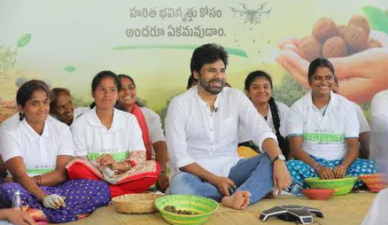
On World Environment Day, June 5, 2026, the Government of Andhra Pradesh launched a massive ecological drive to produce and distribute 2.5 crore seed balls across the state. Deputy Chief Minister and Environment Minister Pawan Kalyan inaugurated the initiative at the Mulapadu Butterfly Park near Vijayawada. This green campaign seeks to restore degraded forest patches, enrich local biodiversity, and expand the state’s total green cover to 50% by the year 2047. The state forest department is executing the project across 300 designated production centers with active community participation.
Core Mechanics and Production Technology
The seed ball technique provides a low-cost, high-efficiency alternative to traditional sapling plantation, particularly for massive scale and tough topographies.
Composition and Preparation
Seed balls, also known as seed bombs, are small pellets made of a specific combination of soil, organic matter, and seeds. The production process involves a precise mixture designed to maximize the survival rate of the embryo:
- Clay and Red Soil (3 Parts): Provides the structural shell that protects the internal seed from predators like birds, rodents, and ants. It prevents the seed from drying out before the rains arrive.
- Humus or Organic Compost (1 Part): Supplies essential nutrients, microbes, and organic matter to support immediate root development during germination.
- Native Seed (1 Core): A single high-quality seed from a native tree species is placed at the center of each ball.
Target Flora Species
The initiative exclusively utilizes indigenous and climate-resilient tree species to ensure high survival rates and preserve the local food web:
- Azadirachta indica (Neem): Chosen for its air-purifying qualities, drought resistance, and medicinal properties.
- Tamarindus indica (Tamarind): Selected for its deep root system, soil binding capacity, and utility to local communities.
- Tectona grandis (Teak): Deployed in forest fringes for long-term canopy development and timber value.
- Pongamia pinnata (Karanja) and Syzygium cumini (Jamun): Placed to support local avifauna and wild herbivores.
Dispersal Mechanisms and Aerial Reforestation
Manually planting trees on steep slopes, rocky terrain, and remote interior forests presents severe logistical challenges and safety risks for forest staff.
Drone-Assisted Aerial Dispersal
The state government has deployed customized large-payload agricultural drones to drop seed balls over inaccessible hilltops, reserve forest blocks, and weathered ravines. These drones use Geographic Information System (GIS) mapping to pinpoint coordinates with thin canopy density. They then release seed balls at designated heights to prevent breakages upon impact with the ground.
Monsoon Synchronization
The dispersal schedule matches the onset of the Southwest Monsoon. The seed balls lie dormant on the ground during dry spells. Once the monsoon rains saturate the outer clay shell, the moisture triggers germination, allowing the root to anchor directly into the topsoil.
Institutional Setup and Community Engagement
The initiative operates via a decentralized network to generate local green jobs and build public ownership over forest conservation.
Network of Production Centers
The forest department established 300 production hubs across all districts of Andhra Pradesh. These centers utilize local infrastructure such as nursery spaces, social forestry complexes, and community halls to mix, mold, and shade-dry the seed balls before field transport.
Stakeholder Collaboration
The project utilizes a collaborative framework to ensure mass production within tight pre-monsoon timelines:
- Vana Samrakshana Samitis (VSS): Joint forest management committees that identify degraded patches and supply local wild seeds.
- Self-Help Groups (SHGs): Women-led micro-enterprises contracted to manufacture seed balls, providing seasonal rural employment.
- Educational Institutions: School and college students participating in voluntary seed ball making workshops at Mulapadu Butterfly Park and other urban eco-parks.
Ecological and Socio-Economic Goals
This environmental campaign forms a core component of the state’s long-term climate adaptation and land restoration strategy.
Expected Environmental Outcomes
| Focus Area | Target Metric / Mechanism | Ecological Benefit |
| Green Cover Expansion | Achieve 50% state canopy by 2047 | Carbon sequestration and reduction of urban heat island effects. |
| Soil Conservation | Deep-rooting native species on hill slopes | Prevention of topsoil erosion, landslides, and flash flood runoffs. |
| Water Table Recharge | Enhanced root networks in catchments | Increased rainwater infiltration and rejuvenation of seasonal forest streams. |
| Biodiversity Corridors | Replanting fruit-bearing native trees | Reduction of human-wildlife conflict by restoring natural food sources inside forests. |
IASPOINT Booster Facts for UPSC
- Masanobu Fukuoka Connection: The modern seed ball technique was popularized by the Japanese pioneer of natural farming, Masanobu Fukuoka, under his philosophy of “Do-Nothing Farming” or natural regeneration.
- Mulapadu Butterfly Park: Located within the Krishna Wildlife Sanctuary ecosystem, it serves as a key biodiversity hub in Andhra Pradesh, holding over 60 species of butterflies and rare dry deciduous flora.
- Vana Samrakshana Samitis (VSS): These are village-level statutory bodies formed under Joint Forest Management (JFM) guidelines to protect adjoining forests in lieu of minor forest produce sharing rights.
- National Forest Policy 1988 Goal: The national target is to maintain 33% of the total geographical area under forest and tree cover. Andhra Pradesh’s state target of 50% by 2047 sets a higher bar for sub-national climate action.
- Seed Ball Survival Factors: Globally, the average success rate of drone-dispersed seed balls ranges between 15% and 25%, depending on rainfall consistency, soil composition, and pre-monsoon rodent activity.