
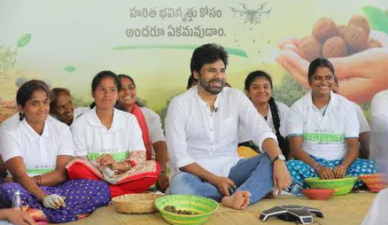
On 5 June 2026 (World Environment Day), the Government of Andhra Pradesh launched a massive ecological drive to produce and distribute 2.5 crore seed balls. Inaugurated at Mulapadu Butterfly Park, the campaign aims to restore degraded forests, enrich biodiversity, and expand the state’s green cover to 50% by 2047. The project is implemented via 300 decentralized production centers utilizing community-led manufacturing.
Core Mechanics and Dispersal
Seed balls (seed bombs) are protective pellets designed for high-efficiency, low-cost reforestation in difficult topographies:
- Composition: A core of native seeds encased in a mixture of clay/red soil (protective shell) and humus/organic compost (nutrients for germination).
- Target Species: Indigenous and resilient trees like Neem, Tamarind, Teak, Karanja, and Jamun are used to support local ecosystems.
- Aerial Dispersal: Customized large-payload drones utilize GIS mapping to drop seed balls on inaccessible hilltops and ravines, synchronized with the onset of the Southwest Monsoon.
Institutional Framework and Community Role
The initiative fosters decentralized participation to generate local employment:
- Vana Samrakshana Samitis (VSS): Identify degraded forest patches and supply native seeds.
- Self-Help Groups (SHGs): Women-led groups handle mass production, providing seasonal rural income.
- Strategic Goal: Recharging water tables, preventing soil erosion, and creating biodiversity corridors to mitigate human-wildlife conflict.
IASPOINT Booster Facts
- Origin: Popularized by Japanese natural farming pioneer Masanobu Fukuoka via his “Do-Nothing Farming” philosophy.
- Policy Context: The National Forest Policy 1988 mandates a 33% forest/tree cover target for India; Andhra Pradesh’s 50% target represents an ambitious sub-national climate action.
- VSS: Village-level bodies under Joint Forest Management (JFM) that protect forests in exchange for minor forest produce rights.
- Efficiency: Drone-dispersed seed balls typically yield a survival success rate of 15% to 25%.