
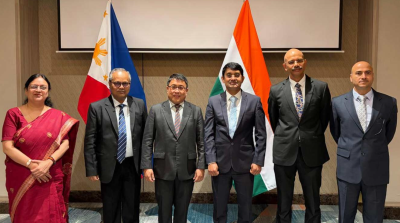
Bilateral trade between India and the Philippines reached 3.9 billion dollars in FY26, reflecting a strong upward trajectory in economic relations. The expanding commercial ties were detailed during the 14th meeting of the India-Philippines Joint Working Group on Trade and Investment (JWGTI) held in Manila in June 2026. Co-chaired by officials from the Indian Department of Commerce and the Philippine Department of Trade and Industry, the dialogue focused on expanding institutional cooperation, easing market access, and identifying priority products and services to ensure sustained long-term development for both nations.
Key Focus Areas of the 14th JWGTI Meeting
The high-level meeting prioritized sectors driven by technological advancement and emerging economic requirements.
Emerging Sectors for Collaboration
- Information Technology and AI: Joint initiatives focus on Information Technology-Business Process Management (IT-BPM), Information and Communication Technology (ICT), and Artificial Intelligence (AI) integration.
- Pharmaceuticals: Improving the export of affordable Indian generic medicines to the Philippines and enhancing regulatory compliance.
- Infrastructure and Energy: Cooperation in construction projects, renewable energy technology sharing, and infrastructural development.
- Entertainment Industry: Promoting institutional ties in the film sector, including co-productions and location sharing.
Trade Facilitation and Regulatory Reforms
- Customs Cooperation: Streamlining cross-border administrative procedures to reduce transit times and operational bottlenecks.
- Agricultural Market Access: Easing phytosanitary barriers to allow smoother access for specific agricultural commodities in both markets.
- National Currency Settlement: Exploring alternative payment channels to facilitate trade settlement using Indian Rupees and Philippine Pesos, lowering dependency on external currencies.
Institutional Trade Agreements and Frameworks
The baseline framework for economic engagement relies heavily on regional mechanisms, with a clear roadmap toward bilateral preferential terms.
ASEAN-India Trade in Goods Agreement (AITIGA)
The two nations agreed on the early conclusion of the ongoing AITIGA Review. This regional free trade agreement aims to lower tariffs, simplify product-specific rules, and create a more balance-of-trade friendly environment between India and the 10 member states of ASEAN, which includes the Philippines.
Bilateral Preferential Trade Agreement (PTA)
Following the conclusion of the AITIGA review, both nations intend to engage in formal negotiations for a dedicated India-Philippines Preferential Trade Agreement (PTA). A PTA acts as an introductory trade pact where partner countries lower customs duties on a mutually agreed list of tariff lines, acting as a precursor to a comprehensive Free Trade Agreement (FTA).
Trade Profile and Economic Complementarities
The structural composition of trade between India and the Philippines highlights complementary supply chains across engineering, agriculture, and manufacturing.
| Trade Direction | Primary Commodities and Services exchanged |
| India’s Exports to Philippines | Pharmaceuticals, engineering goods, petroleum products, motor vehicles, rice, organic chemicals, iron and steel. |
| Philippines’ Exports to India | Electrical machinery, electronic integrated circuits, copper concentrates, paper products, automatic data processing machines. |
IASPOINT Booster Facts for UPSC
- Institutional Chairs: The 14th JWGTI was co-chaired by the Joint Secretary of the Department of Commerce (India) and the Undersecretary of the Department of Trade and Industry (Philippines).
- ASEAN Factor: The Philippines is a founding member of ASEAN (Association of Southeast Asian Nations), established via the Bangkok Declaration in 1967.
- Act East Policy: Strengthened economic ties with Manila form a core component of India’s Act East Policy, transitioning from the earlier Look East Policy to emphasize proactive economic, strategic, and connectivity linkages with the Asia-Pacific region.
- Look East Policy Genesis: India formally launched the Look East Policy in 1991 under the Prime Ministership of P.V. Narasimha Rao to cultivate extensive economic and strategic relations with Southeast Asian nations.
- Next Venue: The 15th meeting of the India-Philippines Joint Working Group on Trade and Investment is scheduled to take place in New Delhi.