
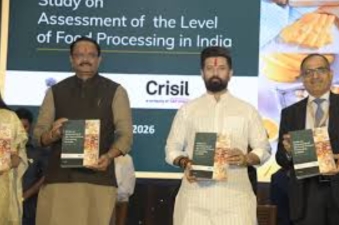
The Regional High-Level Policy Dialogue on South Asian Policy Leadership for Improved Nutrition and Growth (SAPLING) 2026 concluded in Ahmedabad, Gujarat. Jointly organized by India’s Ministry of Food Processing Industries (MoFPI) and the World Bank Group, the two-day forum focused on the theme “Unlocking Value: Advancing Food Processing for Employment Generation and Sustainable Growth in South Asia.” The dialogue brought together over 200 policymakers, industry leaders, and development partners from nations including Bangladesh, Bhutan, Sri Lanka, Nepal, and the Maldives. Discussions centered on transitioning South Asia’s agricultural emphasis from primary production to advanced processing, integrated logistics, cold-chain infrastructure, and cross-border market integration to generate employment and curb severe post-harvest food losses.
Structural Asymmetries in South Asian Agriculture
Sectoral Contribution Disparities
The South Asian agricultural sector generates over $700 billion in value annually and employs approximately 43% of the regional workforce. However, the sector contributes only 16% to the region’s total Gross Domestic Product (GDP). This gap indicates low labor productivity, disguised unemployment on farms, and a critical lack of value-addition infrastructure to convert raw agricultural produce into high-value commodities.
Post-Harvest Loss Metrics
More than 30% of the food produced across South Asia is lost or wasted annually before reaching consumers. This quantum of food waste is equivalent to the volume required to feed nearly 300 million people. These losses stem directly from structural deficits in handling, warehousing, transport, and processing capacities, which depress farmer incomes and destabilize regional food security.
Strategic Objectives of the SAPLING Initiative
Integration with AgriConnect
The SAPLING initiative functions in tandem with the World Bank Group’s global AgriConnect platform. This platform aims to link 300 million farmers worldwide to structured markets by 2030. The collaborative framework drives policy reforms, infrastructure investments, and private capital mobilization to establish resilient, nutrition-focused food value chains across India, Bangladesh, and Sri Lanka.
Core Pillars of Transformation
The policy dialogue emphasized shifting from public-sector dependence to private sector participation. It focuses on three core pillars:
- Infrastructure Modernization: Setting up targeted food processing zones, agro-industrial parks, and smart cold-chain networks.
- Regulatory Simplification: Standardizing food safety certifications and easing cross-border trade guidelines across South Asian states.
- Blended Finance Ecosystems: Developing investment pipelines to channel private equity and venture capital into agri-tech startups and small enterprises.
Indian Policy Experience and Benchmarks
Growth Performance Indicators
India’s agricultural evolution serves as a primary template for the SAPLING framework. The country’s food grain production grew from 51 million tonnes in 1950-51 to more than 330 million tonnes. Concurrently, processed food exports doubled over the past decade, climbing from $4.9 billion to over $10 billion. The domestic food processing sector now yields 9% of manufacturing value added and comprises nearly 13% of national exports.
Executed Government Schemes
The Ministry of Food Processing Industries uses a mix of targeted infrastructure and financial incentive schemes to scale up domestic capacities:
| Scheme Name | Core Objective | Key Target/Mechanism |
| Pradhan Mantri Kisan Sampada Yojana (PMKSY) | Supply Chain Infrastructure | Creates mega food parks, integrated cold chains, and preservation infrastructure. |
| PM Formalisation of Micro Food Processing Enterprises (PMFME) | Formalizing Informal Units | Provides financial, technical, and business support to unorganized micro-units. |
| Production Linked Incentive (PLI) Scheme | Global Competitive Edge | Offers sales-linked incentives to large food processing entities expanding production capacities. |
Employment and Economic Implications
Job Creation and Demographics
South Asia faces a massive demographic challenge, with millions of young individuals entering the job market annually. Since the primary farming sector is oversaturated, the non-farm rural economy must absorb this labor force. Food processing, packaging, quality control, and retail logistics provide high-yield employment opportunities that can reduce rural poverty without causing massive urban migration.
Mitigating the “Processed Food” Narrative
The dialogue highlighted challenges arising from unverified online narratives that classify all processed foods as inherently unhealthy. To prevent economic fallout for Micro, Small, and Medium Enterprises (MSMEs), policymakers proposed structured, science-backed public awareness campaigns. These initiatives distinguish ultra-processed items from basic value-added techniques like drying, pasteurization, milling, and canning, which preserve nutrition and extend shelf life.
IASPOINT Booster Facts for UPSC
- Organizing Partners: The SAPLING initiative is spearheaded by the World Bank Group in active partnership with the Bill & Melinda Gates Foundation.
- Report Release: During the 2026 dialogue, ministers released the “Assessment of the Level of Food Processing in India” report, which revealed that India’s overall food processing level advanced from 10% in 2016 to nearly 17% by 2023.
- NIFTEM Infrastructure: India features two fully functional National Institutes for Food Technology Entrepreneurship and Management (NIFTEM) located at Kundli (Haryana) and Thanjavur (Tamil Nadu), with a third sanctioned for Bihar to supply skilled manpower to the sector.
- Previous Venues: Reflecting its rotating regional character, the SAPLING high-level regional policy dialogue of 2025 was hosted by the Government of Sri Lanka in Colombo, focusing on post-harvest reforms.