
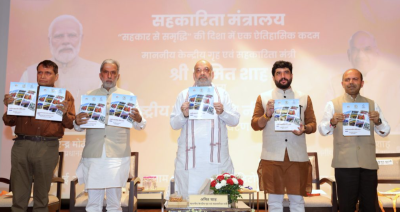
The first meeting of the National Level Policy Implementation and Monitoring Committee under the National Cooperation Policy-2025 was held in New Delhi, chaired by the Secretary of the Ministry of Cooperation. The committee discussed a comprehensive roadmap focusing on institutional strengthening, digital transformation, capacity building, and inclusive growth of cooperatives. These initiatives align with the vision of “Sahkar se Samriddhi” (Prosperity through Cooperation). The implementation strategy focuses on developing Primary Agricultural Credit Societies (PACS) into multipurpose centers, expanding cooperative membership to 50 crore by 2035, and promoting youth and women participation. The policy aims to triple the cooperative sectorβs economic contribution by 2035 through the coordinated efforts of central and state governments, cooperative institutions, and related ministries.
Core Pillars of the National Cooperation Policy-2025
The implementation roadmap targets structural reforms across the cooperative ecosystem to ensure long-term sustainability and economic viability.
Institutional Strengthening and Governance
The policy mandates the restructuring of cooperative societies to improve functional autonomy. It establishes clear guidelines for regular elections, professional management, and independent auditing of cooperative accounts to restore public trust and operational efficiency.
Digital Transformation and Transparency
A national database of cooperatives is being deployed to map the presence and performance of societies across India. The computerization of PACS forms the backbone of this pillar, establishing standardized accounting software, reducing human intervention, and ensuring real-time data synchronization with district and state cooperative banks.
Strategic Targets and Socio-Economic Inclusion
The implementation framework outlines time-bound quantitative and qualitative benchmarks to measure the policy’s success.
Expansion of Membership and Economic Footprint
- Membership Growth: The policy aims to scale total cooperative membership to 50 crore by the year 2035, bringing a larger share of the rural and semi-urban population into the formal cooperative fold.
- Economic Contribution: The multi-agency roadmap outlines strategies to triple the cooperative sector’s contribution to the national Gross Domestic Product (GDP) by 2035.
Demographic and Gender Inclusivity
Special credit lines, training modules, and administrative quotas are designed to increase the participation of women and youth. The policy seeks to position cooperatives as viable entrepreneurship models for rural youth, mitigating migration and fostering local employment.
Revitalization of Primary Agricultural Credit Societies (PACS)
PACS function as the grass-roots level of the short-term cooperative credit structure in India. The 2025 policy completely reimagines their operational mandate.
Multipurpose Transformation
PACS are being transformed from simple credit-delivery outlets into multi-service centers. Under the new model, a single PACS can diversify into various business activities:
- Operating Jan Aushadhi Kendras for affordable medicines.
- Establishing custom hiring centers for agricultural machinery.
- Setting up LPG/petrol/diesel distributorships.
- Managing cold storage units and grain warehouses.
- Functioning as Common Service Centers (CSCs) for digital governance services.
Legal and Structural Alignment
The Ministry of Cooperation has developed model bylaws for PACS. States are being incentivized to adopt these model bylaws to maintain uniformity in the multi-functional operations of grassroots cooperative bodies.
Institutional Structure of Cooperative Credit in India
The short-term cooperative credit structure operates on a distinct three-tier framework across the country.
| Tier Level | Institution | Operational Jurisdiction | Key Functions |
| Apex Tier | State Cooperative Banks (StCBs) | State Level | Disburses credit funds, monitors district banks, interacts with NABARD. |
| Intermediate Tier | District Central Cooperative Banks (DCCBs) | District Level | Financed by StCBs, manages credit requirements of rural banks in the district. |
| Grassroots Tier | Primary Agricultural Credit Societies (PACS) | Village/Gram Panchayat Level | Directly interfaces with farmers, provides short-term crop loans and inputs. |
IASPOINT Booster Facts for UPSC
- Ministry of Cooperation: Created in July 2021 by the Government of India to provide a separate administrative, legal, and policy framework for strengthening the cooperative movement.
- Constitutional Provisions: * The 97th Constitutional Amendment Act, 2011 added the word “cooperatives” to Article 19(1)(c) as a Fundamental Right.
- It inserted Article 43B into the Directive Principles of State Policy (DPSP) regarding the promotion of cooperative societies.
- It added Part IXB to the Constitution, regulating the incorporation, terms of members, and audit of cooperative societies.
- Seventh Schedule Allocation: “Cooperative Societies” is a State Subject listed under Entry 32 of the State List (List II) of the Seventh Schedule to the Constitution of India. However, “Multi-State Cooperative Societies” fall under Entry 44 of the Union List (List I).
- Important Committees: The Sahakar se Samriddhi vision draws insights from past panels, including the Suresh Prabhu Committee, which was constituted to draft the National Cooperation Policy Document.
- Statutory Framework: Multi-State Cooperative Societies are governed by the Multi-State Co-operative Societies Act, 2002, which handles entities operating in more than one state.
